|
Travel
advice: How to get to Woods Hole, etc.
If
you haven't been to BigHook before, here's some advice on which airports
to fly into, how to get from the airport to Woods Hole, about the motels
where you'll be staying, about the Airplane House, which is the actual
BigHook venue, about the village of Woods Hole, etc.
What
we're talking about at BigHook2002
The
theme of BigHook2002 will be Decisions that Shape Networks.
Here's the Agenda:
Wednesday,
9/4
Noon to 2:00 PM: Check in, lunch, swimming, meet fellow participants.
2:00 to 3:30 PM, Session 1a: Intros, a decision you wish had caused
different results - everybody
3:30 to 4:00 PM: break
4:00 to 5:30 PM, Session 1b: Bottom Fishing, or Can a Sinker Swim?
- Googin, Horan, Prytula, Stansberry
5:30 to 8:30 PM: New England Clambake, music by the Crosbie Brothers and
Mait Edey, fishing.
8:30 to 9:30 PM, Session 2: Perspective on a small, loosely connected
planet - Aizu, Comstedt, Denton, Nanda
Thursday - 9/5
7:00 to 8:30 AM: Breakfast, fishing.
8:30 to 10:00 AM, Session 3a: Decisions and Consequences - Bradner,
Pepper
10:00 to 10:30 AM: break
10:30 AM to Noon, Session 3b: Decisions and Consequences, continued -
Odlyzko, Shirky
Noon to 2:00 PM: Lunch, swimming, music.
2:00 to 3:30 PM, Session 4a: Case in point: network security - Crocker,
Reed
3:30 to 4:00 PM: break
4:00 to 5:30, Session 4b: The next big opportunity . . . voice telephony
- Evslin, Hofstatter, Odlyzko, Turner
5:30 to 8:30 PM: Dinner, fishing, music.
8:30 to 9:30 PM, Session 5: Telling the story - Black, Cukier, Gillmor,
Lindstrom
Friday - 9/6
7:00 to 8:30 AM: Breakfast, fishing.
8:30 to 10:00 AM, Session 6a: Good decisions to make next - Forster,
Lucky, Shapiro, Weinberger
10:00 to 10:30 AM: break
10:30 AM to Noon, Session 6b: How Juniper Point connects to Planet
Earth - everybody
Noon to 2:00 PM: Lunch, swimming, music.
2:00 PM: Adjourn
We
can point to many decisions that helped make the Internet what it is today.
One of the most important was the decision to separate Transmission Control
Protocol (TCP) from the Internet Protocol (IP), which allowed IP to operate
with other transmission protocols, like UDP, RTP and SCTP, which, in turn,
allowed the Internet to be used for telephony, gaming, signaling and other
applications that would never have been possible if "reliable"
transport had been built into IP.
Other
arguably* important decisions that helped determine
the shape of today's Internet include (a) the decision to support existing
networks, (b) the decision to use datagrams and routers, (c) the decision
of ARPA to support the original research in the first place, (d) the decision
to separate basic from enhanced services, and (e) Microsoft's decision
to include a TCP/IP stack in Windows95.
There
are many other decisions, not only from from realms technologic, but also
economic and social, that have determined the shape of the networks we
have today. (However, not all of the shaping has been elegant or pretty
-- witness the Telecom Act of 1996).
I think it'll be fun for BigHook2002 participants:
- to
talk about the history of various specific decisions, about what caused
them to be made, and what the intent of the decision makers might have
been,
- to
propose additional arguably* formative decisions
that might have shaped our networks,
- to discuss consequences
of specific decisions, intended and unintended,
and whether the decision makers would be happy with their decision in
hindsight,
(and here are the
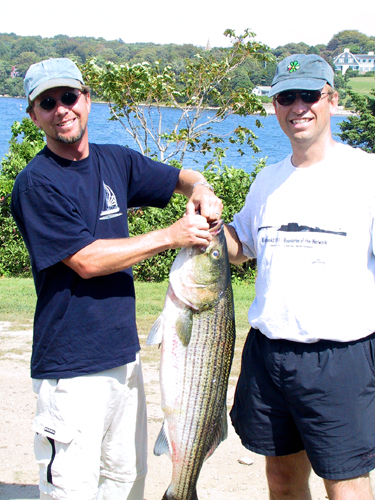
"big
fish"**)
- to try to figure
out whether there are identifiable characteristics of a successful decision,
that is, decisions with mostly intended, mostly beneficial consequences,
- to propose (and
critique) some future decisions that arguably*
would make the Internet even better
- to apply our knowledge
of successful decisions to our proposed decisions to maximize the probability
that they'll make the world a better place.
Of
course, we won't be able to do all that without the usual wide-ranging,
all-inclusive discussion of the forces of greed and good that are shaping
the Internet today, of our efforts to ally with the forces of light and
defeat the forces of darkness, and of what it might take to build the
kind of network we want to leave for our grandchildren.
*arguably:
argue dispassionately, listen passionately
Who's coming
BigHook2002
will be co-created by some 50 carefully invited SMART
People, including:
Scott
Bradner, former chair of the IPv6 working
group, current Area Co-Director of the IETF Transport Area and Network
World columnist.
Anders Comstedt, the Managing Director of Stokab,
a city-chartered dark fiber company that started building its fiber
network in 1994 and became profitable in 1998.
Steve
Crocker, who organized the Network Working Group, the predecessor
of the Internet Engineering Task Force, and wrote Request for Comments
(RFC) #1.
Tom Evslin,
the chairman and founder of ITXC,
the Internet Telephony Exchange Company.
Dan
Gillmor, technology
columnist for the San Jose Mercury News, winner of the Electronic
Frontier Foundation Pioneer Award in 2002.
Bob
Lucky, head of Applied Research at Telcordia,
commentator on corporate culture and chair of the FCC
Technological Advisory Council.
Andrew Odlyzko,
Director of the Digital Technology
Center of the University of Michigan, author of "Content is
not King" and other iconoclastic works.
Robert Pepper, head of the Office
of Plans and Policy of the FCC.
David P. Reed, co-author
of "End to End System Design" (1981), which is the original
Stupid Network paper.
Gary Shapiro, president of the Consumer
Electronics Association and chair of the Home Recording Rights Coallition.
Clay Shirky, explicator
of peer-to-peer architecture, and its economics and social effects.
Jonathan Thatcher,
chair of the IEEE
10 Gigabit Ethernet Task Force and principal engineer at World
Wide Packets.
Timber, the Internet Predator and his running human, Tim
Denton
David Weinberger,
perpetrator of "Journal of the
Hyperlinked Organization", author of Small
Pieces, Loosely Joined, coauthor The
Cluetrain Manifesto and "Paradox
of the Best Network,", which came directly from BigHook2001.
BigHook
2002 once again has the privelege of being served by:
Joe
Sterling, an inspired scribe who has a genius for capturing
the flow of a conversation in words, shapes and pictures.
Chef Roland,
creator of great food.
Here's a complete list of BigHook participants we currently
expect . . .
Spouses, Partners,
Children welcome at all meals, events, etc., (except formal meeting sessions)
and to use the Airplane House grounds during the conference. (Please make
sure we have their names.)
When
The
conversation will convene Wednesday, September 4, 2001, at Noon
with lunch, followed by the first session at 2:00 PM. Participants and
guests are welcome on the airplane house grounds beginning as early as
you want on Wednesday morning. Also, if you arrive on Tuesday evening,
feel free to wander down to the Airplane House to see what's going on.
The
last event will end at about Noon on Friday, September 6.
An optional lunch will be served at noon. Participants and guests will
be welcome to use the Airplane House grounds all day.
The
detailed Agenda is still under construction.
Why: A communications conference
with an emphasis on communicating
What
a difference a year makes. BigHook2000 was a pause in our headlong rush
to get networked. BigHook2001 was an ominous prelude to September 11.
Today, on the eve of BigHook2002, "utter crisis" is the happiest
face that the official telecom establishment can paint. (Maybe we should
stop meeting like this.)
Personally
I'm hoping that the participants in BigHook2002 will help me make sense
of the new terror-security world I've been dragged into; a world with
more emphasis on "killer" than "application." Not
too long ago I used to smirk confidently when I said, "Out of control."
It meant that we'd wrested some power from the Bellheaded hierarchy. It
meant that amazing things would happen when we connect. "Out of control,"
used to mean, "Magic happens."
Now
I find myself saying, "Out of control," with fear in my heart.
Osama and Ashcroft have played their part in this fear, but I wonder if
maybe I've had a small part in creating the mess we're in, whether stuff
I've done or written about has had unintended, undesirable consequences.
For example, did my writings about the possibility of a Y2K crisis turn
up the gain, even a little bit, on1999 IT spending to cause the overshoot
of 2000 and 2001? Or did my critique of telecom-classic play a small part,
maybe a not-quite insignificant part, in hastening telecom's collapse
before new, more appropriate business models could be discovered and put
in place?
Can
I say that these acts were the result of decisions I made? Can I call
any of their consequences "unintended" when I'm not even sure
what an intended consequence might have looked like?
Decision
or not, intended consequences or not, the Communications Revolution is
not over. It will not be stopped by the current crisis any more than the
Industrial Revolution was stopped by the Great Depression. People still
need to communicate. Technology will still make compounded advances. The
rate of innovation might be slowed as giants consolidate and clash, but
giants can't know all the desires of a people or all the corners of a
marketspace. And I have faith, perhaps naive faith, that these corners
will spawn irrepressible new ways to communicate that will be beneficial
to humanity and to the planet that we call home.
The
main goal of BigHook2002 is to try to become more aware of what makes
decisions successful -- ours and other people's --and to become more analytic
of the consequences of decisions so we can more effectively shape the
next stages of the Communications Revolution for the benefit of our grandchildren.
As John Perry Barlow said recently, "Let's think about how we can
be good ancestors."
At most conferences, the formal presentations are not the main event.
The real action takes place in collegial conversations in the hallways,
over meals, etc., far from the prepared, self-interested, marketing-oriented
remarks on the stage. The modus operandi of BigHook is to
capture "the action" as the main event. During these three days,
"presentations," if any, will be brief -- and their main purpose
will be to set the stage and context for ensuing respectful, conscious
discussion.
The Sponsors of BigHook2002
Thanks to the people
and companies who are making BigHook2002 possible, including:
Richard Prytula
and Steve Mattioli of TechnoCap
and YottaYotta, a
TechnoCap company
Stephen Kamman and Tim Horan of CIBC
World Markets
Mark Petrovic and Brinton Young of Earthlink.
plus special material
assistance with Internet connectivity from
Tom Freeburg
of Motorola
Andy Maffei
of the Woods
Hole Oceanographic Institution
The BigHook2002 Staff
Thank you to the following
people for their dedicated efforts:
Dick Campbell,
Audio recording
Judi Clark, Web work
Greg Elin, Sessionblogger software
Annie Lindstrom, Transcripts
Gardner Miller, Point man
David Stanwood, Music production
Back to BigHook
Main Page.
Date page last
modified: 7 Nov 2002
|