Tuesday, September 6, 2016

jerrym
2016-09-06 15:01
yo!

amaffei
2016-09-06 15:01
hello

judic
2016-09-06 15:01
welcome welcome!

drumbeat
2016-09-06 15:07
has joined #bighook-2016

davidi
2016-09-06 15:12
has joined #bighook-2016
davidi
2016-09-06 15:13
hello world
jerrym
2016-09-06 15:13
ah!
drumbeat
2016-09-06 15:14
judi -- How do we hide the left hand menu bar for the big screen
judic
2016-09-06 15:15
world to davidi: hello!
davidi
2016-09-06 15:15
hello judic
judic
2016-09-06 15:15
easiest way: stretch the screen and move that part off to the left
davidi
2016-09-06 15:16
@davidi uploaded a file:  and commented: Here's a picture
and commented: Here's a picturejudic
2016-09-06 15:16
oooh aaaah
davidi
2016-09-06 15:16
this was NOT photoshopped.
davidi
2016-09-06 15:16
the rainbow came right down where the pot of gold was.
drumbeat
2016-09-06 15:19
your left-hand menu disappearing suggestion did he trick, thanks!
davidi
2016-09-06 15:24
Thank you very much.
davidi
2016-09-06 15:24
I just see "general" now
davidi
2016-09-06 15:24
Way good
judic
2016-09-06 15:27
@judic has renamed the channel from "general" to "bighook-2016"
judic
2016-09-06 15:27
I renamed channel to make it easy to archive when the conference is done
davidi
2016-09-06 15:36
ahoy
davidi
2016-09-06 15:37
we are back
davidi
2016-09-06 15:37
maybe temporry
judic
2016-09-06 15:37
ahoy-hoy
judic
2016-09-06 15:37
@davidi see on the left col how andy's amaffei is a hollow dot, meaning that ID is away?
jerrym
2016-09-06 15:38
wooo hooo! the heady speed of these intertubez!
davidi
2016-09-06 15:39
we're getting about 4x the speed of 5 mins ago!!!
judic
2016-09-06 15:39
that's nice.
judic
2016-09-06 15:39
wait until you get 40 more people testing it out.
judic
2016-09-06 15:40
good that Comcast is playing nicely!
davidi
2016-09-06 15:41
the basic net just got 4x faster thx to our friend at Comcast
davidi
2016-09-06 15:41
that is - our basic net connection
davidi
2016-09-06 17:25
boa tarde a todos

levi
2016-09-06 17:36
has joined #bighook-2016

brough
2016-09-06 17:37
has joined #bighook-2016

cayden
2016-09-06 17:38
has joined #bighook-2016
judic
2016-09-06 17:44
Hi and welcome Levi!
judic
2016-09-06 17:44
and @brough and @cayden
levi
2016-09-06 17:45
Hi Judi! This is cool. Like an evolved IRC channel.
judic
2016-09-06 17:45
indeed it is @levi. Should be good for BigHook. You can even send direct messages to people if desired

sob
2016-09-06 17:47
has joined #bighook-2016
davidi
2016-09-06 17:47
Hello Levi & Scott!
davidi
2016-09-06 17:47
(and Brough and Cayden!)
jerrym
2016-09-06 17:48
levi, it's evolved irc with external gills. and some plugins
davidi
2016-09-06 17:48
There are now NO STORM WARNINGS for all of southern New England.
levi
2016-09-06 17:48
Hi David. No travel issues from the storm here. Flights were on time!
davidi
2016-09-06 17:48
BigHook is good to go!!!
cayden
2016-09-06 17:48
hey y'all!
levi
2016-09-06 17:48
Jerry, what are external gills?
cayden
2016-09-06 17:49
also emoji. :sunglasses:
jerrym
2016-09-06 17:49
early primitive amphibians had them. I was working the emergent theme...
levi
2016-09-06 17:49
Ahh :grinning:
davidi
2016-09-06 17:50
Also you can add photos, spreadsheets, and all kinds of objects to the Slack chat
levi
2016-09-06 17:50
I thought maybe I missed a new web tech

odlyzko
2016-09-06 17:50
has joined #bighook-2016
davidi
2016-09-06 17:50
Good afternoon Professor Odlyzko!
davidi
2016-09-06 17:51
http://gills.net - a new app you can get all caught up in :slightly_smiling_face:

lellel
2016-09-06 17:51
has joined #bighook-2016
davidi
2016-09-06 17:51
Good golly ms Lucy!

steve_smith
2016-09-06 17:53
has joined #bighook-2016

rmohan
2016-09-06 17:53
has joined #bighook-2016
lellel
2016-09-06 17:55
Guess I'm supposed to be here
lellel
2016-09-06 17:55
How's the weather?
lellel
2016-09-06 17:56
overcast and damp here in Blu-gene
judic
2016-09-06 17:57
Hi @lellel you're not at BigHook?
judic
2016-09-06 17:58
sunny and warm-ish in Casualfornia
lellel
2016-09-06 18:00
Still in Oregon I fly out at 5
jerrym
2016-09-06 18:01
u betcha
jerrym
2016-09-06 18:03
did that and also set it so if the cursor is in the upper righthand corner, the screensaver won't kick in
judic
2016-09-06 18:05
thank you @jerrym for waking up the room display
jerrym
2016-09-06 18:14
thanks, judic, I didn't realize you'd asked me to do that directly. just read the pop-up :slightly_smiling_face:
judic
2016-09-06 18:16
np @jerrym I can be sneaky like that, but better here because everyone learns something

davidw
2016-09-06 18:16
has joined #bighook-2016
jerrym
2016-09-06 18:16
aye!
jerrym
2016-09-06 18:16
Mr. Weinberger! Welcome to the Hook of Bigness chat
davidw
2016-09-06 18:17
howdy, Big Slackers!
jerrym
2016-09-06 18:17
Embiggening the Hook Since 2000 <tm>
davidw
2016-09-06 18:18
Looking forward to seeing you all. I'm coming with people who are leaving from Logan at 6:30am, so with luck we'll be there before 10am, ready to get our hook on!
lellel
2016-09-06 18:19
Hey Judy - you might want to point folks at the phone apps as well - I tend to read my slack feeds on the iphone - faster and easier to switch contexts or include photos. (syas she while typing in a firefox window)
davidw
2016-09-06 18:19
Oh, @lellel is Lucy! I get it.
judic
2016-09-06 18:19
thanks for suggestion @lellel I will.
lellel
2016-09-06 18:19
my initials doubled since Lucy is always gone :wink:
davidw
2016-09-06 18:20
are bighookers in Woods Hole already?
judic
2016-09-06 18:21
many are
jerrym
2016-09-06 18:21
a few
judic
2016-09-06 18:21
what? the core team isn't many? How is this?
davidi
2016-09-06 18:21
We've got a few . . . Jerry, Dewayne and some locals.
davidw
2016-09-06 18:22
lucky devils.
davidw
2016-09-06 18:22
Say hello to Dewayne for me.
davidw
2016-09-06 18:23
@davidi, are you ready to control the outbreak of anti-Trumpism that has overtaken just about every conversation I
davidw
2016-09-06 18:23
ve had in the past year?
davidw
2016-09-06 18:24
(Note: I am what I refer to as extreme, extreme anti-Trump, fwiw)
davidi
2016-09-06 18:25
dunno . . . but I'm all for thinking NEW thoughts and saying new, original, insightful things
davidi
2016-09-06 18:26
As Szent Gyorgyi once said, Discovery consists of seeing what everybody else has seen but thinking new thoughts about it.
davidi
2016-09-06 18:26
I won't have much patience for thoughts that have already been expressed on MSNBC, Kos or TPM.
judic
2016-09-06 18:33
davidi
2016-09-06 18:47
There are NO STORM WARNINGS of any kind in southern New England at this time.
davidw
2016-09-06 18:48
Thanks, @judic. That's very helpful.

enoss
2016-09-06 18:51
has joined #bighook-2016
davidw
2016-09-06 18:55
Yo, enoss!
cayden
2016-09-06 19:02
woof. still experiencing delays into BOS. sitting on the tarmac in chicago -- fingers crossed
judic
2016-09-06 19:04
pushing the sunny skies eastward for @cayden
davidi
2016-09-06 19:06
The last bus
davidi
2016-09-06 19:08
The last bus from Boston Logan to Woods Hole leaves Logan at 7:20 PM. If Cayden is later than this, can somebody pick them up tonight???? (Just working the scenarios here)
davidi
2016-09-06 19:08
Or of you're arriving later this evening and renting a car to Woods Hole?
davidi
2016-09-06 19:10
Hopefully Cayden will get to BOS well before 7:20.

kennedyjp
2016-09-06 19:15
has joined #bighook-2016
davidi
2016-09-06 19:16
Hello Pat Kennedy!
cayden
2016-09-06 19:21
no worries @davidi; i'm carpooling with herman. hoping he waits for me. :grin:

dsearls
2016-09-06 20:21
has joined #bighook-2016
dsearls
2016-09-06 20:24
Awaiting Brett, who we?ll ferry to Woods Hole in the morning. Should make lunch.

jlivingood
2016-09-06 21:00
has joined #bighook-2016
jlivingood
2016-09-06 21:00
Just checked into my hotel. I think I'll wander over soon

shuli
2016-09-06 21:06
has joined #bighook-2016

david.reed
2016-09-06 21:20
has joined #bighook-2016
david.reed
2016-09-06 21:21
Howdy all. See you tomorrow noon.
judic
2016-09-06 21:22
Hi @dsearls @jlivingood @shuli @david.reed

jamestraynor
2016-09-06 21:30
has joined #bighook-2016

dangillmor
2016-09-06 21:48
has joined #bighook-2016
dangillmor
2016-09-06 21:50
hi all
dangillmor
2016-09-06 21:51
YAST
judic
2016-09-06 21:53
Hi @dangillmor YAST? Yet another software tool?
dangillmor
2016-09-06 21:55
Yet Another Slack "Team"
dangillmor
2016-09-06 21:55
actually like it -- IRC on steriods
judic
2016-09-06 21:55
right. The BigHook slack team.
dangillmor
2016-09-06 21:59
Great to be coming back...on Rt 3 now (not driving, just in case anyone wondering...)
judic
2016-09-06 22:04
@judic set the channel purpose: This channel is for BigHook-wide communications. All participants are in this channel.
davidi
2016-09-06 22:14
If you're in Woods Hole, there's a pretty good dinner now being explored buffet style out here at the Airplane House!
davidi
2016-09-06 22:15
And a few bottles of wine, some beer, etc.
Wednesday, September 7, 2016

doctorow
2016-09-07 00:43
has joined #bighook-2016
davidi
2016-09-07 01:38
cory are you still there?

hermanw
2016-09-07 01:53
has joined #bighook-2016

christophermitchell
2016-09-07 03:17
has joined #bighook-2016

desiree
2016-09-07 11:16
has joined #bighook-2016
judic
2016-09-07 11:36
Good morning, good morning!
hermanw
2016-09-07 12:30
Good morning!
hermanw
2016-09-07 12:34
One of the joys of BH is sharing excellent books, worth reading. Every year I come home with a list. This year's contribution from my side : " Double Entry" by Jane Gleeson-White. The marketing suggests it is about the dull issues of bookkeeping, the reality is a fascinating read how a particular method of recording flows of value shaped history
cayden
2016-09-07 12:37
good morning! grabbing a breakfast sammy at pie in the sky -- have a little work to take care of, but feel free to join
davidi
2016-09-07 13:57
Good morning Cayden and everybody!
davidi
2016-09-07 13:58
We're all set up out here at the Airplane House, so feel free to wander out at your leisure
davidi
2016-09-07 13:59
The first Official BigHook event is lunch at noon.
davidi
2016-09-07 14:01
The first session starts at 1:30 PM. This, IMHO is THE MOST IMPORTANT session, because people introduce themselves. Since BigHook is much more about relationships than it is about information exchange, knowing who else is in the room is the very essence of the meeting.
david.reed
2016-09-07 14:46
Walking down from Sands of Time shortly. See you guys.
davidi
2016-09-07 15:05
hi?
davidi
2016-09-07 15:05
I've just posted an email I wrote in 2012 documenting some of the real-world results of BigHook
enoss
2016-09-07 15:41
hello all!

hmhgoldstone
2016-09-07 15:42
has joined #bighook-2016
davidi
2016-09-07 15:42
hello heather and enoss
hmhgoldstone
2016-09-07 15:45
See everyone shortly!
dangillmor
2016-09-07 15:51
+davidi the most recent example of BH inspiring a column came directly from a Harold Feld post to the mail list: http://www.slate.com/blogs/future_tense/2016/08/25/fcc_support_for_hackable_wireless_routers_is_a_win_for_all_of_us.html

dymaxion
2016-09-07 16:05
has joined #bighook-2016
davidi
2016-09-07 16:31
Lunch is served.
davidw
2016-09-07 17:30
Lunch is unserved!
amaffei
2016-09-07 17:30
Music happened, The start
davidw
2016-09-07 17:32
Not that there?s anything wrong with that.
judic
2016-09-07 17:32
If someone sitting next to you doesn't have access to slack and didn't receive an invite, please send me a direct message and we'll get that taken care of.

wseltzer
2016-09-07 17:32
has joined #bighook-2016
wseltzer
2016-09-07 17:33
thanks @judic !
judic
2016-09-07 17:33
hi and welcome @wseltzer!
enoss
2016-09-07 17:33
millenials! so unreliable :wink:

jamesvasile
2016-09-07 17:36
has joined #bighook-2016

brewsterkahle
2016-09-07 17:37
has joined #bighook-2016

roelofm
2016-09-07 17:38
has joined #bighook-2016

haroldfeld
2016-09-07 17:40
has joined #bighook-2016

mrr
2016-09-07 17:41
has joined #bighook-2016
davidw
2016-09-07 17:44
It?s not about the transmission of information.
dsearls
2016-09-07 17:48
Greaat line: anonymity loves company
davidw
2016-09-07 17:49
should we be keeping some rough notes in slack? E.g. Note: Big ideas from Big Hook: stuff BH knows about.
dsearls
2016-09-07 17:49
I like that idea.
christophermitchell
2016-09-07 17:49
Ayup
roelofm
2016-09-07 17:49
And now, let's hope for some companies that love anonymity
davidw
2016-09-07 17:50
Note: End to End. Follow-on about the supposed change in Tor
dsearls
2016-09-07 17:50
Wondering if backchannels from years past are available, and useful.
davidw
2016-09-07 17:50
?s positioning
dangillmor
2016-09-07 17:50
henceforth the "N10" principle
judic
2016-09-07 17:50
yes @dsearls the backchannels from many years are archived and available
dsearls
2016-09-07 17:50
That?s cool.
davidw
2016-09-07 17:52
Original End to End paper: http://web.mit.edu/Saltzer/www/publications/endtoend/endtoend.pdf
davidw
2016-09-07 17:53
?Explain it to me like I?m a policy maker? version: http://www.worldofends.com
enoss
2016-09-07 17:53
and @davidi riff on it that got him "removed" from AT&T http://www.isen.com/stupid.html
davidw
2016-09-07 17:54
+1 The @davidi riff is where "stupid" became a term for the Net's architecture: "The Rise of the Stupid Network."
mrr
2016-09-07 17:54
"N2N" is a Native to Native tag that is used by National Center for American Indian Economic Development.
hermanw
2016-09-07 17:55
End2end can also be explained as separating data (syntax/semantics) from meaning (context dependent sender receiver) from value. Credits Terrence Deacon.
davidw
2016-09-07 17:55
Gardner is the house?s caretaker++
doctorow
2016-09-07 17:56
If anyone would like a FrieNDA copy of my next book, WALKAWAY, email
davidw
2016-09-07 17:56
oh, *was* the house?s caretaker++
wseltzer
2016-09-07 17:56
great book, @doctorow!
dangillmor
2016-09-07 17:56
@doctorow's Walkaway is brilliant...
davidw
2016-09-07 18:01
Note: Ground rules explained. The first rule of BH is ...
jerrym
2016-09-07 18:01
article about goTenna: http://www.cnet.com/news/gotenna-creates-cell-network-out-of-thin-air-anywhere-on-earth/
enoss
2016-09-07 18:02
@jlivingood nice tweaking! 270 down/28 up
jlivingood
2016-09-07 18:03
:slightly_smiling_face:
haroldfeld
2016-09-07 18:04
The compromise of 2010, of which I reluctantly took part, was one of the most awful, soul-sucking experiences of my life.
davidw
2016-09-07 18:05
The second rule of BH: Stay hydrated, folks!
jerrym
2016-09-07 18:06
the first is There Is No Bighook?
haroldfeld
2016-09-07 18:07
But it was highly educational wrt many things, including the uses of power.
dsearls
2016-09-07 18:09
Do we know who isn?t coming? Might help a little to know...
dsearls
2016-09-07 18:09
I?m not old. I?ve just been young a long time.
davidw
2016-09-07 18:09
Nicola Greco is home with fever and stomach illness.
davidw
2016-09-07 18:11
The Educational Broadband Service (EBS), formerly known as the Instructional Television Fixed Service (ITFS), is an educational service that has generally been used for the transmission of instructional material to accredited educational institutions and non-educational institutions such as hospitals, nursing homes, training centers, and rehabilitation centers using high-powered systems. Our recent revamping of the EBS spectrum will now make it possible for EBS users to continue their instructional services utilizing low-power broadband systems while also providing students with high-speed internet access. - http://wireless.fcc.gov/services/index.htm?job=service_home&id=ebs_brs
doctorow
2016-09-07 18:14
Thank you, @wseltzer and @dangillmor !
davidw
2016-09-07 18:14
Emotional labor is the process of managing feelings and expressions in order to fulfill emotional requirements as part of the job role. More specifically, workers are expected to regulate their emotions during interactions with customers, co-workers and superiors.
Emotional labor - Wikipedia, the free encyclopedia
https://en.wikipedia.org/wiki/Emotional_laborWikipedia
wseltzer
2016-09-07 18:14
maintainership-as-a-service
doctorow
2016-09-07 18:15
"What is the deal with buffer overruns?"
haroldfeld
2016-09-07 18:15
Srsly. Biggest gripe I have is often that my colleagues love big ideas but no one wants to do nuts and bolts at FCC to make sure things work. Tech transition, Part 4 reporting, NG911 are super important to people's lives. But does anyone else want to do them? Noooo . . .

pepper
2016-09-07 18:15
has joined #bighook-2016
jamesvasile
2016-09-07 18:16
GoTenna appears to basically be a murs radio that leaves out speakers and a mic in favor of using your phone's mic and speakers over bluetooth. It has the same range as murs. FCC approved as a Part 95 device.
haroldfeld
2016-09-07 18:16
Also, really wanted to go to Worldcon this year. *sigh* At least I made it to Pennsic.
davidw
2016-09-07 18:16
murs = Multi-Use Radio Service https://en.wikipedia.org/wiki/Multi-Use_Radio_Service
haroldfeld
2016-09-07 18:17
Licensing by rule is making a big comeback in recent years.
dymaxion
2016-09-07 18:18
While engineer-centric development is a step forward in some ways, it's still got the unfortunate perpetual failure mode of causing organizations to build engineer-centric systems
jamesvasile
2016-09-07 18:18
It encodes audio data and sends packets between devices. There is some public key encryption scheme, and I don't recall how key exchange is done, but I recall it raised some logistics concerns.
doctorow
2016-09-07 18:19
@dymaxion +1
dymaxion
2016-09-07 18:19
What does it mean to do infrastructure and systems work in an environment free of politics? All infrastructure is inherently political.
davidw
2016-09-07 18:19
Note: Gradual power explained.
haroldfeld
2016-09-07 18:19
@dymaxion +1
davidw
2016-09-07 18:20
?Leadership without easy answers"
dymaxion
2016-09-07 18:20
(I think politics means many different things in this context; explaining what politics means in a given context can be useful)
jlivingood
2016-09-07 18:21
@haroldfeld FWIW, in Slack, to +1 to a post go to the right and you can add reactions and stuff like that
enoss
2016-09-07 18:22
at Tucows we love custom emojis. for those more talented than me https://get.slack.help/hc/en-us/articles/206870177-Create-custom-emoji
dymaxion
2016-09-07 18:23
I wish the bit about body cameras driving things for good was true, but the research broadly shows they're either ineffective or increase violence
christophermitchell
2016-09-07 18:23
Some custom emojies from past BH photos: :dpr_explaining::isen_happy::isen_unhappy:
jamesvasile
2016-09-07 18:23
The Atlantic has some interesting coverage of body cam's sticky issues. https://www.google.com/search?q=atlantic+body+cameras&oq=atlantic+body+cameras&aqs=chrome..69i57j0l2.3628j0j7&sourceid=chrome&ie=UTF-8
enoss
2016-09-07 18:23
with that frame, why is the Mexican Wall not analogous to Star Wars?
christophermitchell
2016-09-07 18:24
Star Wars had less of a racial resonance?
jamesvasile
2016-09-07 18:24
It might be that we can do body cams right, but I don't know any jurisdictions doing it.
dangillmor
2016-09-07 18:24
Lots of police have already learned to shout "stop resisting"
mrr
2016-09-07 18:24
@enoss Canadian Wall?
wseltzer
2016-09-07 18:25
loves the reading lists that come out of bh. Keeping my library's "request this" open in another tab!
rmohan
2016-09-07 18:25
@enoss, may be that's why that idea is resonating with a significant cross section of the american population
davidw
2016-09-07 18:25
ABOUT http://18MR.ORG
When we launched in September 2012, there were approximately 18 million Asians and Pacific Islanders in the United States, representing nearly 6% of the total population and growing faster than any other racial group. Despite that, Asian Americans remain one of the most politically under?organized, under?engaged, and under?represented constituencies: only 55% of Asian American citizens of voting age are registered to vote ? the lowest rate of all races.
http://18MR.org was founded to promote AAPI civic engagement, influence, and movement ? http://18millionrising.org/about/
christophermitchell
2016-09-07 18:25
@dangillmor Reminds me of the South Park analog: Lookout, it's coming right for us!
christophermitchell
2016-09-07 18:27
13 seconds from mention in room until @davidw put it on the chat.
jamesvasile
2016-09-07 18:27
+1 on her work
jlivingood
2016-09-07 18:27
@jamesvasile Also interesting is http://smallwarsjournal.com/blog/teaching-the-police-to-wage-the-%E2%80%9Cthree-block-war%E2%80%9D on the whole body cam thing
haroldfeld
2016-09-07 18:29
I call this "the demographic snake" It has been an obsession of mine for about 35 years when I learned demographics. I have been tracking it ever since.
wseltzer
2016-09-07 18:30
"where are the channels for new companies to break through?"
dymaxion
2016-09-07 18:30
It's like the system of capitalism reproduces structural control and always treats humans as a resource to mine and control.
christophermitchell
2016-09-07 18:30
Who has the power? Amazon, Facebook, Google, etc
cayden
2016-09-07 18:30
i should perhaps also add that i'm stuck doing electoral work a lot of times because that's where philanthropic money is. i'm interested in shifting the innovation cycles away from (federal) electoral cycles.
christophermitchell
2016-09-07 18:31
Not sure where capitalism starts and stops. Some people see it as markets. Some people see it as inevitable monopoly capitalism.
davidw
2016-09-07 18:32
@davidi introduces new facilities for de-hydrating.
jerrym
2016-09-07 18:33
chris, to complicate matters, there are many variants of capitalism: https://webbrain.com/u/10Pi
cayden
2016-09-07 18:34
and that it evolves!
doctorow
2016-09-07 18:34
We can't save the environment without saving the Internet, though https://www.theguardian.com/technology/2015/jun/15/internet-answer-questions-of-our-time
davidw
2016-09-07 18:35
A country code top-level domain (ccTLD) is an Internet top-level domain generally used or reserved for a country, sovereign state, or dependent territory identified with a country code. All ASCII ccTLD identifiers are two letters long, and all two-letter top-level domains are ccTLDs.
Country code top-level domain - Wikipedia, the free encyclopedia
https://en.wikipedia.org/wiki/Country_code_top-level_domain
dymaxion
2016-09-07 18:36
@dymaxion set the channel topic: It's a big hook.
davidw
2016-09-07 18:37
IETF NomCom
The Nominating Committee or, as it is typically known, the NomCom, exists to review each open IESG, IAB and IAOC position and to nominate a candidate for each. The NomCom is comprised of at least one chair, 10 voting volunteers, 2-3 liaisons, and an advisor. The NomCom Chair is appointed between the first and second meetings of the year, and the new NomCom officially begins its work once the selected volunteers are seated following the volunteer solicitation, random selection and community review time periods.
enoss
2016-09-07 18:37
HSM = hardware security module (in case anyone other than me didn't know)
dymaxion
2016-09-07 18:38
A hardware security module (HSM) is a physical computing device that safeguards and managesdigital keys for strong authentication and providescryptoprocessing. These modules traditionally come in the form of a plug-in card or an external device that attaches directly to a computer or network server. https://en.m.wikipedia.org/wiki/Hardware_security_module
davidw
2016-09-07 18:38
Comcast Corporation (NASDAQ: CMCSA) is a global media and technology company with two primary businesses, Comcast Cable and NBCUniversal. Comcast Cable is one of the nation's largest video, high-speed Internet and phone providers to residential customers under the XFINITY brand and also provides these services to businesses. NBCUniversal operates news, entertainment and sports cable networks, the NBC and Telemundo broadcast networks, television production operations, television station groups, Universal Pictures and Universal Parks and Resorts.
doctorow
2016-09-07 18:41
Cough net neutrality cough
doctorow
2016-09-07 18:42
Cough lobbying against municipal networks cough
mrr
2016-09-07 18:42
@doctorow +1
jerrym
2016-09-07 18:42
you seem to have a slight catarrh, cory :slightly_smiling_face:
doctorow
2016-09-07 18:43
The laudanum helps
christophermitchell
2016-09-07 18:43
I think problem is not Comcast, it is an economic system that seems inevitably predisposed to massive firms that have the wrong incentives relating to customer service and the network we want to leave to our children... among other things.
christophermitchell
2016-09-07 18:43
If Brian Roberts wanted to run Comcast like Ting is run, he would be out of a job pronto.

nickgrossman
2016-09-07 18:43
has joined #bighook-2016
davidw
2016-09-07 18:43
I?d like to get Cory and James a whole bunch of beers.
doctorow
2016-09-07 18:44
Bourbon for me, pls. I have a flask of Five Roses cask strength in my room.
haroldfeld
2016-09-07 18:44
My job is to make sure Comcast and others have incentive to fix the damn mistakes.

kfc
2016-09-07 18:44
has joined #bighook-2016
dymaxion
2016-09-07 18:44
I mean, we could start by talking about the but where companies refuse to do their own basic research and lean on market structures instead...
enoss
2016-09-07 18:45
@doctorow if single malt will get you by I have some talisker on site
doctorow
2016-09-07 18:45
Anything you collect may breach. Anything you retain WILL breach.
davidw
2016-09-07 18:46
CALEA® Standards for Law Enforcement Agencies. Below is a comprehensive list of the titles of all Law Enforcement Standards. The 189 highlighted standards constitute the tier 1 option, CALEA® Law Enforcement Accreditation Program.
enoss
2016-09-07 18:46
afaik CALEA does not require DPI
doctorow
2016-09-07 18:47
Hilarious that a government regulation has somehow acquired a Circle-R
haroldfeld
2016-09-07 18:47
@doctorow Talisker! God bless you sir!
davidw
2016-09-07 18:47
Commission on Accreditation for Law Enforcement Agencies - Wikipedia
https://en.wikipedia.org/.../Commission_on_Accreditation_for_Law_Enforc...
Wikipedia
The Commission on Accreditation for Law Enforcement Agencies, Inc. (CALEA) is a ... CALEA Accreditation standards provide the necessary reports and analyses a CEO needs to make fact-based, informed management decisions. CALEA ...
davidw
2016-09-07 18:47
That?s more like it. And no trademark!
davidw
2016-09-07 18:47
Your BH bot apologizes.
wseltzer
2016-09-07 18:48
CALEA ® -- it's registered? the one we're thinking of is Communications Assistance to Law Enforcement Agencies, I think.
dymaxion
2016-09-07 18:48
They'll just take the upstream and/or pop the routers, same as anyone else
christophermitchell
2016-09-07 18:48
Getting angry at Comcast for this stuff is like getting mad at a tiger for eating your livestock. It is in the tiger's nature. We need a system that doesn't create tigers.
wseltzer
2016-09-07 18:48
davidw
2016-09-07 18:48
Your BH bot has already corrected its error.
doctorow
2016-09-07 18:48
98+% of the "child porn" in the Swedish/Danish national blacklist wasn't child porn -- it was everything from sites about drugs to assisted suicide to online gambling etc
christophermitchell
2016-09-07 18:49
This is not a defense of Comcast, but I think getting too angry at them individually is a waste of energy
haroldfeld
2016-09-07 18:49
@christophermitchell +1, or a way to tamethe tiger.
wseltzer
2016-09-07 18:49
maybe the CALEA-FBI axis can sue the CALEA® folks
dangillmor
2016-09-07 18:49
Jason's one of the good guys...glad he's here.
christophermitchell
2016-09-07 18:49
@haroldfeld Not a fan of taming the tiger - for reasons that Barry Lynn will explain better than I could :smiley:
steve_smith
2016-09-07 18:49
agree, it?s great that Chris is here
doctorow
2016-09-07 18:49
The cult of fiduciary duty turns corporations into Cthulhoid monstrosities https://twitter.com/doctorow/status/517708854680117248
christophermitchell
2016-09-07 18:50
Jason is the Comcast guy - not me. I am the one trying to destroy the incumbent monopolies.
steve_smith
2016-09-07 18:50
ahhh, right, thanks for the correction :slightly_smiling_face:
davidw
2016-09-07 18:51
It?s great that Chris is here nonetheless.
doctorow
2016-09-07 18:51
We have attained peak indifference to surveillance http://www.locusmag.com/Perspectives/2016/07/cory-doctorow-peak-indifference/
haroldfeld
2016-09-07 18:51
@christophermitchell to paraphrase Monty Python, I want a big hat that says "Tiger Tamer!"
haroldfeld
2016-09-07 18:52
But destroying the local monopolies good too.
davidw
2016-09-07 18:52
Civic Hall | The Home for Civic Tech in NYC
http://civichall.org/
Civic Hall is a one-of-a-kind community center for civic tech innovators. Located in NYC, it provides a space to share knowledge, build tools and solve problems ...
dymaxion
2016-09-07 18:52
@doctorow: I think some of that in the small is fiduciary duty, but that's also an instance of a forcing function that market-systems always are held hostage by
davidw
2016-09-07 18:53
HuffPo on Barry from 2013: http://www.huffingtonpost.com/mary-manning-cleveland/the-prophetic-work-of-bar_b_2571505.html
davidw
2016-09-07 18:54
christophermitchell
2016-09-07 18:54
Cornered is one of the most amazing books I have read in terms of changing how I think. http://www.barryclynn.com/?page_id=25
jerrym
2016-09-07 18:55
can you paraphrase one of those ideas that stuck?
christophermitchell
2016-09-07 18:55
There is practically no market that has actual competition. There are lots of brands, often controlled by a small handful of firms
dangillmor
2016-09-07 18:55
Wondering when Facebook's overwhelming dominance will get noticed by antitrust people: http://www.slate.com/blogs/future_tense/2016/05/11/republicans_are_upset_with_facebook_for_censoring_news_that_s_funny.html
wseltzer
2016-09-07 18:55
so Amazon is intermediating formerly (more) direct connections, e.g. between authors and readers
christophermitchell
2016-09-07 18:56
Competition is not about market benefits, but also a working political system. Concentrated economic power leads to concentrated political power leads to concentrated economic power ...
davidw
2016-09-07 18:56
Barry C. Lynn is an American journalist and writer. He is a senior fellow at the New America Foundation think tank in Washington, D.C., where he directs the Markets, Enterprise, and Resiliency Initiative. He has written extensively on globalization, economics, and politics for such publications ranging from The Financial Times and Forbes to Mother Jones and the Harvard Business Review.[1] https://en.wikipedia.org/wiki/Barry_C._Lynn
brewsterkahle
2016-09-07 18:56
wseltzer
2016-09-07 18:56
which was the speech you were recommending, Barry?
davidw
2016-09-07 18:57
christophermitchell
2016-09-07 18:57
Barry Lynn is polite - don't interrupt him too much because you will miss the power of his ideas. He doesn't speak over people...
christophermitchell
2016-09-07 18:57
Isn't the Netherlands the second best represented country here?
doctorow
2016-09-07 18:58
I remember when the .ca registry required you to give them the lat/long of your server to the second
davidw
2016-09-07 18:58
Canada?
doctorow
2016-09-07 18:58
Also they qualified all domains with province-based second-level domains, e.g. http://foo.on.ca
davidw
2016-09-07 18:58
Although, Canada is only technically a separate country.
doctorow
2016-09-07 18:58
One nation, under Canada
christophermitchell
2016-09-07 18:58
how many Canadians? 3 from Netherlands?
dangillmor
2016-09-07 18:58
The Warren speech is amazing...
enoss
2016-09-07 18:58
how many canadians living in canada is the more relevant question!
haroldfeld
2016-09-07 18:59
The dominance of FB, Amazon, Google and other digital platforms is one of the hot topics at the moment in antitrust policy circles. The problem has been that (as Barry Lynn can explain better than I) the means of dominance have challenged modern antitrust theory. Additionally, just pinning down the economics is hard.
doctorow
2016-09-07 18:59
@dangillmor it really was
haroldfeld
2016-09-07 18:59
It's not *just* a network effect. In fact, it is rarely a single factor, although patterns emerge.
dangillmor
2016-09-07 19:00
@enoss enough to keep it interesting...
nickgrossman
2016-09-07 19:00
@wseltzer: @davidw i was actually in the room for the speech. It was very clear and powerful. Worth reading / watching
davidw
2016-09-07 19:01
@haroldfeld: Does ?network effect? still refer strictly to the value of the presence of other people at a site, or has it taken on some broader meaning?
dymaxion
2016-09-07 19:01
@davidw: definitely broader
davidw
2016-09-07 19:01
@nickgrossman: Cool!
dymaxion
2016-09-07 19:02
Shorthand for Metcalf's law to a first approximation
davidw
2016-09-07 19:02
@dymaxion: Oh, I meant Metcalfe?s law. Thanks.
doctorow
2016-09-07 19:03
Double-entry bookkeeping was a radical force for transparency and contributed to the sidelining of the aristocracy http://boingboing.net/2014/06/24/how-accounting-forced-transpar.html
wseltzer
2016-09-07 19:03
it's harder to measure the non-price effects of lack of competition
hermanw
2016-09-07 19:03
doctorow Great book, see references
enoss
2016-09-07 19:04
davidw
2016-09-07 19:04
@dymaxion ?although maybe closer to Reed?s Law: not the number of nodes but the number of actual relationships.
dymaxion
2016-09-07 19:04
(although in the age of "engagement" and "value capture", Metcalf's law should be emended to "the value of a network is the square of the upside value per node left on the table by the group structuring the network")
davidw
2016-09-07 19:05
Mary Poovey in her great book attributes the rise of facts (as a concept and tool) in part to the development of double entry bookkeeping. https://www.sidn.nl/a/sidn-services/registry-services/whois?language_id=2&langcheck=true
davidw
2016-09-07 19:05
Damn, wrong link to Poovey: A History of the Modern Fact: http://press.uchicago.edu/ucp/books/book/chicago/H/bo3614698.html
dymaxion
2016-09-07 19:06
@davidw: even inside the relationship count, there needs to be an accounting for value capture
davidw
2016-09-07 19:08
Brewster Kahle - Wikipedia, the free encyclopedia
https://en.wikipedia.org/wiki/Brewster_Kahle
Wikipedia
Brewster Kahle is an American computer engineer, Internet entrepreneur, internet activist, advocate of universal access to all knowledge, and digital librarian.
davidw
2016-09-07 19:09
?locking the web open? is a great motto
nickgrossman
2016-09-07 19:09
Big idea for the decentralised web:
davidw
2016-09-07 19:09
How many zeros are in 500 billion - http://Answers.com
http://www.answers.com ? WikiAnswers ? Categories ? Science ? Math and Arithmetic
there are 11 zeroes 500 billion
dangillmor
2016-09-07 19:09
something I co-wrote about Decentralized Web Summit: http://www.fastcompany.com/3061357/the-web-decentralized-distributed-open
wseltzer
2016-09-07 19:09
how do we resist the re-centralization of any newly decentralized web?
wseltzer
2016-09-07 19:10
since after all, we started decentralized
davidw
2016-09-07 19:10
@wseltzer YES! That for me is the key question!
nickgrossman
2016-09-07 19:10
@wseltzer: I think it just happens in cycles, over and over
shuli
2016-09-07 19:10
Another great article about the summit http://www.nytimes.com/2016/06/08/technology/the-webs-creator-looks-to-reinvent-it.html?_r=0
nickgrossman
2016-09-07 19:11
Each time there is a different control point and freedom vector
wseltzer
2016-09-07 19:11
@davidw, @nickgrossman yes, and can we move on an upward spiral to resist at least the known centralization incentives?
davidw
2016-09-07 19:11
Boston Internet Providers That Aren't Comcast: netBlazr Concierge ...
http://bostinno.streetwise.co/.../boston-internet-providers-that-arent-comcast-netblazr-concie...
Aug 18, 2015 - NetBlazr Is Changing the Way We Connect to the Internet. The MassChallenge alum is offering an alternative to Comcast for entire residential ...
brewsterkahle
2016-09-07 19:11
davidw
2016-09-07 19:12
Robert Pepper - Cisco Blog
http://blogs.cisco.com/author/robertpepper
Cisco Systems
Robert Pepper leads Cisco's Global Technology Policy team working with governments across the world in areas such as broadband, IP enabled services, ...
davidw
2016-09-07 19:13
belay that link!
doctorow
2016-09-07 19:13
I've been a Facebook vegan since about 2006
davidw
2016-09-07 19:13
This is NOT Pepper?s FB page: Dr Pepper Snapple Group | Facebook
http://www.facebook.com ? Places ? Plano, Texas ? Food & Beverage Service & Distribution
hermanw
2016-09-07 19:14
The acronym is GAFA, is it not? Goog, Apple, FB, AZN
wseltzer
2016-09-07 19:14
It's Pepper vs the Real Names policy and TM combined!
davidw
2016-09-07 19:15
Communications and Society Program - The Aspen Institute
https://www.aspeninstitute.org/programs/communications-and-society-...
Aspen Institute
The overall goal of the Communications and Society Program is to promote integrated, thoughtful, values-based decision making in the fields of communications ...
mrr
2016-09-07 19:15
Dr. Pepper
davidw
2016-09-07 19:15
State Department Welcomes 'Digital Economy Officers' to U.S. ...
https://blogs.state.gov/.../state-department-welcomes-digital-economy-officers...
DipNote
Mar 30, 2016 - We are developing a new Digital Economy Officer Program as part of that effort and we are working with our colleagues from the Department of ...
davidw
2016-09-07 19:16
good point, @judic !
dymaxion
2016-09-07 19:16
If only the Facebook connect efforts weren't abusive imperialism. :-(
doctorow
2016-09-07 19:17
Poor Internet for Poor People
nickgrossman
2016-09-07 19:17
@wseltzer @davidw @brewsterkahle cryptocurrencies are the strongest inventives for decentralization I?ve seen, though there is still the potential for re-centralization on top of those, perhaps in new ways (mining consolidation, wealth inequality, etc)
wseltzer
2016-09-07 19:17
If only the motives of individuals carried through to the works of the corporation
dymaxion
2016-09-07 19:18
The scale of astroturfing and direct attacks against community activists that fb has engaged in during the fb connect work is pretty shocking
doctorow
2016-09-07 19:18
Google got in on the arm-twisting anti-NN program in India, too http://boingboing.net/2015/08/20/google-covertly-lobbied-agains.html
davidw
2016-09-07 19:18
@nickgrossman Do you find MaidSafe promising?
hermanw
2016-09-07 19:19
I do not believe a Brexit will materialize
doctorow
2016-09-07 19:19
Zero rating doesn't benefit poor people http://www.hindustantimes.com/tech/dear-mark-zuckerberg-facebook-is-not-and-should-not-be-the-internet/story-w9S3uhnEYVP8L85EtbTqCO.html
doctorow
2016-09-07 19:19
@hermanw Why wouldn't it?
jlivingood
2016-09-07 19:20
nickgrossman
2016-09-07 19:20
@davidw i haven?t looked super closely, but their model is a very common one these days
enoss
2016-09-07 19:20
facebook zero rating in malaysia was lead gen. the CEO shared the story with a c-level mobile crowd. there was no public interest in the story he told
nickgrossman
2016-09-07 19:20
@davidw i suspect others on my team have looked more closely; I will check
dangillmor
2016-09-07 19:20
Interesting to see a LOT more skepticism here (at least judging from this board) about Facebook than Comcast...
davidw
2016-09-07 19:20
The Internet Governance Forum
http://www.intgovforum.org/
Internet Governance Forum
Welcome to the website of the Internet Governance Forum (IGF), a multistakeholder platform that enables the discussion of public policy issues pertaining to the ...
brewsterkahle
2016-09-07 19:20
love bitcoin for transactions? would like to weave it into the decentralized web to help people make money be publishing on the web? not easy [ref p1473275864000443]
doctorow
2016-09-07 19:21
@dangillmor I've gone to enormous lengths to avoid both, but AFAIK Comcast is a US-only disaster....
dymaxion
2016-09-07 19:21
@dangillmor: Comcast is a well-understood evil; Facebook is a new, less-understood evil
nickgrossman
2016-09-07 19:21
@brewsterkahle steemit has been the most interesting expdriment in that direction thus far
hermanw
2016-09-07 19:21
@doctorow the underestimation of what is involved will dawn gradually. May cleverly tied the failure to the 3 proponents, so when the public gets scared she can drop them
davidw
2016-09-07 19:21
@brewsterkahle : I am not convinced by what MaidSafe is doing/promising, but it has woven in cryptocurrency as an incentive for publishing?a bit like Xanadu
dangillmor
2016-09-07 19:21
@brewsterkahle one drawback in that granularity of payment could be granularity of new kinds of DRM
hermanw
2016-09-07 19:22
@doctorow And like my UK friends say "we are bred to expect disappointment"
doctorow
2016-09-07 19:22
@hermanw I hope you're right, but it's in EU's interest to force a swift, extremely punitive exit, and then admit Scotland, so that e.g. Madrid gets the message that if they pull out, the Catalans will be welcome
dangillmor
2016-09-07 19:23
@doctorow i have a FB account i check periodically (like once a month) from a VM that does nothing but run a locked down browser with a fake MAC address...mainly to see what they're doing.
brewsterkahle
2016-09-07 19:23
maidsafe is ambitious. I think we can build a web on top of the existing web using javascript/webassemply which would up with upgrading smoothly. but whatever works.
doctorow
2016-09-07 19:23
I buy my domains from Hover
davidw
2016-09-07 19:23
Me too.
nickgrossman
2016-09-07 19:23
same
davidw
2016-09-07 19:23
Why? Because customer service and Elliot
dangillmor
2016-09-07 19:24
Everyone should use Hover for their domains. Also Ting for mobile is wonderful. I buy from Elliot whenever possible...
davidw
2016-09-07 19:24
Ting Internet | Crazy fast fiber Internet for US cities.
https://ting.com/internet
Ting Inc.
Crazy fast fiber Internet in Charlottesville, VA, Westminster, MD and Holly Springs, NC. Check your address to see if we're serving your neighborhood yet.
hermanw
2016-09-07 19:24
@doctorow There is large fraction of EU leaders that want a dreadfull public spectacular failure-in-the-making to last until elections are over. After that, clean up the mess. The punitive part is limited to Juncker and some others
nickgrossman
2016-09-07 19:25
@brewsterkahle am I remembering correctly you demoed some decentralized publshing thing last year?
hermanw
2016-09-07 19:25
@doctorow local elections in the countries, to keep right wing parties that also bank on immigration issues at bay
brewsterkahle
2016-09-07 19:26
yes, demoed my blog served out of p2p systems. and what we saw at the summit was even better: [ref p1473276305000489]
davidw
2016-09-07 19:26
Your BH Bot can?t find a Clinton?s speech that mentioned Ting, but here?s Clinton?s tech policy: https://www.hillaryclinton.com/briefing/factsheets/2016/06/27/hillary-clintons-initiative-on-technology-innovation/
doctorow
2016-09-07 19:26
@hermanw I hope you're right. But there's an insatiable UK Tory appetite for exit, and the EC is full of hardball players. Also, there's hard PIGS energy for exit and terrorizing the austerity nations into staying in is very high
hermanw
2016-09-07 19:27
@doctorow I have been known to be wrong before :slightly_smiling_face:. It is not clearcut, 60/40 imho.
davidw
2016-09-07 19:27
doctorow
2016-09-07 19:27
I got sued by the Magicjack guy, once, and handed him his ass http://boingboing.net/2010/02/23/magicjack-dials-wron.html
davidw
2016-09-07 19:28
My prior link has the Isenberg Magic Jack video on it.
brewsterkahle
2016-09-07 19:28
brussels was no going in good directions on copyright, so more sovereign could help in that aspect (for the rest, I dont have much of an idea).
dangillmor
2016-09-07 19:28
@Magic Jack's suit against BoingBoing become a chapter opener in one of my books. https://mediactive.com/9-0-chapter-9-laws-and-norms/
davidw
2016-09-07 19:28
Note: musical interlude
doctorow
2016-09-07 19:29
@dangillmor Notwithstanding the Hargreaves report,the UK Tories are pretty dismal on copyright, too -- if anything, worse than EU
brewsterkahle
2016-09-07 19:29
in a push for a non-common-currency: I wish SF had its own currency so it could inflate and deflate without having to give people raises and then the pain of reducing pay.
brewsterkahle
2016-09-07 19:30
I would like to see what greece would do on copyright if given the opportunity.
desiree
2016-09-07 19:37
@brewsterkahle what would you think greece would do on copyright?\
roelofm
2016-09-07 19:58
@desiree: claim IP on olive oil?
lellel
2016-09-07 19:59
Demand the return of the Elgin marbles ..
dangillmor
2016-09-07 20:00
Doesn't most Italian olive oil come from Greece anyway?
davidw
2016-09-07 20:02
From grease???? Oh no!
doctorow
2016-09-07 20:03
Assert a patent on Pythagorean theories
dangillmor
2016-09-07 20:04
enoss
2016-09-07 20:05
an amazing, unknown, children's book written by @davidw http://www.my100milliondollarsecret.com/books/acrobat/My100MillionDollarSecret_online.pdf
enoss
2016-09-07 20:05
my kids LOVED it at 8-10
enoss
2016-09-07 20:05
I quite enjoyed it too
davidw
2016-09-07 20:06
Check is in the mail, @enoss
davidw
2016-09-07 20:08
This?: http://www.dunross.se/Dunross/
This is Dunross. Dunross is an independent international investment group focused on Breakout Nations. At present, Dunross has twentyfive employees and ...
davidw
2016-09-07 20:10
Afilias is best known for technology that supports a wide range of top level domains on the internet.
Specifically, Afilias runs the master directories and DNS for over 25 top level domains today, including:
http://afilias.info/
wseltzer
2016-09-07 20:11
does the scale of attacks drive concentration?
dangillmor
2016-09-07 20:11
or vice versa?
hermanw
2016-09-07 20:11
What (state) actor would like to do this?
hermanw
2016-09-07 20:12
China?
hermanw
2016-09-07 20:12
Russian?
hermanw
2016-09-07 20:12
At this scale?
enoss
2016-09-07 20:12
@hermanw china for sure. russia maybe. we see the same thing
wseltzer
2016-09-07 20:13
Ram: seeing attacks for the purpose of profiling responses, rather than for immediate impact
haroldfeld
2016-09-07 20:13
I would think multiple protocols, randomized as to response, alternated regularly to defeat attacks without generating signatures.
hermanw
2016-09-07 20:13
@haroldfeld so like an immune system? More and more analogy to biology?
davidw
2016-09-07 20:14
CITP: The Center for Information Technology Policy - Research at Princeton
http://www.princeton.edu ? Home ? News & Events ? Features ? Archive
Princeton University
Apr 9, 2012 - Researchers at the Center for Information Technology Policy (CITP) are at the forefront of developing guidelines and technical solutions to ...
haroldfeld
2016-09-07 20:14
We may need to insitutionalize war games for cyber defense.
davidw
2016-09-07 20:14
Elinor Ostrom - Facts - http://Nobelprize.org
http://www.nobelprize.org/nobel_prizes/economic-sciences/.../ostrom-facts.html
Nobel Prize
As a political scientist Elinor Ostrom's research methods differed from how most economists work. Usually they start with a hypothesis, an assumption of reality, ...
brewsterkahle
2016-09-07 20:15
incremental copyright things that could help, and especially in countries like greece, estonia, iceland, norway? (nation that have their own languages): digitize everything published in that language; format shifting is allowed; digitize and lend over the net; legal deposit of digital materials (and then it can be mined in universities and libraries), and other fun things. @desiree
davidw
2016-09-07 20:15
Evan Selinger - Rochester Institute of Technology
https://www.rit.edu/cla/philosophy/Selinger.html
Rochester Institute of Technology
Jun 9, 2016 - Evan Selinger, Professor in the Department of Philosophy at the Rochester Institute of Technology, received his Ph.D. in Philosophy at Stony ...
Evan Selinger
http://eselinger.org/
Evan Selinger.
dymaxion
2016-09-07 20:15
@haroldfeld: War games are interesting, but they're not actually great as defense design tools. There's a different discipline there.
rmohan
2016-09-07 20:16
@haroldfeld part of the challenge is that the attacks are specific and responses have to be specific, making randomized responses quite difficult
davidw
2016-09-07 20:16
Infrastructure: The Social Value of Shared Resources - Brett M ...
http://www.brettfrischmann.com/infrastructure_book
Infrastructure: The Social Value of Shared Resources is available in hard cover, paperback, and for the Kindle. You can purchase the book from OUP, Amazon, ...
davidw
2016-09-07 20:17
(See above)
rmohan
2016-09-07 20:17
@wseltzer scale of attacks used to drive concentration ... higher concentration may simply mean easier ways to knock systems over
davidw
2016-09-07 20:18
?The Tao of Frischmann"
hermanw
2016-09-07 20:18
Biology has gone to decentralization and redundancy, and learning immune systems
davidw
2016-09-07 20:18
(Sorry - the Tao quip was @enoss)
davidw
2016-09-07 20:19
Fun fact: Scott had the first email address at Harvard. It was and is /
davidw
2016-09-07 20:20
Scott Bradner - Wikipedia, the free encyclopedia
https://en.wikipedia.org/wiki/Scott_Bradner
Wikipedia
Scott Bradner is a senior figure in the area of Internet governance. He serves as the secretary to the Internet Society and was formerly a trustee. He is on the ..
davidw
2016-09-07 20:21
Maybe Scott?s uneconomic internet articles (pdf) http://www.sobco.com/papers/ieeecon.uneconomic.pdf
davidw
2016-09-07 20:22
Personal note: Scott is indeed an incredibly generous teacher. He has been incredibly patient with me over the years.
sob
2016-09-07 20:24
actually my 1st email address was sob@harv10 (1970)
rmohan
2016-09-07 20:24
@rmohan uploaded a file: 
davidw
2016-09-07 20:25
I work on both security and systems failures at a number of different scales. I've spent more than a decade thinking about threat modeling and application security in an enterprise context. As I've started working with at-risk communities directly, I've realized that we know far less than we should about how to actually keep people safe. Without both that direct engagement and a broad, contextual understanding of how these systems fit into the world, this is unlikely to change. In my day to day work, I help teams and projects to share this understanding, but this only scales so far. https://www.patreon.com/Dymaxion
davidw
2016-09-07 20:25
Steve Crocker - Wikipedia, the free encyclopedia
https://en.wikipedia.org/wiki/Steve_Crocker
Wikipedia
Stephen D. Crocker is the inventor of the Request for Comments series, authoring the very first RFC and many more. He received his bachelor's degree (1968) ...
davidw
2016-09-07 20:26
*Plan to Transition Stewardship of Key Internet Functions Sent* ... - Icann
https://www.icann.org/news/announcement-2016-03-10-en
ICANN
Mar 10, 2016 - The plan provides a comprehensive package to transition the U.S. Government's stewardship of these technical functions, called the IANA ...
davidw
2016-09-07 20:27
*Steve Crocker | Internet Hall of Fame*
http://internethalloffame.org ? Inductees
Internet Hall of Fame
Steve Crocker. Dr. Crocker is CEO and co-founder of Shinkuro, Inc., a start-up company focused on dynamic sharing of information across the Internet and the ...
haroldfeld
2016-09-07 20:28
I have lost track of how many times Republicans claim the Obama Administration is going to give away the Internet to the U.N.
sob
2016-09-07 20:28
the N is large
haroldfeld
2016-09-07 20:28
Apparently, the UN keeps giving it back.
enoss
2016-09-07 20:28
first time I ever agreed with Ted!
davidw
2016-09-07 20:30
?Error Free Software?? podcast http://technology.djaghe.com/?tag=icann-steve-crocker
dsearls
2016-09-07 20:30
Steve is one of a remarkable number of people from Van Nuys, CA. Redford, DeLorean, ? many others.
davidw
2016-09-07 20:32
Introduction
The software for the ARPA Network exists partly in the IMPs and
partly in the respective HOSTs. BB&N has specified the software of
the IMPs and it is the responsibility of the HOST groups to agree on
HOST software.
During the summer of 1968, representatives from the initial four
sites met several times to discuss the HOST software and initial
experiments on the network. There emerged from these meetings a
working group of three, Steve Carr from Utah, Jeff Rulifson from SRI,
and Steve Crocker of UCLA, who met during the fall and winter. The
most recent meeting was in the last week of March in Utah. Also
present was Bill Duvall of SRI who has recently started working with
Jeff Rulifson.
Somewhat independently, Gerard DeLoche of UCLA has been working on
the HOST-IMP interface.
I present here some of the tentative agreements reached and some of
the open questions encountered. Very little of what is here is firm
and reactions are expected.
davidw
2016-09-07 20:33
*April Fool's RFC?s*
https://www.cs.hmc.edu/~awooster/joke_rfcs.html
Since 2001, I've been trying to keep an up-to-date list of April Fool's RFC's. ... of RFC 1149 for IPv6; RFC5984 - Increasing Throughput in IP Networks with ...
davidw
2016-09-07 20:33
The Complete April Fools' RFCs book by Thomas A. Limoncelli and ...
http://rfc-humor.com/
Network Working Group T. A. Limoncelli, P. H. Salus Request for Levity: 0000 http://rfc-humor.com The Complete April Fools' Day RFCs Status of this Memo Wished ...
doctorow
2016-09-07 20:33
I wrote a story called "Shannon's Law" about IP over Magic http://www.tor.com/2011/05/05/shannons-law/
davidw
2016-09-07 20:33
Leonard Kleinrock - Wikipedia, the free encyclopedia
https://en.wikipedia.org/wiki/Leonard_Kleinrock
Wikipedia
Leonard Kleinrock (born June 13, 1934) is an American engineer and computer scientist. A computer science professor at UCLA's Henry Samueli School of ...
dymaxion
2016-09-07 20:34
Heh, way back in the day I used to keep an April 1 index too
davidw
2016-09-07 20:35
Let?s post a fake index on April 1.
davidw
2016-09-07 20:35
April Meta-fools!
haroldfeld
2016-09-07 20:36
"ask not: 'why are these days not as good as the days of old?' for this question is not prompted by wisdom." -- Ecclesiastes
davidw
2016-09-07 20:38
TheBrain is a piece of software: http://www.thebrain.com/community/big-thinkers/jerry_full/
davidw
2016-09-07 20:39
gullets with wallets and eyeballs. See: https://blogs.harvard.edu/doc/2015/03/27/on-taking-personalized-ads-personally/
wseltzer
2016-09-07 20:40
"design from trust"
davidw
2016-09-07 20:40
?rough consensus and running code? : e.g., RFC 7282 - On Consensus and Humming in the IETF - IETF Tools
https://tools.ietf.org/html/rfc7282
Internet Engineering Task Force
We believe in: rough consensus and running code. That is, our credo is that we don't let a single individual dictate decisions (a king or president), nor should ...
sob
2016-09-07 20:40
Ice-nine is a material appearing in Kurt Vonnegut's novel Cat's Cradle. Ice-nine is supposedly a polymorph of water (invented by Dr. Felix Hoenikker); instead of melting at 0 °C (32 °F), the result melts at 45.8 °C (114.4 °F). - wikipedia
doctorow
2016-09-07 20:40
?[Slitscan's audience] is best visualized as a vicious, lazy, profoundly ignorant, perpetually hungry organism craving the warm god-flesh of the anointed. Personally I like to imagine something the size of a baby hippo, the color of a week-old boiled potato, that lives by itself, in the dark, in a double-wide on the outskirts of Topeka. It's covered with eyes and it sweats constantly. The sweat runs into those eyes and makes them sting. It has no mouth, Laney, no genitals, and can only express its mute extremes of murderous rage and infantile desire by changing the channels on a universal remote. Or by voting in presidential elections.?
-William Gibson
dangillmor
2016-09-07 20:41
as Jerry memorably called the consumer: "?a gullet who lives only to gulp products and crap cash?
jerrym
2016-09-07 20:41
actually, that's a Doc statement, misquoting me :slightly_smiling_face:
dangillmor
2016-09-07 20:41
i stand corrected
jerrym
2016-09-07 20:41
my Brain online: http://JerrysBrain.com and some more info here: http://therexpedition.com/2015/01/not-a-zombie-alert-my-brain-is-in-the-app-store/
davidw
2016-09-07 20:41
It?s yours now, @jerrym
jerrym
2016-09-07 20:42
that it is :slightly_smiling_face:
doctorow
2016-09-07 20:42
Originality = hiding your influences
wseltzer
2016-09-07 20:42
@christophermitchell "communities should be free to do stupid things"
nickgrossman
2016-09-07 20:42
@doctorow profound!
jamesvasile
2016-09-07 20:42
Originality = v0.1
enoss
2016-09-07 20:42
so glad that was cleared up as I was thinking "crap, @dsearls stole that from @jerrym ........"
davidw
2016-09-07 20:43
Didn?t Oliver Wilde say that, @doctorow ? Or was it Santayana?
davidw
2016-09-07 20:43
(jk)
doctorow
2016-09-07 20:43
I forget who said it -- but "amateurs plagiarize, artists steal"
davidw
2016-09-07 20:43
That was me. I said it. Yup.
dangillmor
2016-09-07 20:44
@doctorow i think Steve Jobs was quoting Picasso when he said something like that
davidw
2016-09-07 20:44
(When in doubt, Wilde, Twain, and Santayana are the go-to attributions)
jerrym
2016-09-07 20:44
I said amateurs plagiarize, artists rob...
enoss
2016-09-07 20:45
ZOMBIE DRM!
davidw
2016-09-07 20:46
Additional links about Cory: BUFFER OVERLOAD. PROGRAM STOP.
jamesvasile
2016-09-07 20:46
Or, say, a Lexmark printer?
davidw
2016-09-07 20:47
*#rectalthermometer hashtag on Twitter*
https://twitter.com/hashtag/rectalthermometer
"In 2016 we have DRM up the ass" @doctorow on #IoT #rectalThermometer Wish I didn't miss this awesome talk @hopeconf ...
davidw
2016-09-07 20:48
*How to protect the future web from its founders' own frailty* | Cory ...
http://craphound.com/.../how-to-protect-the-future-web-from-its-founders-o...
Cory Doctorow
Jun 24, 2016 - Because if you put just enough DRM around a product that you can ... it in the ?Internet of Things rectal thermometer?, which debuted at CES ...
davidw
2016-09-07 20:48
*Cory Doctorow Rejoins EFF to Eradicate DRM Everywhere* | Electronic ...
https://www.eff.org/.../cory-doctorow-rejoins-eff-eradi...
Electronic Frontier Foundation
Jan 20, 2015 - Doctorow will be a special consultant to the Apollo 1201 Project, a mission to eradicate DRM in our lifetime. Apollo 1201 will challenge the use of DRM as well as the legal structures that support it. "Apollo was a decade-long plan to do something widely viewed as impossible: go to ...
davidw
2016-09-07 20:49
*EFF is suing the US government to invalidate the DMCA*... - Cory Doctorow
http://craphound.com/.../eff-is-suing-the-us-government-to-invalidate-the-d...
Cory Doctorow
Jul 21, 2016 - EFF is suing the US government to invalidate the DMCA's DRM provisions ... put overlays on DRM-restricted digital video signals; and Matthew ...
davidw
2016-09-07 20:50
*Disney teams up with 3D printed doll company MakieLab ?*
http://www.3ders.org/.../20151130-walt-disney-3d-printed-doll-company-makielab-to-mak...
Nov 30, 2015 - Walt Disney Co. has recently made another foray into the world of 3D printing by teaming up with London based MakieLab to create 3D printed dolls that feature clothing imprinted with classic Disney characters, such as Minnie Mouse and Maleficent. ... Now, because of the Disney ...
davidw
2016-09-07 20:51
*burning man / Boing Boing*
http://boingboing.net/tag/burning-man
Boing Boing
Cory Doctorow / 9:41 pm Thu, Aug 25, 2016 ... Further Future is a desert festival created by wealthy Burning Man attendees who want to get rid of the festival's ...
wseltzer
2016-09-07 20:53
I thought I was going to get to follow Cory: "I'm from the W3C, and we're here to bring you DRM in the browser"
steve_smith
2016-09-07 20:53
For a BoF with @doctorow or to discuss sometime this BH, I could use a better understanding of the relation / inclusion of DRM in html5.
wseltzer
2016-09-07 20:54
jk
davidw
2016-09-07 20:55
Brave New Software
http://www.bravenewsoftware.org/
Brave New Software is dedicated to keeping the Internet open and decentralized. We build user-focused open source tools that solve practical problems in how ...
doctorow
2016-09-07 20:55
Ha! I know you're on the side of the angels, @wseltzer - not to mention hanging in there in a tough situation and fighting hard
davidw
2016-09-07 20:55
Adam Fisk CEO of Brave New Software Project, Lead Engineer of ...
https://www.pinterest.com/pin/38210296811216381/
Pinterest
Adam Fisk CEO of Brave New Software Project, Lead Engineer of Limewire | See more about Software Projects, Engineers and Software.
davidw
2016-09-07 20:56
(Your BHbot has no known control over when Slack decides to paste in super-large, super-distracting photos.)
davidw
2016-09-07 20:56
Brave New Software is dedicated to keeping the Internet open and decentralized. We build user-focused open source tools that solve practical problems in how the internet works for people. Our operating structure and our purpose are aligned so that the only incentive for our team is to do right by our users.
We rely on seed funding from grants and socially-conscious investors to ensure that our user?s needs and our purpose drive all of our decisions. We are never beholden to any outside interests and we conduct our business as transparently as possible.
Our current focus is on Lantern, a new internet censorship circumvention tool based on advanced peer-to-peer technology.
doctorow
2016-09-07 20:56
BTW if any of you are involved with CSAIL/MIT, I'd love to talk to you about writing to the dean to ask why MIT is funding an institution that is pursuing a project that could put the faculty in jail for pursuing legit research
christophermitchell
2016-09-07 20:57
I don't know enough about Bitcoin - but isn't one of its biggest problems that the exchanges keep getting robbed? Or general fraud?
davidw
2016-09-07 20:57
Lantern is a free application that delivers fast, reliable and secure access to the open Internet. https://getlantern.org/
jamesvasile
2016-09-07 20:57
Also, my consulting shop: http://opentechstrategies.com, which has some papers on gov and open source tech
davidw
2016-09-07 20:58
Justice as Fairness - Wikipedia, the free encyclopedia
https://en.wikipedia.org/wiki/Justice_as_Fairness
Wikipedia
Justice as Fairness: Political not Metaphysical is an essay by John Rawls, published in 1985. In it he describes his conception of justice. It comprises two main principles of liberty and equality; the second is subdivided into Fair Equality of Opportunity and the Difference ...
davidw
2016-09-07 21:00
About TDV
The Southern California Tribal Chairmen's Association(SCTCA) is addressing the lack of Internet access for its tribal communities, taking their wireless broadband network to the next level of support for its communities, the "tribal home". It has been a long term goal of the Tribal Digital Village(TDV), an SCTCA program that spawned the TDV Network (TDVNet) back in 2001 to bring Internet services to our key community buildings and programs. We have done the ground work to support key community operations on reservations, and created over 350 miles of point-to-point and point-to-multi-point links supporting 86 tribal buildings, i.e.- tribal administration buildings, EPA departments, fire stations, law enforcement, utilities departments, and Libraries, Schools and Head Start programs. We have the Infrastructure in place to support such an endeavor, and the desire from the people to have access to broadband. We are actively deploying the next phase of TDVNet's deployment.
SCTCA?s primary function is to provide Tribal TANF (Temporary Aid to Need Families), and we support rural and urban San Diego, and Santa Barbara Counties. It is our job to perform this function for the people. Job training, education, GED, vocational certifications, career counseling, education counseling, and case work are all part of healing our community and creating a self-sufficient opportunity for everyone. In order to heal our community properly and provide all the resources to them, we need to bring Internet to the home. http://sctdv.net/node/118
davidw
2016-09-07 21:02
NCAI: Home
http://www.ncai.org/
National Congress of American Indians
The National Congress of American Indians, founded in 1944, is the oldest, largest and most representative American Indian and Alaska Native organization ...
davidw
2016-09-07 21:03
Is this the Seidman book?*State and Law in the Development Proces*s - | Ann Seidman | Palgrave ...
http://www.palgrave.com/us/book/9780333601471
Palgrave Macmillan
'Ann and Robert Seidman have written an invaluabe theoretical (and ... state power through law to empower third world peoples to play an effective role in building a peaceful world of plenty for all. ... Of Theory and Justifications and their Uses.
wseltzer
2016-09-07 21:04
@haroldfeld: "cultivating functional delusions"
davidw
2016-09-07 21:06
*Liars and Outliers*
https://www.schneier.com/books/liars_and_outliers/
Liars and Outliers reaches across academic disciplines to develop an understanding of trust, cooperation, and social stability. From the subtle social cues we ...
jerrym
2016-09-07 21:07
Liars & Outliers is excellent
jamesvasile
2016-09-07 21:07
The bar drives a bunch of the pro bono stuff. Techs don't have that equivalent.
dsearls
2016-09-07 21:07
?public interest technology? great term
davidw
2016-09-07 21:08
*Data and Goliath*
https://www.schneier.com/books/data_and_goliath/
Data and Goliath. The Hidden Battles to Collect Your Data and Control Your World. A Book by Bruce Schneier. A New York Times Best Seller. You are under ...
haroldfeld
2016-09-07 21:08
My reflection on functional delusions and advocacy: http://osewalrus.livejournal.com/1142303.html
dangillmor
2016-09-07 21:08
How create ecosystem for public interest tech: important...
christophermitchell
2016-09-07 21:08
I read Dada and Goliath last year after BH and found it well worth it - no a "slog" at all :smiley:
dymaxion
2016-09-07 21:09
Lawyers have a concept of public duty rooted in from where we get law; technologists don't understand that the societal basis of infrastructure and tools give them this same onus
davidw
2016-09-07 21:09
*A Call to the Security Community: The W3C's DRM Extension Must Be ?*
https://www.eff.org/.../call-security-community-w3cs-d...
Electronic Frontier Foundation
Jul 13, 2016 - A large community of security researchers and public interest groups have been alarmed by the security implications of baking DRM into the ...
davidw
2016-09-07 21:09
*Encrypted Media Extensions* - Wikipedia, the free encyclopedia
https://en.wikipedia.org/wiki/Encrypted_Media_Extensions
Wikipedia
Encrypted Media Extensions (EME) is a W3C draft specification for providing a communication channel between web browsers and digital rights management ...
cayden
2016-09-07 21:10
Non-profit sector is shifting, but slowly -- one of the great things I've had the privilege to do is educate a lot of old-school AAPI orgs (mostly grassroots and policy shops) on a variety of internet governance issues.
doctorow
2016-09-07 21:10
Netflix threatened to boycott the web if W3C didn't do DRM
davidw
2016-09-07 21:10
*W3C DRM working group chairman vetoes work on protecting security ?*
http://boingboing.net/2016/06/18/w3c-drm-working-group-chairman.html
Boing Boing
Jun 18, 2016 - At issue is the DMCA and its global equivalents, which impose daunting penalties on those who break DRM, even for legal reasons -- whether ...
davidw
2016-09-07 21:10
*Fighting DRM in the W3C* - Schneier on Security
https://www.schneier.com/blog/archives/2016/01/fighting_drm_in.html
Jan 14, 2016 - The W3C added DRM to the web's standards in 2013. ... No one would have abandoned DRM had the W3C not standardized an interface.
doctorow
2016-09-07 21:12
But it's nearly impossible for companies to coordinate the way they do at W3C without the W3C -- otherwise they'd be clobbered by antitrust regulators
christophermitchell
2016-09-07 21:12
Did they make that decision at a point when many of us were concerned that the future of the Internet was threatened by the appification of everything?
jamesvasile
2016-09-07 21:12
Here's what Harry Halpin says about it and he knows more about how this happened than anybody I've spoken to. RMS and Danny O'Brien are in the video too, but Harry has the interesting bits IMO. https://joi.ito.com/weblog/2016/04/06/a-recent-discus.html
doctorow
2016-09-07 21:12
WHATWG is about to publish an extensive denunciation of W3C DRM
davidw
2016-09-07 21:13
*Web Hypertext Application Technology Working Group*
https://whatwg.org/
WHATWG
An unofficial collaboration of Web browser manufacturers and interested parties who wish to develop new technologies designed to allow authors to write and ...
doctorow
2016-09-07 21:13
Do Not Track is the W3C's *other* dumpster-fire
davidw
2016-09-07 21:14
*Lumen*
https://lumendatabase.org/
The Lumen database collects and analyzes legal complaints and requests for removal of online materials, helping Internet users to know their rights and ...
davidw
2016-09-07 21:14
Urban Dictionary: *Dumpster Fire*
http://www.urbandictionary.com/define.php?term=Dumpster%20Fire
Urban Dictionary
I'm Peter's friend, Glen Quagmire. Thanks for having me in your home and I would have had sex with you but Peter neglected to tell me you were a dumpster fire.
dymaxion
2016-09-07 21:15
Does anyone know if lumen has sample language and documentation around risk factors for contributing die folks who are fighting that fight internally?
jlivingood
2016-09-07 21:15
This needs more discussion on all sides so we understand it technically https://www.w3.org/TR/encrypted-media/
davidw
2016-09-07 21:15
Encrypted Media Extensions - Wikipedia, the free encyclopedia
https://en.wikipedia.org/wiki/Encrypted_Media_Extensions
Wikipedia
Encrypted Media Extensions (EME) is a W3C draft specification for providing a communication channel between web browsers and digital rights management ...
doctorow
2016-09-07 21:16
Nicely done, @wseltzer!
davidw
2016-09-07 21:17
Fighting DRM sounds like a topic BH wants to take up this year. Good case study for talking about power?
jamesvasile
2016-09-07 21:17
I'm down.
wseltzer
2016-09-07 21:18
Thanks @doctorow @jlivingood @davidw @jamesvasile
davidw
2016-09-07 21:19
*Potential topics*:
davidw
2016-09-07 21:19
1. DRM [yes]
davidw
2016-09-07 21:19
2. Hard power, soft power [yes]
davidw
2016-09-07 21:20
3. Effect of networks on power transmission: core vs. edge (Network power structures) (nope)
wseltzer
2016-09-07 21:23
4. 2016 Election Power
wseltzer
2016-09-07 21:23
5. Algorithmic power
davidw
2016-09-07 21:25
6. Power the decentralized web: next steps [maybe]
davidw
2016-09-07 21:26
7. Difference between power and force (sociological) (nope)
wseltzer
2016-09-07 21:26
@dymaxion missed your question about lumen. What are you looking for sample language about?
jerrym
2016-09-07 21:26
davidw
2016-09-07 21:27
8. Catastrophic Risk
hermanw
2016-09-07 21:28
Would the jungle of ownership of data (based on EULA and copyright) be under DRM? (We did a check on cooperative cars: data communication between cars passed > 10 individual vendor general conditions that claimed ownership of data passing through chip/device/SW etc.)
jlivingood
2016-09-07 21:29
On DRM, saying "DRM is bad and we must kill it" to this group seems simplistic or emotional or both. I would love to see the group that presents build the argument from the foundation up. For example, start by explaining what is DRM and how does it work and what are the realistic alternatives. It may be helpful to imagine we're Fredrich Moser from BH2015 and we produced "A Good American" at some estimated production cost (like USD$1M) and walk us through today's distribution system to the end customer/viewer. What kind of content/access/DRM controls exist and how do they work? How does DRM work in browsers today? How does EME work (specifically, is it an HTML tag or?)? It seems fine to argue someone should be against "DRM" but in that case IMO we need to better define what it is, what is bad and why, and what the alternatives are. Just my two cents - and as a side note I know very little personally about DRM so I am not a good expert to speak to this though I have a sense of how content production and distribution agreements work.
davidw
2016-09-07 21:29
9. Testosterone-free Power (yes? no?)
davidw
2016-09-07 21:30
10. How to increase our agency (?The fucking thing I?ve been working on for the past 10 yrs. - doc?) (tomorrow)
wseltzer
2016-09-07 21:31
@jlivingood, here's my too-long argument against DRM as a barrier to open and user-innovation: https://wendy.seltzer.is/writing/seltzer-anticircumvention.pdf
wseltzer
2016-09-07 21:31
agree we need to do it shorter
dymaxion
2016-09-07 21:31
@wseltzer: I'll grab you at some point
jlivingood
2016-09-07 21:33
Thanks @wseltzer I'll try to scan it quickly overnight (64 pages). I think this could be a fascinating discussion and very informative! IMO building the foundation is important so we really even understand why DRM exists.
doctorow
2016-09-07 21:34
@jlivingood I've written a book about this - there's copies kicking around (INFORMATION DOESN
doctorow
2016-09-07 21:34
'T WANT TO BE FREE)
dsearls
2016-09-07 21:35
Because the planet is a Rubik?s sphere.
doctorow
2016-09-07 21:35
There's also a ton of talks, eg. http://boingboing.net/2012/01/10/lockdown.html
dangillmor
2016-09-07 21:35
I thought the equator moved...
davidw
2016-09-07 21:35
?The Power of Ooze? - [insert your own politics joke here]
davidw
2016-09-07 21:36
About Joan, Bruce Rinker says, she's "Her kilns have been running since the early 1970?s. . . . Like other alchemists, Joan is a knotty person to sort out. Is she a ceramic artist, a potter, a geoscientist, a wizard, an old soul, or a futurist? Any one label falls away from this discerning woman likes leaves from an autumn tree aflame with color. Joan?s pottery is stunningly beautiful and original. The mud for her pots comes from Earth?s hot heart. http://www.thesoftearthspeaks.com/about-joan.html
davidw
2016-09-07 21:36
Email: or
doctorow
2016-09-07 21:38
@jlivingood Here's the FAQ about EME and W3C https://www.eff.org/deeplinks/2016/06/w3c-eme-and-eff-frequently-asked-questions
doctorow
2016-09-07 21:39
(also, Comcast is one of the principal proponents for in-browser DRM at W3C, along with Cablelabs, MPAA, RIAA, and Netflix)
jlivingood
2016-09-07 21:41
Thanks @doctorow for the pointer. And I am aware we participate at W3C on this. I've pinged our guy for more info about it.
doctorow
2016-09-07 21:42
I think there's a good case for the idea that Comcast and the cable industry would never have come into existence if EME had existed in the age of CATV https://www.eff.org/deeplinks/2016/04/save-comcast
davidw
2016-09-07 23:39
PHOEBE HUNT
Bio//
Having traveled around now for a while, playing the fiddle, studying the violin and loving the art of the song, Phoebe is currently recordingn her debut full length studio album, "Shanti's Shadow". Like every project she undertakes, this one is dear to her heart, carying great meaning for her...
Thursday, September 8, 2016
dymaxion
2016-09-08 00:11
It's like as long as we attack the form of power we will always lose and lose at scale.
wseltzer
2016-09-08 00:16
Yochai: "even when we open up one commons, it becomes fodder for closure at another point"
christophermitchell
2016-09-08 00:24
@dymaxion Is it about losing vs winning as a binary? The fight never ends permanently. So there is a big gray area of losing and winning, no?
dymaxion
2016-09-08 00:25
Of course not. But if we'd like to gain ground, maybe we shouldn't continue with tactics that we understand will occupy it full bandwidth to hold at zero
dymaxion
2016-09-08 00:26
*our
desiree
2016-09-08 00:29
yochai: we can?t continue with keynesian economics ( progressivism)
and can?t live with the train wreck relying on market solutions only.
haroldfeld
2016-09-08 00:30
This totally ignores the underlying gov regulation.
wseltzer
2016-09-08 00:33
what about the algorithmic erosion of consumer surplus?
christophermitchell
2016-09-08 00:33
Ella: "Maybe we could do something about rich people"
wseltzer
2016-09-08 00:42
Eric von Hippel on Lead user innovation, http://web.mit.edu/people/evhippel/papers/Lead%20Users%20Eric%20von%20Hippel%20and%20Glen%20Urban%20-%201988.pdf
christophermitchell
2016-09-08 00:42
I'm a fan of Guifi, but let's not pretend many of would be satisfied with its performance (from what I understand)
brewsterkahle
2016-09-08 01:24
goal is"cheap bliss"
christophermitchell
2016-09-08 01:26
Some things take longer to route around than others
dymaxion
2016-09-08 01:32
A friend has been trying to place an investigative article on malvertising for six months, to no luck.
dangillmor
2016-09-08 01:42
@dymaxion can i help
dangillmor
2016-09-08 01:42
@christophermitchell it varies -- a lot.
wseltzer
2016-09-08 01:53
Barry: the once and future railroad regulation: no discrimination, no vertical intergration

sumanah
2016-09-08 03:40
has joined #bighook-2016

mljones
2016-09-08 03:44
has joined #bighook-2016
sumanah
2016-09-08 09:32
@mrr https://www.gnome.org/outreachy/ is the paid internship program I mentioned last night - 3-month paid telecommuting internships that mentor people who are demographically underrepresented in the open source industry, including American Indians.
sumanah
2016-09-08 09:41
@jerrym Portland, Oregon software get-togethers that might be interesting to you:
http://resfestpdx.com/ and its component events
http://indiewebcamp.com/
http://opensourcebridge.org/ one of my favorite tech conferences
sumanah
2016-09-08 09:46
@jlivingood You might be interested in speaking with the folks at the Recurse Center about what they've learned about setting up software research labs https://www.recurse.com/blog/110-pausing-rc-research . Also, @dsearls @jerrym @cayden @hmhgoldstone the Recurse Center is that self-directed experimental educational environment for programmers I mentioned https://www.recurse.com/about , the one with the lightweight rules https://www.recurse.com/manual#sec-environment that have, as a side effect, helped me learn to be calmer and more curious.
sumanah
2016-09-08 09:54
@mrr the Recurse Center http://recurse.com offers grants to people from certain underrepresented groups (including Native Americans) who already are novice or experienced programmers and want to come to NYC for 6 weeks or 3 months to get better. https://www.recurse.com/diversity RC would love for this to be more widely known.
sumanah
2016-09-08 09:56
[Incidentally: in your Slack preferences for Big Hook https://bighook.slack.com/account/settings , I recommend:
* Messages & Media: Inline media & links: Uncheck the checkbox for "Expand website links to show a preview of the content, when available"
* Messages & Media: Message Theme: switch from "Clean" to "Compact" ("The most messages you can fit on screen at once")]
hermanw
2016-09-08 12:30
davidw
2016-09-08 12:31
Did anyone find my hat? Any hat?
dsearls
2016-09-08 12:35
George Lakoff on Trump: https://georgelakoff.com/2016/07/23/understanding-trump-2/
davidw
2016-09-08 12:35
davidw
2016-09-08 12:35
Trump?s Tech Policy:
davidw
2016-09-08 12:36
Haha. He doesn?t have one.
davidw
2016-09-08 12:38
At a meeting recently, several people said that they teach their children to say ?Please? when asking Siri for information.
sumanah
2016-09-08 12:38
http://www.motherjones.com/politics/2016/08/trump-white-blue-collar-supporters is the Arlie Russell Hochschild piece I mentioned, about the deep "story"
mljones
2016-09-08 12:42
tension of "unknowable" algorithms like neural networks and EU regulation: http://www.wired.com/2016/07/artificial-intelligence-setting-internet-huge-clash-europe/
dsearls
2016-09-08 12:42
I wish I had been at that table. To me the big current problem with algorithms is that so many live unaccountably in black boxes, such as ones that decide whether or not you get a job, or a loan, because of something you said on Facebook.
wseltzer
2016-09-08 12:43
how can we make these algorithms manipulable by their end-users? so we can give feedback on the results and tweak them
davidw
2016-09-08 12:44
We talked a bit about that, Wendy and Doc. We didn?t solve it, needless to say.
steve_smith
2016-09-08 12:44
We did talk about that, and agreed we thought it would be good to be able to do that. We?re not aware of anyone offering that though.
davidw
2016-09-08 12:44
The issue for me is that intelligible algorithms are likely to be far less predictive than ones that are so complex that humans can?t understand them.
wseltzer
2016-09-08 12:44
so higher-order, how do we set the incentives up so that manipulability is offered?
davidw
2016-09-08 12:45
E.g., fraud alerts use so many variables that the human brain may not be able to make sense of why datum a, b, and c result in an alert?even if the alert is accurate
davidw
2016-09-08 12:46
Credit scores are an example of where we insist on intelligible algorithms, for sound social reasons, e.g., fairness and actionability.
sumanah
2016-09-08 12:46
https://about.commonsearch.org/mission (Sylvain Zimmer's project) might be interested in doing something like that
davidw
2016-09-08 12:46
Amazon gives a rudimentary way of adjusting their recommendations, by excluding purchases as non-representative, e.g., you bought the dungeons and dragons series for your niece.
hermanw
2016-09-08 12:47
When false positives or false negatives by algorithms cannot be checked by humans, we get into territory that scares me
davidw
2016-09-08 12:47
but it?s pretty rudimentary
davidw
2016-09-08 12:48
Agreed, @hermanw, although it obviously (?) depends on whether the algorithms are predicting movies you might be interested in or whether you?re a terrorist who shouldn?t be allowed to get on a plane.
christophermitchell
2016-09-08 12:48
@dsearls Is there a competitive market solution to the black box algorithm problem?
wseltzer
2016-09-08 12:48
and how do we know Amazon isn't privileging those who give them a higher cut? or downlisting those who compete with them?
davidw
2016-09-08 12:48
Shocking, @wseltzer !
davidw
2016-09-08 12:49
(excellent question.)
christophermitchell
2016-09-08 12:49
Benevolent dictators are great until they aren't... also until their kids take over
enoss
2016-09-08 12:49
@doctorow for benevolent dictator!
davidw
2016-09-08 12:49
All hail @doctorow!
dsearls
2016-09-08 12:50
The impossible problem for machines of simulating humans is that all of us are different by design, and different five minutes from now. No machine can appreciate what Shakespeare meant by ?Time cannot wither, nor custom stale, her infinite variety.? Nor emulate Shakespeare.
hermanw
2016-09-08 12:50
+1 @dsearls
desiree
2016-09-08 12:50
+100 @doctorow
davidw
2016-09-08 12:50
But they can with a fair degree of accuracy predict whether you?re going to click on Branagh?s Hamlet in your Netflix list.
doctorow
2016-09-08 12:51
Here's a transcript of my talk at the Archive's #dwebsummit: http://boingboing.net/2016/06/24/how-to-protect-the-future-web.html
doctorow
2016-09-08 12:52
Here's the two principles, with elaboration @haroldfeld
We must set agreements and principles that allow us to resist the song of the Sirens in the future moments of desperation. And I want to propose two key principles, as foundational as life, liberty, and the pursuit of happiness or the First Amendment:
1) When a computer receives conflicting instructions from its owner and from a remote party, the owner always wins.
Systems should always be designed so that their owners can override remote instructions and should never be designed so that remote instructions can be executed if the owner objects to them. Once you create the capacity for remote parties to override the owners of computers, you set the stage for terrible things to come. Any time there is a power imbalance, expect the landlord, the teacher, the parent of the queer kid to enforce that power imbalance to allow them to remotely control the device that the person they have power over uses.
You will create security risks, because as soon as you have a mechanism that hides from the user, to run code on the user's computers, anyone who hijacks that mechanism, either by presenting a secret warrant or by breaking into a vulnerability in the system, will be running in a privileged mode that is designed not to be interdicted by the user.
If you want to make sure that people show up at the door of the Distributed Web asking for backdoors, to the end of time, just build in an update mechanism that the user can't stop. If you want to stop those backdoor requests from coming in, build in binary transparency, so that any time an update ships to one user that's materially different from the other ones, everybody gets notified and your business never sells another product. Your board of directors will never pressurize you to go along with the NSA or the Chinese secret police to add a backdoor, if doing so will immediately shut down your business.
Throw away the Oreos now.
Let's also talk about the Computer Fraud and Abuse Act. This is the act that says if you exceed your authorization on someone else's computer, where that authorization can be defined as simply the terms of service that you click through on your way into using a common service, you commit a felony and can go to jail. Let's throw that away, because it's being used routinely to shut down people who discover security vulnerabilities in systems.
2) Disclosing true facts about the security of systems that we rely upon should never, ever be illegal.
We can have normative ways and persuasive ways of stopping people from disclosing recklessly, we can pay them bug bounties, we can have codes of conduct. But we must never, ever give corporations or the state the legal power to silence people who know true things about the systems we entrust our lives, safety, and privacy to.
These are the foundational principles. Computers obey their owners, true facts about risks to users are always legal to talk about. And I charge you to be hardliners on these principles, to be called fanatics. If they are not calling you puritans for these principles you are not pushing hard enough. If you computerize the world, and you don't safeguard the users of computers form coercive control, history will not remember you as the heroes of progress, but as the blind handmaidens of future tyranny.
davidw
2016-09-08 12:53
Here?s a recent non-tech column I wrote on IPFS and TBL?s Solid: http://www.digitaltrends.com/web/ways-to-decentralize-the-web/
mljones
2016-09-08 12:53
in re algorithms: worth disaggregating 1) filter bubble and different forms of blackboxing: 2) blackboxed bc proprietary (we are blocked from knowing or auditing) 3) blackboxed bc algorithmic form not knowable or auditable
hermanw
2016-09-08 12:53
@doctorow great principles. Could they be referenced by a name, like we did with Asimovs three laws of robots?
dangillmor
2016-09-08 12:54
Here's the piece Kevin Marks and I did about Brewster's event: http://www.fastcompany.com/3061357/the-web-decentralized-distributed-open
brewsterkahle
2016-09-08 12:55
doctorow
2016-09-08 12:57
@hermanw I already have Doctorow's Three Laws ("Any time someone puts a lock on something that belongs to you and won't give you the key, the lock isn't for your benefit"; "Fame won't make you rich, but no one will give you money if they haven't heard of you" "Information doesn't want to be free, but people do") -- but I'd love for someone else to title these two
dsearls
2016-09-08 12:58
+1 @doctorow
hermanw
2016-09-08 12:58
@doctorow then we just have to find a suitable victim :wink:
wseltzer
2016-09-08 12:59
I'm more optimistic about tort law done right - it can address incentives at a systemic level
christophermitchell
2016-09-08 13:01
On what is catastrophic and what is not, I thought this conversation with Nassim Nicholas Taleb was useful. http://www.econtalk.org/archives/_featuring/nassim_taleb/ - a single terrorist nuke attack or devastating meltdown is very very bad but does not threaten life on the planet. Some bad outcomes do - he would call those catastrophic and it is useful to distinguish between them.
davidw
2016-09-08 13:02
Herman Kahn - Wikipedia, the free encyclopedia
https://en.wikipedia.org/wiki/Herman_Kahn
Wikipedia
Herman Kahn (February 15, 1922 ? July 7, 1983) was a founder of the Hudson Institute and one of the preeminent futurists of the latter part of the twentieth ...
davidw
2016-09-08 13:02
(There?s an argument that Kahn?s ?war games? for RAND actually made the unthinkable thinkable and thus more likely.)
doctorow
2016-09-08 13:02
@hermanw In keeping with my skepticism about cults of personality, I think it'd be better to have no one's names associated with it!
dsearls
2016-09-08 13:04
http://osewalrus.livejournal.com/1079693.html
Cassandrafreude: Definition
Cassandrafreude (n): the bitter pleasure of things going wrong in exactly the way you predicted, but no one believed you when it could have made a difference. A portmanteau of Cassandra, the mythological Trojan princess, and schadenfreude, a German word meaning deriving pleasure from someone else's pain.
hermanw
2016-09-08 13:05
@doctorow good point. "The Principles of ........"
dsearls
2016-09-08 13:06
All the clicking keyboards sound like soft rain.
mljones
2016-09-08 13:07
Kahn's exemplified using catastrophic risk to trump other ways of focusing decisionmaking; that catastrophic risk model substitutes for the granular work we need and often is potent for pushing poor policy outcomes.
jerrym
2016-09-08 13:07
hey, y'all: awesome linkstorm this morning. thank you.
davidw
2016-09-08 13:07
The links sound like snow falling on waves
hermanw
2016-09-08 13:08
Control versus Influence
hermanw
2016-09-08 13:09
Power Over versus Power With
davidw
2016-09-08 13:09
Carol Gilligan and In a Different Voice. One of the founders of the ethics of care was American ethicist and psychologist Carol Gilligan. Gilligan was a student of developmental psychologist Lawrence Kohlberg. Gilligan developed her moral theory in contrast to her mentor's theory of stages of moral development.
Ethics of care - Wikipedia, the free encyclopedia
wseltzer
2016-09-08 13:09
note that calling it female vs male is also alienating
hermanw
2016-09-08 13:09
+1
mrr
2016-09-08 13:09
+1
haroldfeld
2016-09-08 13:10
Are men driven differently to use power? I would suggest that while historically we have perpetuated this idea, the dramatic variations wrt what is constituted "male" v. "female" attributes of power across cultures and across history suggests that the only common attribute is human beings like to differentiate by sex.
davidw
2016-09-08 13:10
Gilligan?s In a Different Voice was revelatory for me as a philosophy grad student. Hugely influential, and am important corrective to traditional Western ethics and epistemology.
davidw
2016-09-08 13:12
@hmhgoldstone +1
davidw
2016-09-08 13:12
Related to power to convene: Power to form and participate in networks.
dsearls
2016-09-08 13:13
Some of us have talked about *agency* as an expression of power. Definitions from an off-Web source:
dsearls
2016-09-08 13:13
the deeper original meanings of agency are about acting for ones? self. Here are the Oxford English Dictionary?s relevant definitions of agent:
1. a. One who (or that which) acts or exerts power, as distinguished from the patient, and also from the instrument.
2. He who operates in a particular direction, who produces an effect. Of things: The efficient cause.
4. a. Of persons: One who does the actual work of anything, as distinguished from the instigator or employer; hence, one who acts for another, a deputy, steward, factor, substitute, representative, or emissary. (In this sense the word has numerous specific applications in Commerce, Politics, Law, etc., flowing directly from the general meaning.)
Here are the OED?s first three definitions of agency:
1. The faculty of an agent or of acting; active working or operation; action, activity.
2. Working as a means to an end; instrumentality, intermediation.
3. Action or instrumentality embodied or personified as concrete existence.
haroldfeld
2016-09-08 13:14
I would recommend looking at differences between Victorian visions of masculinity v. femininity, Freudian visions of masculinity v. femininity, Medieval Japanese visions of masculinity v. femininity for a search for common elements v. disparate elements. Most of what the modern western neo-Freudian ideas about the "masculine" sphere and the "feminine" sphere is significantly at odds with the Victorian ideal as illustrated by Kipling's "Female of the species."
enoss
2016-09-08 13:15
not sure I understand why hedge funds are better or worse than wealthy individuals
enoss
2016-09-08 13:15
or pubcos
davidw
2016-09-08 13:15
@dangillmor should play his 3 hour card.
davidw
2016-09-08 13:15
I?d like to hear him on this topic.
hermanw
2016-09-08 13:16
@doctorow "The First Principles of Personal Computing", allows extension beyond the first 2 you posted
jamesvasile
2016-09-08 13:18
Has the mainstream press ever been anything but wholly owned by wealth and power?
doctorow
2016-09-08 13:18
@hermanw How about the "Iron Laws of PC" or "Inviolable rights of..." or "Fundamental" etc
davidw
2016-09-08 13:18
Third rule of BH: ?We?re here because there?s work to be done."
christophermitchell
2016-09-08 13:18
Glad @davidw was so clear about it - we often do get lost in describing and arguing about how to describe problems.
davidw
2016-09-08 13:18
@doctorow @hermanw Is it really about PCs?
doctorow
2016-09-08 13:19
@davidw Yes, good point. "Computer-embroidered world"?
hermanw
2016-09-08 13:19
No, this is about Personal Computing as control over your computers
dangillmor
2016-09-08 13:19
@jamesvasile it has always been part of larger agendas, but at times capable of independence in the right way
dangillmor
2016-09-08 13:20
@enoss the funds and PE are more shadowy, for one thing; most journalists whose organizations are controlled by hedge funds could not ID the CEO of the fund, I'll bet.
jerrym
2016-09-08 13:21
let's do an Airplane House camp at next year's Burn!
jamesvasile
2016-09-08 13:22
@dangillmor So there's a diffusion of personal responsibility?
jlivingood
2016-09-08 13:22
For dates, @davidi - try using a Doodle poll with yes-no-ineedbe option
dangillmor
2016-09-08 13:23
@jamesvasile to a degree, i think (don't have data)
davidw
2016-09-08 13:23
+1 @jlivingood . I?m nervous about this process for assessing preferences
jamesvasile
2016-09-08 13:23
Fair enough
davidw
2016-09-08 13:23
So sorry to hear about Barlow.
amaffei
2016-09-08 13:24
Session: Introductions (cont.)
davidw
2016-09-08 13:24
John Perry Barlow - Wikipedia, the free encyclopedia
https://en.wikipedia.org/wiki/John_Perry_Barlow
Wikipedia
John Perry Barlow (born October 3, 1947) is an American poet and essayist, a retired Wyoming cattle rancher, and a cyberlibertarian political activist who has ...
dangillmor
2016-09-08 13:26
@davidw Barlow? What?
davidw
2016-09-08 13:26
JP Barlow?s early proclamation:
A Declaration of the Independence of Cyberspace by John Perry ...
https://vimeo.com/111576518
doctorow
2016-09-08 13:27
If you're in the Bay Area and want to visit Barlow, you should -- he likes F2F with people
davidw
2016-09-08 13:27
@dangillmor - Cory said a few minutes ago that Barlow isn?t traveling and is in a personal hospice. (John Gilmore, I think he said.)
dangillmor
2016-09-08 13:28
@davidw thanks. didn't realize that. have to visit soon.
davidw
2016-09-08 13:28
FCC Tech Advisory Council https://www.fcc.gov/general/technological-advisory-council
jamesvasile
2016-09-08 13:29
Will we see Sascha this week?
davidw
2016-09-08 13:29
2016 PCAST report https://www.whitehouse.gov/administration/eop/ostp/pcast/docsreports
davidw
2016-09-08 13:31
Dewayne: Reboot open spectrum by empowering communities ? ?Radio by its nature wants to be free."
amaffei
2016-09-08 13:31
Intro: David Reed
jerrym
2016-09-08 13:32
I thought Stewart Brand was Zelig!
davidw
2016-09-08 13:32
Zelig: In this fictional documentary, a man achieves notoriety for his ability to look and act like anyone he meets. With his unique talent for mimicry, Zelig (Woody Allen)
christophermitchell
2016-09-08 13:33
Sometimes I wonder if Heinlein was envisioning DPR when coining the term "grok"
davidw
2016-09-08 13:34
Original end-to-end article: http://web.mit.edu/Saltzer/www/publications/endtoend/endtoend.pdf
davidw
2016-09-08 13:34
David works at TidalScale
jamesvasile
2016-09-08 13:35
DPR once talked about a wide band radio project and I've been hoping for a few years that would be his next job
roelofm
2016-09-08 13:35
"It doesn?t take much to get Reed to hold forth on his strong, well-articulated political and social beliefs." http://www.salon.com/2003/03/12/spectrum/
dsearls
2016-09-08 13:36
All problems and solutions start with mental constructs. DPR has started a lot of them.
christophermitchell
2016-09-08 13:36
Curious if that panel was thinking "this will solve our problem" or "this is an incremental step in a field in which the powerful want to go backward."
dangillmor
2016-09-08 13:36
A 2002 column I wrote about David Reed and his smart radios ideas:
dsearls
2016-09-08 13:37
Required reading: Phil Windley on The Compuserve of Things: http://www.windley.com/archives/2014/04/the_compuserve_of_things.shtml
dsearls
2016-09-08 13:38
Summary
On the Net today we face a choice between freedom and captivity, independence and dependence. How we build the Internet of Things has far-reaching consequences for the humans who will use?or be used by?it. Will we push forward, connecting things using forests of silos that are reminiscent the online services of the 1980's, or will we learn the lessons of the Internet and build a true Internet of Things?
christophermitchell
2016-09-08 13:38
Until Nexus is actually developed (great trilogy by Ramez Naam - recommended by long time Big Hooker Sascha Meinrath) - the Internet will continue to be "of things"
davidw
2016-09-08 13:38
If you want to feel original, never ever Google what you just said
wseltzer
2016-09-08 13:38
@david.reed : Amazon's control point: AWS data flows of connected things
davidw
2016-09-08 13:38
+1 to @dangillmor for demonstrating what slack snippets do. Thanks, Dan!
dangillmor
2016-09-08 13:39
@davidw discovered by accident...
mrr
2016-09-08 13:39
+1 @christophermitchell
davidw
2016-09-08 13:39
*What is 5G and How Will It Make My Life Better?* - Gizmodo
http://gizmodo.com/what-is-5g-and-how-will-it-make-my-life-better-1760847799
Gizmodo
Feb 24, 2016 - Similar to 4G and 3G before it, 5G is a wireless connection built specifically to keep up with the proliferation of devices that need a mobile ...
amaffei
2016-09-08 13:40
Intro: Roxanne Googln
davidw
2016-09-08 13:40
Hillary?s telecommunication policy, which is fairly detailed, rests too much on 5G. #ImWithHer
dangillmor
2016-09-08 13:41
Susan Crawford's great takedown of the 5G hype: https://backchannel.com/the-next-generation-of-wireless-5g-is-all-hype-1790239b8ca8#.ktdgbmagw
doctorow
2016-09-08 13:41
The Internet of Terrible Things On Fire
jamesvasile
2016-09-08 13:41
"Mobile web is in stasis" -- I'd like to hear more about that.
davidw
2016-09-08 13:41
?Mobile is in stasis? #oxymorons
dangillmor
2016-09-08 13:42
+1 @jamesvasile
wseltzer
2016-09-08 13:42
Roxanne: "the mobile web is so over"; it's all about machine-learning IoT
doctorow
2016-09-08 13:42
+1 @jamesvasile
amaffei
2016-09-08 13:42
Intro: Pat Kennedy
wseltzer
2016-09-08 13:43
will things send more data than Netflix?
mrr
2016-09-08 13:43
@doctorow The Internet of Floaty Things in Water that Monitor Stuff
christophermitchell
2016-09-08 13:44
Haven't we seen that for a decade in email? Spam vs actual messages
jlivingood
2016-09-08 13:44
I'm co-editing a paper on IoT Security & Privacy Issues at BITAG w/Nick Feamster from Princeton. http://bitag.org/documents/pr20160628-Announcing-IoT-Topic.pdf
jlivingood
2016-09-08 13:44
Targeted release in Oct 2016
davidw
2016-09-08 13:44
Pat also founded Lit San Leandro
Search Results
Lit San Leandro ? Offering state-of-the-art fiber optic Internet ...
http://litsanleandro.com/
We can help your business connect to the many benefits of the San Leandro fiber loop. ... Lit San Leandro offers state-of-the-art fiber optic Internet connections to ...
christophermitchell
2016-09-08 13:45
Pat says that Lit San Leandro may have had a role in spurring Comcast and AT&T to pull more permits in the last year to invest in better networks than they had in the previous 15 ... or so - numbers are hard to remember
amaffei
2016-09-08 13:46
Intro: Andrew Odlyzko
christophermitchell
2016-09-08 13:46
Odlyzko kills cameras - travels and takes so many photographs of old railroad records that he wears them out
christophermitchell
2016-09-08 13:47
Of course @brewsterkahle has killed a few cameras and replaces shutters in house...
davidw
2016-09-08 13:47
Andrew Odlyzko - Wikipedia, the free encyclopedia
https://en.wikipedia.org/wiki/Andrew_Odlyzko
Wikipedia
Andrew Michael Odlyzko (born 23 July 1949) is a mathematician and a former head of the University of Minnesota's Digital Technology Center and of the ...
davidw
2016-09-08 13:47
Andrew Odlyzko: *Complete publications list* - DTC
http://www.dtc.umn.edu/~odlyzko/doc/complete.html
christophermitchell
2016-09-08 13:48
Presumably the "market system" is different from century old trading places...
jerrym
2016-09-08 13:48
Andrew: market system isn't natural. people are social. bigcos don't like the discipline (monopoly rents being so much tastier!)
jerrym
2016-09-08 13:49
chris, yes, I think Andrew would agree
davidw
2016-09-08 13:49
The collapse of the Railway Mania, the development of capital ... - DTC
http://www.dtc.umn.edu/~odlyzko/doc/mania02.pdf
christophermitchell
2016-09-08 13:49
working markets are painful - few profits, job insecurity, etc.
davidw
2016-09-08 13:49
Let a thousand @enoss?s bloom!
davidw
2016-09-08 13:50
The Bourgeois Virtues: Ethics for an Age of Commerce, McCloskey
http://www.press.uchicago.edu/ucp/books/.../bo3750637.html
University of Chicago Press
The book The Bourgeois Virtues: Ethics for an Age of Commerce, Deirdre N. McCloskey is published by University of Chicago Press.
christophermitchell
2016-09-08 13:50
I think @enoss may be more unique than even we appreciate. Willing to be convinced I'm wrong. But they seem not to just pop up regularly.
davidw
2016-09-08 13:50
?Bourgeois Delusions?: excellent band name?
mrr
2016-09-08 13:50
+1 @christophermitchell
jamesvasile
2016-09-08 13:51
@christophermitchell Tuning social structures to serve the needs of our economic structures trades social concerns for economic benefits. Modern labor mobility is really bad for family structure, for example.
amaffei
2016-09-08 13:52
Intro: Matt Jones
davidw
2016-09-08 13:52
It does make one wonder, @christophermitchell , why, if @enoss is right that the market is so open, there aren?t so many more of elliots. Or, put differently, what could be done to enable a thousand elliots to burn.
doctorow
2016-09-08 13:52
FCC just nerfed the Unlock the Box proposal https://www.techdirt.com/articles/20160907/04465035454/after-massive-cable-industry-lobbying-disinformation-effort-fcc-is-forced-to-weaken-cable-box-reform-plan.shtml @haroldfeld @jlivingood
jamesvasile
2016-09-08 13:52
He is bringing a historian's perspective to the point where "unaccountable machine learning meets surveillance"
doctorow
2016-09-08 13:54
AKA, Shock Doctrine
christophermitchell
2016-09-08 13:54
@davidw we are trying to track firms like Elliot's ... there are more popping up - USInternet in Minneapolis is one. Some have been around a long time ... but I suspect many of the firms popping up, inspired by Elliot either plan to sell out at big profit in 5-10 years or will without having planned it. There is something odd about being so dedicated to building like Elliot has over the years.
enoss
2016-09-08 13:55
@christophermitchell I get that scepticism, but I am not sure it is true. in general, people are learning that loving what you do, especially with purpose, is more important than money and those that build ISPs are more likely to appreciate that
enoss
2016-09-08 13:56
there is not a TON of overlap between geek and luxury-seeker
doctorow
2016-09-08 13:56
Outstanding dystopian novel about opportunistic surveillance regimes http://boingboing.net/2007/06/11/ken-macleods-executi.html
davidw
2016-09-08 13:56
@christophermitchell if they?ve structured the ownership/governance of fiber the way Elliot does, would their selling out matter much?
amaffei
2016-09-08 13:56
Intro: Doc Searls
dangillmor
2016-09-08 13:56
@doctorow the lies the industry told were bald
dangillmor
2016-09-08 13:56
Doc's VRM is incredibly important.
jamesvasile
2016-09-08 13:57
VRM hasn't gotten the attention it deserves.
davidw
2016-09-08 13:57
And 17 years of hard labor and spirit in helping the vision of the Web to flourish.
dangillmor
2016-09-08 13:57
ad blockers the most massive boycott in human history...so true.
christophermitchell
2016-09-08 13:57
@davidw Most of Elliot's builds are owned by him. So yes. And those inspired by him are more likely to embrace the market-driven fiberhood model for targeting investment which I think Ting has avoided. Many see the lesson of Elliot that there is a biz opportunity, not that there is an opportunity to build a benevolent Internet kingdom
davidw
2016-09-08 13:57
The intention economy is an approach to viewing markets and economies focusing on buyers as a scarce commodity. The consumers' intent to buy drives the production of goods to meet their specific needs. It is also the title of Doc Searls book: The Intention Economy: When Customers Take Charge published in May, 2012.
Intention economy - Wikipedia, the free encyclopedia
wseltzer
2016-09-08 13:58
the challenge is that it's not a movement yet; it's a bunch of individuals acting individually
jamesvasile
2016-09-08 13:58
Doc's latest book is worth the read: https://www.amazon.com/Intention-Economy-When-Customers-Charge/dp/1422158527/ref=sr_1_1?ie=UTF8&qid=1473343074&sr=8-1&keywords=doc+searls
davidw
2016-09-08 13:58
The Intention Economy is Doc?s 2012 book. https://hbr.org/product/the-intention-economy-when-customers-take-charge/an/12789-HBK-ENG
dangillmor
2016-09-08 13:58
@christophermitchell so the fiber competitors (not Elliot, presumably) will eventually sell to new monopolists? or become them?
christophermitchell
2016-09-08 13:59
Heh, what I think many don't understand of Elliot's model is precisely what Doc has focused on for years - VRM-inspired approach
davidw
2016-09-08 13:59
VRM = Vendor Relationship Mgt, a parade Doc has been leading, as he sometimes puts it. Project VRM - Berkman Center for Internet & Society - Harvard University
https://cyber.law.harvard.edu/projectvrm
doctorow
2016-09-08 13:59
The anti-surveillance activities of the adblocker user community are significant, but they're not a movement yet - lack a sense of political consciousness. Reminds me of Napster users ca 2001, 52,000,000 ppl, more than voted for either candidate in the 2000 elections, but had no ability to materialize collective action (or even collective outrage) when the courts shut down the fastest-adopted technology in the history of the world
jlivingood
2016-09-08 13:59
Why is Europe in particular so far ahead of the US on these issues?
amaffei
2016-09-08 13:59
Session: Break
amaffei
2016-09-08 13:59
MUSIC!!
christophermitchell
2016-09-08 14:00
@dangillmor That is my fear. Though of course restructuring the economy along ways that Barry Lynn and others suggest would reduce that likelihood by changing incentives I think
christophermitchell
2016-09-08 14:02
Those who are worried about encouraging competition may be surprised to find it is much harder to sustain competition than to just create it
davidw
2016-09-08 14:02
We should ask if we can have permission to post some of these performances with a CC license.
davidw
2016-09-08 14:26
I asked. We have enthusiastic permission to post our videos of these amazing performances, under a CC license. Yay!!
hermanw
2016-09-08 14:26
Great !
amaffei
2016-09-08 14:30
Session: Back from Break
enoss
2016-09-08 14:31
@jlivingood which issues (the thread bounced around a bit before you asked)?
amaffei
2016-09-08 14:32
Intro: Herman Wagter
jlivingood
2016-09-08 14:32
@enoss On data privacy issues
dsearls
2016-09-08 14:33
@jlivengood, the reason, I have often heard, is that detailed records were once kept on people, and it was used to kill them. This is a vivid memory in Europe.
jlivingood
2016-09-08 14:33
makes sense - especially given the Stasi and so on
enoss
2016-09-08 14:34
@jlivingood another pragmatic reason is that data farming is done by big US companies making money on europeans, making it an easy political issue
davidw
2016-09-08 14:34
Herman Wagter: Former CEO, Amsterdam CityNet | CityAge || Build ...
http://cityage.org/project/herman-wagter-former-ceo-amsterdam-citynet/
Herman Wagter is a program manager specialized in developing and managing large multi-stakeholder initiatives. He managed the Amsterdam .
davidw
2016-09-08 14:35
Herman Wagter's long and detailed article about Amsterdam - BCS
http://www.bcs.org/upload/pdf/how_amsterdam_was_fibred.pdf
British Computer Society
dsearls
2016-09-08 14:36
@doctowow, while the adoption of ad blockers grew on pace with surveillance, it?s also true that consciousness around it, and sentiments toward a movement, are both small. Want to fix that. (It also doesn?t help that the most popular ad blocker takes shakedown money from purveyors of ?acceptable? ads, some of which are based on tracking. That needs fixing too.
davidw
2016-09-08 14:37
Question for BH: Is there *anything* that does not need fixing? :unamused:
steve_smith
2016-09-08 14:37
I?d be curious how many of us bighookers use ad blockers (and which ones)
christophermitchell
2016-09-08 14:38
I use privacy badger, which blocks some ads
cayden
2016-09-08 14:38
^ same
davidw
2016-09-08 14:38
*How Amsterdam was wired for open access fiber* | Ars Technica
http://arstechnica.com/tech.../how-amsterdam-was-wired-for-open-access-fiber...
Ars Technica
Mar 18, 2010 - We asked Herman Wagter, CEO of the company that built the Citynet fiber project, to talk about how he got the job done, and to explain the ...
dymaxion
2016-09-08 14:39
I use a few different tools working together
wseltzer
2016-09-08 14:39
privacybadger, requestpolicy, noscript, and adblock
mljones
2016-09-08 14:39
would be good to know incentives for adoption of ad blockers due to (1) privacy concerns, (2) security (malware), (3) slow loading times. I've ublock
brewsterkahle
2016-09-08 14:39
adblock-plus on firefox, and I keep chrome virgin and only used when pages look wrong.
davidw
2016-09-08 14:39
PON: Passive optical network - Wikipedia, the free encyclopedia
https://en.wikipedia.org/wiki/Passive_optical_network
Wikipedia
Passive Optical Network (PON) is a telecommunications technology that implements a point-to-multipoint architecture, in which unpowered Fiber Optic Splitters ...
dymaxion
2016-09-08 14:40
Same as Wendy, plus AdBlock select element and custom greasemonkey scripts on places like Facebook and Pinterest that run native ads
dsearls
2016-09-08 14:40
I?ve been covering the ?adblock wars? in various pubs. A long list of pieces is here: http://blogs.harvard.edu/doc/the-adblock-war/
dymaxion
2016-09-08 14:40
(oh, and ublock on mobile)
dangillmor
2016-09-08 14:40
The food...
davidw
2016-09-08 14:41
Ha. But I didn?t mean things at BH that need fixing!
dymaxion
2016-09-08 14:41
@mljones: all the reasons for me, plus claiming back attention that I don't think they've earned
christophermitchell
2016-09-08 14:42
More than half the munis use PON also I believe. I'm told that PON is more trusted because with so many incumbents using it, it has a very clear path for upgrades. Also have been told that PON has lower operating costs- but that is mixing PON with Active, not merely about homerun vs other topology.
jerrym
2016-09-08 14:42
it all needs fixing, @davidw. to quote a recent philosopher, shit is bullshit and fucked up
davidw
2016-09-08 14:42
I use uBlock because I heard that ABP is no longer cool. (I?m a follower.)
doctorow
2016-09-08 14:43
@dsearls I want to make that consciousness too -- my paradigm is "peak indifference" http://www.locusmag.com/Perspectives/2016/07/cory-doctorow-peak-indifference/
jerrym
2016-09-08 14:43
from my perspective, we consumerized everything, building all institutions for efficiency and scale, which leads to control and coercion. all these institutions (and systems) can be redesigned from trust
dsearls
2016-09-08 14:43
Many pubs think tracking protection is ad blocking, though it?s not, except as a collateral effect: https://medium.com/@dsearls/an-invitation-to-settle-adblock-matters-with-forbes-wired-and-other-publishers-bc4c0d40a314
davidw
2016-09-08 14:43
PErcentage of GDP spent on healthcare by country: http://data.worldbank.org/indicator/SH.XPD.TOTL.ZS
christophermitchell
2016-09-08 14:44
A different question @davidw is Right Track / Wrong Track
davidw
2016-09-08 14:44
Netherlands 2014 % of GDP: 10.9
jerrym
2016-09-08 14:44
US%?
doctorow
2016-09-08 14:44
Insert "Dutch Treat" joke here.
davidw
2016-09-08 14:45
USA 2014: 17.1%
christophermitchell
2016-09-08 14:45
Hard to pay for a network using only avoided costs - our accounting system doesn't make that easy.
davidw
2016-09-08 14:45
Those figures are for ?healthcare"
davidw
2016-09-08 14:45
Canada: 10.4%
davidw
2016-09-08 14:45
Yay! USA wins!
jerrym
2016-09-08 14:46
Netherlands vs US health stats compared: http://www.nationmaster.com/country-info/compare/Netherlands/United-States/Health
jerrym
2016-09-08 14:46
USA! USA! USA!
christophermitchell
2016-09-08 14:46
I think the best open access model is Ammon- Idaho. We did an awesome video about it. They use SDN to virtualize the fiber. But they are not on PON, FYI. https://www.youtube.com/watch?v=tSQVvFY4lPI
enoss
2016-09-08 14:47
that is levi
amaffei
2016-09-08 14:47
Session: Levi Maaia
christophermitchell
2016-09-08 14:47
Small cable is getting crushed by a combination of market structure and an FCC that seems to forget there are small entities that cannot handle the paperwork that Comcast et al can.
amaffei
2016-09-08 14:48
Intro: Levi Maala (actually)
davidw
2016-09-08 14:48
Levi C. Maaia : LINC Center ? UC Santa Barbara
http://linc.education.ucsb.edu/people/levi-c-maaia/
davidw
2016-09-08 14:48
Levi?s 2010 Net Neutrality op-ed: http://archive.boston.com/bostonglobe/editorial_opinion/letters/articles/2010/12/28/internet_rules_give_big_business_control/
davidw
2016-09-08 14:49
Excerpt from his op-ed: "the FCC?s vote to approve new rules governing the Internet fell far short of President Obama?s campaign promise to protect online free speech and commerce. The new rules hand much control to wired and wireless Internet service providers."
davidw
2016-09-08 14:49
Full Channel - Independent TV, Internet, phone provider in Barrington ...
https://www.fullchannel.com/
Full Channel
The independent, family-owned cable provider of choice for Internet, Digital TV & Phone services in Rhode Island's East Bay.
wseltzer
2016-09-08 14:49
Levi: We don't have a lot of Mr. Rogers where we need him
davidw
2016-09-08 14:49
Cable in the Classroom - Wikipedia, the free encyclopedia
https://en.wikipedia.org/wiki/Cable_in_the_Classroom
Wikipedia
Cable in the Classroom is a defunct American division of the National Cable & Telecommunications Association that assisted the cable television industry in ...
christophermitchell
2016-09-08 14:50
Cox has been happy to compete with Full Channel but will not challenge Charter or Comcast.
doctorow
2016-09-08 14:50
If this doesn't reduce you to tears, I don't wanna know you http://boingboing.net/2012/04/11/mr-rogers-defends-pbs-in-cong.html
dangillmor
2016-09-08 14:50
@doctorow best pitch ever -- I used to show it to entrepreneurship students.
davidw
2016-09-08 14:51
Note to non-Americans: Mr. Rogers was a beloved, kind, gentle children?s entertainer who, breaking with tradition, was never implicated as a child predator.

sumanah
2016-09-08 14:51
@levi you already know about Mel Chua's work (she's finishing up her PhD in engineering education, especially in translating the work of open source as communities of practice)? http://blog.melchua.com/
wseltzer
2016-09-08 14:51
and Mr Rogers defended the VCR against Jack Valenti, because "people shouldn't be controlled by the networks"
christophermitchell
2016-09-08 14:52
Any idea that the private market could do PBS type content evaporated with the evolution of History, Science, and Discovery channels
amaffei
2016-09-08 14:53
Intro: Sean Gonsalves
christophermitchell
2016-09-08 14:53
Sean's columns were an inspiration to me in college
davidw
2016-09-08 14:53
Stories by Sean Gonsalves | Alternet
http://www.alternet.org/authors/sean-gonsalves
AlterNet
Stories by Sean Gonsalves. Sean Gonsalves is a syndicated columnist and news editor with the Cape
davidw
2016-09-08 14:53
Sean?s PR company: Sean Gonsalves | Regan Communications
http://regancomm.com/who-we-are/cape-cod-executives/sean-gonsalves/
davidw
2016-09-08 14:54
Sean Gonsalves (@SeanGonComm)
davidw
2016-09-08 14:56
From Sean?s bio at Regan Comms: Sean first began writing an op-ed column for the Cape Cod Times in 1993, covering everything from politics to jazz.
It wasn?t until two years later, in 1995, that he was offered an entry level reporting position at the Times. Sean started writing obituaries and occasional short features. Then, he moved to the ?night cops? beat, in which he was responsible for compiling the daily court report, as well as churning out police logs by night?s end.
In 1996, Sean was offered a contract with Universal Press Syndicate to syndicate the column he was writing. One of the youngest nationally syndicated columnists in the country at the time, Sean was just 24 years old when he signed with UPS. The column was picked up by 22 newspapers across the country, including the Oakland Tribune, Detroit Free-Press, Kansas City Star and the Seattle Post-Intelligencer. In Seattle, his weekly opinion offerings were one of the most popular columns in that paper for nearly a decade. Sean?s work has also appeared in the Boston Globe, USA Today, the Washington Post and the International Herald-Tribune.
davidw
2016-09-08 14:56
"After nearly 20 years in journalism, Sean joined Regan Communications to help others better communicate with an often cynical and skeptical public."
davidw
2016-09-08 14:58
?Power = ability to achieve purpose? - Sean
davidw
2016-09-08 15:01
The Three Types of Legitimate Rule - Wikipedia, the free encyclopedia
https://en.wikipedia.org/wiki/The_Three_Types_of_Legitimate_Rule
Wikipedia
The Three Types of Legitimate Rule is an essay written by Max Weber, a German economist and sociologist, explaining his tripartite classification of authority.
christophermitchell
2016-09-08 15:03
Apparently Yochai ranks below Jesus and Hitler in charisma. Still kinda a compliment...
wseltzer
2016-09-08 15:03
I'd hope that our respect for Yochai is rational :slightly_smiling_face:
davidw
2016-09-08 15:03
I?m personally going with irrational exuberance.
sumanah
2016-09-08 15:03
Wendy - YES -- that's what I meant :slightly_smiling_face:
sumanah
2016-09-08 15:05
how many times was AaronSw here?
christophermitchell
2016-09-08 15:05
So this is purely theoretical
christophermitchell
2016-09-08 15:05
You like to eat clams...
christophermitchell
2016-09-08 15:06
about to finish a PhD...
amaffei
2016-09-08 15:06
Session: How a Cable Company might provide Fiber to the Home
jerrym
2016-09-08 15:07
didn't have Weber's three types in my Brain, but did find three faces of power (how governments control people), from the book Power: A Radical View: https://webbrain.com/u/19qT
davidw
2016-09-08 15:07
At least once. Plus a number of us counted him as a friend, as well as an embodiment of our hopes ? which is heavy burden for anyone.
christophermitchell
2016-09-08 15:07
A number of munis have gone from DOCSIS 1 or 2 straight to FTTH. They thought DOCSIS 3.0 and 3.1 were too incremental and wouldn't be a wise long term investment
dsearls
2016-09-08 15:07
There should be a sign at the border saying ?Welcome to Canada! Now 30% Off!"
davidw
2016-09-08 15:08
Data Over Cable Service Interface Specification (DOCSIS /?d?ks?s/) is an international telecommunications standard that permits the addition of high-bandwidth data transfer to an existing cable TV (CATV) system.
DOCSIS - Wikipedia, the free encyclopedia
davidw
2016-09-08 15:08
FTTH: fiber to the home
christophermitchell
2016-09-08 15:08
Thanks @davidw
davidw
2016-09-08 15:09
BHbot does not know how to process gratitude. Please carry on.
sumanah
2016-09-08 15:09
[I knew Aaron too, and miss him, and am glad we remember him here]
christophermitchell
2016-09-08 15:10
How much scale does a provider need? I would like to see Full Channel partnering with nearby munis to get greater scale and presumably to more stability
christophermitchell
2016-09-08 15:10
why fiber? Because we want to be producers, not just consumers.
dsearls
2016-09-08 15:10
On authority as a form of power, or importance...?... importance is what Cory Doctorow called Whuffie (http://en.wikipedia.org/wiki/Whuffie), in his book Downand out in The Magic Kingdom. By whatever name?reputation, authority, brand value, Whuffie?we don't acquire it alone. Its value is bestowed by others. In fact, the same might be said for its substance.
Several years ago I was talking with Tim O'Reilly about the discomfort we both felt about treating information as a commodity. It seemed to us that information was something more than, and quite different from, the communicable form of knowledge. It was not a commodity, exactly, and was insulted by the generality we call "content."
Information, we observed, is derived from the verb inform, which is related to the verb form. To inform is not to "deliver information," but rather, to form the other party. If you tell me something I didn't know before, I am changed by that. If I believe you and value what you say, I have granted you authority, meaning I have given you the right to author what I know. Therefore, we are all authors of each other. This is a profoundly human condition in any case, but it is an especially important aspect of the open source value system. By forming each other, as we also form useful software, we are making the world, not merely changing it.
dsearls
2016-09-08 15:11
sumanah
2016-09-08 15:11
@dsearls Did you ever read Virginia Held's 1990s essay "Mothering versus Contract"?
christophermitchell
2016-09-08 15:11
Fiber isn't just about speed, but reliability. And we have a window where we can route around incumbents by taking advantage of technological superiority.
doctorow
2016-09-08 15:12
Yochai Hitler is my new indie band name
wseltzer
2016-09-08 15:14
stealth fiber!
dsearls
2016-09-08 15:14
@sumanah looking for a link? got one?
sumanah
2016-09-08 15:14
"Mothering versus Contract" is in the 1990 collection "Beyond Self-Interest" http://press.uchicago.edu/ucp/books/book/chicago/B/bo3774588.html and I've read a photocopy of it once -- need to read it again
christophermitchell
2016-09-08 15:14
Guessing Cox customer service has a different access than those who call Full Channel help desk.
christophermitchell
2016-09-08 15:15
accent
levi
2016-09-08 15:15
Some say we are the ones with the accent!
doctorow
2016-09-08 15:16
I remember when Bell Canada decided to put all the DSL terminators in a single data-center, which someone promptly drove a ditchwitch through. Our CIO spent a week standing at the crater's edge with a crowd of dozens of others, begging the techs to reconnect our line
sumanah
2016-09-08 15:16
remembers all the times she answered the phone, doing customer service at http://Salon.com, and US people assumed she was in India. Despite her born-and-raised in the US accent.
doctorow
2016-09-08 15:16
Nocturnal privilege
wseltzer
2016-09-08 15:17
Batteries!
christophermitchell
2016-09-08 15:17
Again, the challenge of monetizing avoided cost proves easier to conceptualize than actually do
doctorow
2016-09-08 15:18
A recurring discussion I had this year at Burning Man was what Black Rock City would look like when a plurality of attendees arrived in hybrids and EVs with MONSTER batteries, along with a collection of PV panels; near-100% municipal electrification overnight
dsearls
2016-09-08 15:18
Aaron was here at least two times I know from photos I took. Here?s one: https://www.dropbox.com/sh/up5tdvzf3niju9z/AAAD_FteodPnKNRPkixRrZsQa?dl=0&preview=2006bighook_44.JPG

christophermitchell
2016-09-08 15:19
or buy hydro
davidw
2016-09-08 15:19
Renewable energy -> Intermittent Power -> Unreliable Power -> Brownouts-in-waiting
davidw
2016-09-08 15:20
Universal Ethernet | Ethernet Academy Articles | Papers
http://www.ethernetacademy.net/Ethernet-Academy-Articles/universal-ethernet
Jan 16, 2010 - The Universal Ethernet Telecommunications Service (UETS) is a highly scalable Layer 2 based network architecture, protocol, and addressing ...
davidw
2016-09-08 15:20
ABout UETS:
christophermitchell
2016-09-08 15:20
The incumbent power cos are trying to rebrand home solar panels as "private power" that is undermining the grid. Incumbents incumbents incumbents....
davidw
2016-09-08 15:20
The Universal Ethernet Telecommunications Service (UETS) is a highly scalable Layer 2 based network architecture, protocol, and addressing schema, which will support a wide range of services and access technologies to deliver the capacity required for future network applications with greatly improved security and robustness to support the massive amount of traffic related to quadruple-play services of the next generation network.
Ethernet Fabric Routing (EFR) is a new generation high-capacity physical switching technique, based on the utilization of local MAC addresses, indicated with the U/L bit fixed to one, and assigned to every physical interface as implicit labels with global, not local, meaning. The terminals does not use its own universal address, as in conventional LANs, but the switch's port physical address, as in the old telephone Central Offices.
The new network node concept, named Central Universal Ethernet (CUE), performs the switching by means of Banyan networks [1], the less complex and most scalable interconnection topology, that can handle throughputs of tens to hundreds of terabits per second with a very small size, high packing density, and an extremely low power consumption and heat dissipation, to fully exploit the combination of electronic and optical technologies.
wseltzer
2016-09-08 15:20
@davidw++ /me had only found Utah Effective Teaching Standards or Ukrainian Evangelical Theological Seminary
mrr
2016-09-08 15:21
FIncumbents @christophermitchell
davidw
2016-09-08 15:21
@wseltzer Google auto-corrected it to etsy
doctorow
2016-09-08 15:22
Bruce Sterling once proposed that the way we'd get renewables was by giving SUV owners EVEN BIGGER cars, with huge fuelcells whose hydrogen came from midwestern windmills (on the roof at work/home) that used excess capacity to crack H from H20; drive your monster car home from the office and plug your house into it. No 2-way grid required, and you can tell people that it is their environmental duty to drive literally the biggest cars they can find
doctorow
2016-09-08 15:23
There's enough wind in the great plains to power the whole USA (it's just not evenly distributed)
christophermitchell
2016-09-08 15:24
@doctorow not at all convinced this is a smart time to centralize production of energy even further
dangillmor
2016-09-08 15:24
@christophermitchell in (very partial) defense of the power companies there is a cost to providing an always-available grid. the problem is that the state PUCs they own are giving them vast rate increases and unjustified penalties on home users who go solar.
christophermitchell
2016-09-08 15:25
@dangillmor agree that there is a cost - an ALEC (American Legislative Exchange Council) is pushing hard to make that cost punitive rather than rational
amaffei
2016-09-08 15:25
3M: Andrew Odlyzko
davidw
2016-09-08 15:26
Center for Media and Democracy?s ?expose? of ALEC: http://www.alecexposed.org/wiki/ALEC_Exposed
haroldfeld
2016-09-08 15:26
We have data. We have lots of data. It comes from related markets. We even have some data from ILECs and Goog's efforts.
davidw
2016-09-08 15:26
"Through ALEC, Global Corporations Are Scheming to Rewrite YOUR Rights and Boost THEIR Revenue
Through the corporate-funded American Legislative Exchange Council, global corporations and state politicians vote behind closed doors to try to rewrite state laws that govern your rights. These so-called "model bills" reach into almost every area of American life and often directly benefit huge corporations."
dangillmor
2016-09-08 15:26
@christophermitchell of course they would, since they're owned and operated by Big Business interests.
davidw
2016-09-08 15:27
Wikipedia on ALEC: American Legislative Exchange Council - Wikipedia, the free ...
https://en.wikipedia.org/wiki/American_Legislative_Exchange_Council
wseltzer
2016-09-08 15:27
railroad investments had hardly any track record, heh
haroldfeld
2016-09-08 15:27
There are real reasons why cable successfully fought off the invasion of DBS, even when we solved the access to content. There are reasons Google is struggling with Google fiber and why it has inspired significant upgrade. There is a wealth of data that is relevant and bears on this question.
haroldfeld
2016-09-08 15:28
(Why yes, I have worked on this a lot.)
enoss
2016-09-08 15:29
a must read for any serious deployer of capital https://en.wikipedia.org/wiki/Extraordinary_Popular_Delusions_and_the_Madness_of_Crowds
haroldfeld
2016-09-08 15:29
See this old blog post of mine analyzing the issues. http://www.wetmachine.com/tales-of-the-sausage-factory/why-verizon-should-give-away-fios-connections-and-get-people-addicted-to-speed/
hermanw
2016-09-08 15:29
Datapoint from NL: once incumbent got its TV offering on par with cable, it really took off for them in residential markets
dsearls
2016-09-08 15:29
@haroldfeld Is Google really struggling with fiber? The Verge wrote a thing about it, but on one list (which some of us are on), Milo Medin weighed in saying the piece was simply false, and growth continues apace.
haroldfeld
2016-09-08 15:30
@dsearls As always, depends who you ask. Certainly the mass layoffs rumor is false so far.
haroldfeld
2016-09-08 15:30
OTOH, they clearly are encountering lots of hurdles to deployment and actually getting into buildings.
davidw
2016-09-08 15:31
@dsearls Are more cities slated to be googlefibered?
hermanw
2016-09-08 15:31
Datapoint from Belgium: copper network is a cheap one, only one twisted pair. Now Belgacom invests in FttH because Telenet (Malone) beats them in everything
christophermitchell
2016-09-08 15:31
I expect Google to grow fiber slowly, fixed wireless, leased fiber to modern MDU much more quickly.
hermanw
2016-09-08 15:31
No option in channel bonding
davidw
2016-09-08 15:31
?In general the human race does not like reality.? Andrew Odlyzko.
haroldfeld
2016-09-08 15:31
They have something like 34 selected. But they are having trouble actually deploying.
jerrym
2016-09-08 15:31
"In general, the human race doesn't like reality" -- Andrew Odlyzko
jlivingood
2016-09-08 15:32
It does not help that it sounds like the deployment designs differ in each market - at least from what I hear.
hermanw
2016-09-08 15:32
we can start an outtro, now that the intro is finished
christophermitchell
2016-09-08 15:35
My colleague at Institute for Local Self-Reliance has done an in-depth series on Beyond the Utility - democratizing energy production - posted in reverse order here: https://ilsr.org/tag/utility-3-0/
davidw
2016-09-08 15:36
Search Results
[PDF]The Authoritarians Bob Altemeyer Associate Professor ... - Shaw
http://members.shaw.ca/jeanaltemeyer/drbob/TheAuthoritarians.pdf
May 2, 2007 - Winnipeg, Canada .... Who am I? I=m a nearly retired psychology professor in Canada
amaffei
2016-09-08 15:36
Session: Mixed Topics
davidw
2016-09-08 15:37
From the intro to the book:
davidw
2016-09-08 15:37
What is Authoritarianism?
Authoritarianism is something authoritarian followers and authoritarian
leaders cook up between themselves. It happens when the followers submit too
much to the leaders, trust them too much, and give them too much leeway to do
whatever they want--which often is something undemocratic, tyrannical and
brutal. In my day, authoritarian fascist and authoritarian communist dictatorships
posed the biggest threats to democracies, and eventually lost to them in wars
both hot and cold. But authoritarianism itself has not disappeared, and I=m going
to present the case in this book that the greatest threat to American democracy
today arises from a militant authoritarianism that has become a cancer upon the
nation.
christophermitchell
2016-09-08 15:38
Trust, a theme of a recent BH
doctorow
2016-09-08 15:38
Recurring motif in group meetings is that women raise their hands & wait to be called on, men leap in - I am just as guilty of it as anyone. Going to try and stop. Feel free to call me on it when I lapse.
davidw
2016-09-08 15:38
[ ] Want to be a slave to the Borg
[ ] Cool icons
mrr
2016-09-08 15:39
@davidw I drink the koolaid!
christophermitchell
2016-09-08 15:39
Ain't no one forced me to be here. Here because of the power of the room
mrr
2016-09-08 15:39
I trust the room
christophermitchell
2016-09-08 15:39
I don't think most white men think the police are ever going to shoot them
enoss
2016-09-08 15:40
so many of our economic relationships are forced
sob
2016-09-08 15:40
[] I can not see the restrictions (constraints) because of the zillion possibilities (e.g. a million apps)
davidw
2016-09-08 15:40
SHUT UP OR ELSE - David Graeber on Structural Violence - YouTube
Video for david graber structural violence of the state:arrow_forward: 2:35
https://www.youtube.com/watch?v=4nnlo002YQQ
Nov 5, 2015 - Uploaded by London Real
"The vast majority of people on Earth are being told to shut up every day." - David Graeber on structures of ...
mrr
2016-09-08 15:40
@christophermitchell +1
christophermitchell
2016-09-08 15:40
Graeber's "A utopia of rules" book is amazing.
roelofm
2016-09-08 15:41
Force is a way to exercise power. The threat of (using) force is a source of power. ?
hermanw
2016-09-08 15:43
We use 3 concepts; control for limiting options onesided/topdown, guidance for when you cannot control but provide a direction with incentives, and cultivate when you act like a gardener, tweaking the ecosystem to incite a certain direction of evolution
christophermitchell
2016-09-08 15:44
@doctorow the insight that our comic book heroes never build and the villains do left my jaw hanging open.
jerrym
2016-09-08 15:44
"the privilege of privilege is not noticing the privilege" -- like seldom/never having the experience of feeling the fist in the glove threatening you
rmohan
2016-09-08 15:44
@roelofm the threat is a source of control, which is powerful; it's not power itself
christophermitchell
2016-09-08 15:44
@jerrym that is one of the strong points in Graeber's book. White men never have to spend time thinking about how other people perceive things differently.
mrr
2016-09-08 15:45
@christophermitchell @doctorow its hard to build when you are constantly on defense.
davidw
2016-09-08 15:45
Someone: ?White privilege doesn?t mean you got things because you?re white. It means when you didn?t, it wasn?t because you?re white."
christophermitchell
2016-09-08 15:45
Other people have to spend lots of time thinking about how white men think and act
jerrym
2016-09-08 15:45
tx, chris
dangillmor
2016-09-08 15:45
@christophermitchell they do, occasionally, in other parts of the world -- one of the reasons we should travel...
christophermitchell
2016-09-08 15:46
@dangillmor I shouldn't generalize US to world
jamesvasile
2016-09-08 15:46
I am mildly disturbed that he sounds put out by this obligation to education his children.
jamesvasile
2016-09-08 15:46
s/education/educate/
christophermitchell
2016-09-08 15:47
We can't discuss capitalism without having some similar conception of what we are talking about. Capitalism means too many different things to different people. Everyone talks past each other on it.
rmohan
2016-09-08 15:48
What is power (that exerts control) vs. what is powerful (that exerts influence)? The power of a poem, the power of music vs. the power of a gun, the power of a state- have we explored those themes?
dsearls
2016-09-08 15:48
To oppose compulsory education is not to feel no obligation to educate children. See John Taylor Gatto, who excelled within the compulsory system he also opposed: http://www.informationliberation.com/?id=11375
davidw
2016-09-08 15:48
So, force is always illegitimate?
dangillmor
2016-09-08 15:49
force is also applied in self-defense
enoss
2016-09-08 15:49
to me, we conflate issues with the concept of the nation state (which currently sucks) with capitalism. the flaws of capitalism are almost all outcomes of the flaws in the nation state
jerrym
2016-09-08 15:49
architecture is destiny: https://www.youtube.com/watch?v=QFIveF7VxdQ&feature=youtu.be
hermanw
2016-09-08 15:49
force is a tool, the wy it is used determines the morality
hermanw
2016-09-08 15:49
way
davidw
2016-09-08 15:49
I?d be willing to say that force always needs a justification, but in tons of places it can be justified
roelofm
2016-09-08 15:49
@rmohan: but the threat can "alter the behaviors, beliefs, outcomes, or configurations of some other entity" (Yochai Bencher's definition of power)
davidw
2016-09-08 15:50
s/places/circumstances
jamesvasile
2016-09-08 15:50
@enoss That sounds suspiciously like capitalism as religion.
christophermitchell
2016-09-08 15:50
I can't help but remember a favorite Heinlein quote: "My mother said violence never solves anything." "So?" Mr. Dubois looked at her bleakly. "I'm sure the city fathers of Carthage would be glad to know that."
jerrym
2016-09-08 15:50
the tl;dr: Architecture Is Destiny; Design Creates Architecture; Intent Informs Design
jerrym
2016-09-08 15:50
and it's unicorns all the way down
dsearls
2016-09-08 15:50
somebody is typing loudly on a very clicky keyboard...
christophermitchell
2016-09-08 15:50
@dsearls I blame Harold
davidw
2016-09-08 15:51
@wseltzer +1
christophermitchell
2016-09-08 15:51
I think we are not getting to what we can do...
steve_smith
2016-09-08 15:51
It?s worth looking at how physics defines these things.
steve_smith
2016-09-08 15:51
Force == mass x acceleration. Which happends when two objects interact
steve_smith
2016-09-08 15:52
Power = work over time. If you walk a mile or run a mile, it takes the same force. But if you run it you are using more power
steve_smith
2016-09-08 15:52
Facebook, e.g. does tons of interactions in a second. Ergo they have much power.
davidw
2016-09-08 15:52
@christophermitchell yes yes yes
doctorow
2016-09-08 15:53
The DRM in Apple products is orthogonal to simplicity; letting people decide to reconfigure their own devices without facing liability would not made the simplicity drain out
davidw
2016-09-08 15:53
I?d prefer to give up on the word and talk about things we can do and what?s stopping us from doing the things we would do
hermanw
2016-09-08 15:53
@steve_smith small correction, walk or run a mile = same amount of work (ignoring friction by air).
dangillmor
2016-09-08 15:53
EFF on latest iphone: https://www.eff.org/deeplinks/2016/09/end-headphone-jacks-rise-drm
enoss
2016-09-08 15:53
@doctorow closed for apple is a cultural artifact of jobs
doctorow
2016-09-08 15:53
@enoss I think that may be so
davidw
2016-09-08 15:54
@steve_smith small correction: walk or run a mile = same amount of work (ignoring friction by air) (and ignoring on whether I am 20 yrs old or 65).
rmohan
2016-09-08 15:54
@roelofm To me, threats control behaviors; force enables power because choice gets restricted, but it's not power itself
dangillmor
2016-09-08 15:54
@enoss but other hardware companies have adopted it wholesale
enoss
2016-09-08 15:54
@dangillmor attribution error!
jamesvasile
2016-09-08 15:54
@doctorow Yep. Most people would choose to remain within the Apple ecosystem and keep the integrated simplicity. We know this because every time Apple introduces a new aspect of their integrated, simple system, the independent products that used to provide those services shrivel. If we open Apple products up, most users wouldn't notice.
davidw
2016-09-08 15:55
Android has a number of senescent UIs that simplify it beyond Apple?s idea of simplicity
hermanw
2016-09-08 15:55
Mired in semantics?
doctorow
2016-09-08 15:55
That's some pretty Sun Tzu stuff right htere
davidw
2016-09-08 15:55
That?s true for people, but for legal systems?
jerrym
2016-09-08 15:56
The concept of power has thoroughly been discussed in the literature
(French & Raven, 1968; Hersey & Natemeyer, 1979; Hoy & Miskel, 1982;
Stimson & Appelbaum, 1988). French and Raven (1968) in their classic
study identified five types of power available to principals. Hersey
and Natemeyer (1979) expanded French and Raven's power bases into
seven. They categorized them into two groups: positional and personal.
These categories were based on the teachers' perception of the
principal. The positional power bases are: 1 .Reward power based on
the perceived power to determine distributions of rewards; 2.Coercive
power based on the perceived power to punish; 3. Legitimate power
based on the perceived authority to prescribe behavior; 4. Connection
power based on the perception that the principal has relationships
with influential people inside or outside the school organization. The
personal power bases are: 1. Referent power based on the teacher's
identification with the principal; 2. Information power based on the
perception that the principal has valuable information; 3. Expert
power based on the perception of the principal' s special knowledge or
expertise.
doctorow
2016-09-08 15:57
Don't hold back dude
doctorow
2016-09-08 15:57
Here's EFF's complaint in our lawsuit to invalidate Section 1201 of the DMCA, making it legal to break DRM for lawful purposes https://www.eff.org/document/1201-complaint
jamesvasile
2016-09-08 15:57
I'm not sure how we can stop talking past each other if we can't agree on what we're talking about
dsearls
2016-09-08 15:57
The noun is ?giveashitfreude."
christophermitchell
2016-09-08 15:58
We can discuss definitions in context maybe - but in this vacuum it is painful
wseltzer
2016-09-08 15:58
How do we obtain [the ability to achieve our shared ends]?
wseltzer
2016-09-08 15:59
rather than "what is power"?
hermanw
2016-09-08 15:59
@jerrym Sitzpinkler is the German word
davidw
2016-09-08 15:59
If we agree on a definition, we have gotten nowhere. Let?s talk about what is stopping us and enabling us, and that other people in the room don?t know is enabling and stopping us.
davidw
2016-09-08 16:03
And highly sexist, obvie!
davidw
2016-09-08 17:33
Per a lunchtime convo: Clay Shirky (2003) on why groups benefit from having explicit constitutions: http://www.shirky.com/writings/herecomeseverybody/group_enemy.html
davidw
2016-09-08 17:34
My response at the same conference: http://www.hyperorg.com/misc/unspokengroups.html
dymaxion
2016-09-08 18:03
@brewsterkahle: What did you sail here on?
davidw
2016-09-08 18:03
TOPIC: Non-testosterone Power?reframed as Yin and Yang.
amaffei
2016-09-08 18:04
Session: Yin / Yang DIscussion
brewsterkahle
2016-09-08 18:06
YANG / yin now in society
dsearls
2016-09-08 18:06
This sounds a lot like Riane Eisler?s Chalice and the Blade: https://www.amazon.com/Chalice-Blade-Our-History-Future/dp/0062502891
davidw
2016-09-08 18:07
Are we usefully contextualizing the discussion, or avoiding talking about gender? (I trust the room to see where it goes.)
christophermitchell
2016-09-08 18:07
Does that overwhelming feeling go away at some point?
jerrym
2016-09-08 18:07
it's related, Doc
enoss
2016-09-08 18:08
the purpose is yin and the means are yang for vint. lovely
jerrym
2016-09-08 18:09
this Yin/Yang model is just a framework offered. not meant to redirect the conversation, but hopefully to help us figure out how testosterone seems to have taken over
jerrym
2016-09-08 18:09
also, everyone heard of TIMR?
wseltzer
2016-09-08 18:09
no
jerrym
2016-09-08 18:09
Testosterone Induced Mental Retardation. epidemic.
jerrym
2016-09-08 18:10
and def not PC (apologies)
sumanah
2016-09-08 18:11
some questions @hmhgoldstone is posing:
davidw
2016-09-08 18:11
Related disease: MAS: Male Answer Syndrome: men?s compulsion to answer questions even when they have no idea what they (we) are talking about.
sumanah
2016-09-08 18:11
1) what are the powers we would like the internet to embody & imbue to people?
davidw
2016-09-08 18:11
1. what are the powers we?d like the Internet to embody and imbue?
sumanah
2016-09-08 18:11
oh I'll let you do this David :slightly_smiling_face:
hermanw
2016-09-08 18:11
@davidw AKA Mansplaining?
davidw
2016-09-08 18:12
2. How in a very concrete sense would that play out? What would it look like?
davidw
2016-09-08 18:12
How do we do that? What steps?
davidw
2016-09-08 18:12
@sumanah Am I mantranscribing?
dangillmor
2016-09-08 18:12
@davidw let me rephrase what you just said...
jerrym
2016-09-08 18:12
I'm mansitting...
davidw
2016-09-08 18:13
3. What are the concrete benefits to leverage and encourage the steps we?d like to see happen.
sumanah
2016-09-08 18:13
@davidw no you're not.
dsearls
2016-09-08 18:13
What do we want gravity to do? That strikes me as a question similar to what we want the Internet to do.
wseltzer
2016-09-08 18:14
"Mothering versus Contract"
dsearls
2016-09-08 18:14
All the questions Heather asks of the Net I think are ones we want to ask of ourselves, taking advantage of the Net.
jerrym
2016-09-08 18:14
Mothering Vs Contract by Virginia Held in Beyond Self-Interest https://www.amazon.com/Beyond-Self-Interest-Jane-J-Mansbridge/dp/0226503607/jerrymichalskisr
dangillmor
2016-09-08 18:14
what do we want the Internet to enable?
dymaxion
2016-09-08 18:15
@dsearls: The internet was designed, though. Many things emerged from that design that we weren't expecting, but gravity is a pre-existing phenomenon. The Internet may not be either good or bad, but it's not neutral either, and our intent does shape it.
wseltzer
2016-09-08 18:16
https://laurenralpert.files.wordpress.com/2016/01/held-non-contractual-society.pdf apparently the article from which the chapter was expanded
davidw
2016-09-08 18:16
nice find, @wseltzer !
jerrym
2016-09-08 18:16
super! thanks, Wendy
jerrym
2016-09-08 18:18
accounting vs accountability. interesting...
doctorow
2016-09-08 18:18
Rule of law...
jerrym
2016-09-08 18:18
gift economy (or exchange) vs commercial economy, a parallel topic
doctorow
2016-09-08 18:19
Lessig's 4 forces can be applied to power: Law, norms, markets, and code
davidw
2016-09-08 18:19
accountabalism: when accountability for its own sake eats its charges.
dsearls
2016-09-08 18:19
?accountable? sounds too transactional to me, for a relationship that?s based on generosity and love. How about ?responsible? instead?
davidw
2016-09-08 18:20
?community: a group of people who are accountable to one another? - Cayden
hermanw
2016-09-08 18:20
Community accountable to each other? Sounds rather limited as a model
dangillmor
2016-09-08 18:20
even "responsible" may not capture the nurturing aspect...
hermanw
2016-09-08 18:21
Community provides safety, resources and care for each other
wseltzer
2016-09-08 18:21
transactional vis a vis relational works for me as a frame (better than the gendered readings)
dsearls
2016-09-08 18:21
A little more toward that: http://radar.oreilly.com/2006/04/doc-searls-business-as-moralit.html
jamestraynor
2016-09-08 18:22
anarcho syndicalism, anyone?
dsearls
2016-09-08 18:23
the meaningful parts of that:
? Morality of self-interest. This gives us ?owning?, ?domination?, etc. The Old School. Industrial Age shit. Still prevails in many business plans that are just for killing other companies.
? Morality of accounting. We balance everything. ?Paying debts?, ?owing favors?. This is our system of justice, by the way. It?s all about accounting. (Note the scales of justice symbol.)
? Morality of generosity. We give. We are open. We love without expectation of reward, or even accounting. (In fact, when you bring in accounting, you compromise it.) Think about how we give to our spouses, our children, without strings. It pays off, too. But that?s fundamentally not what it?s about.
cayden
2016-09-08 18:23
@hermanw: to me, those things are the what -- accountability is the why. accountability does not need to be in the negative, either
doctorow
2016-09-08 18:24
Two of the characters in my next book discuss the Tragedy of the Commons:
doctorow
2016-09-08 18:24
It's searing, evil, world-changing bullshit. The solution to the tragedy of the commons isn't to get a cop to make sure sociopaths aren't overgrazing the land, or shunning anyone who does it, turning him into a pariah. The solution is to let a robber-baron own the land that used to be everyone's, because once he's running it for profit, he'll take exquisite care to generate profit forever
desiree
2016-09-08 18:25
Paper on 8 princilpes from Ostrom for Sustainable Governance of Common-Pool resources Phttp://swfound.org/media/61531/isusymposium2012paper_tchowbweeden.pdf
davidw
2016-09-08 18:26
Lewis Hyde talks about the traditional task of ?beating the bounds? (I think) in which once a year the villagers would rewalk the boundaries of the commons, pushing back overgrowth and hedges in order to maintain the space.
davidw
2016-09-08 18:26
Publications - Common As Air - Lewis Hyde
http://www.lewishyde.com/publications/common-as-air
Lewis Hyde
Common as Air offers a stirring defense of our cultural commons, that vast store of art and ideas we have inherited from the past and continue to enrich in the ...
enoss
2016-09-08 18:27
@doctorow yikes. I hope they were just in character!
dymaxion
2016-09-08 18:27
@doctorow: That's only true for immortal oligarchs with no other investment opportunities
dsearls
2016-09-08 18:27
Great book, Common as Air.
hermanw
2016-09-08 18:29
Balance means also forces that oppose each other, and correct when one starts to push
mljones
2016-09-08 18:30
What are the infrastructural conditions to enable greater community, for accountability? How head off pathological potentials within our infrastructures? e.g. powers and limits of anonymity--both enabler of toxic action and shield for communities
hermanw
2016-09-08 18:32
hermanw
2016-09-08 18:32
From an ex-BigHooker
davidi
2016-09-08 18:34
Herman I disagree. Nadia is NOT an ex-BigHook person
mrr
2016-09-08 18:34
Former BigHooker?
wseltzer
2016-09-08 18:34
isn't scale part of the challenge
davidi
2016-09-08 18:34
I can't invite everybody to every meeting
sumanah
2016-09-08 18:35
a question I posed, just in case others want to reflect on it: how might you get better at performing emotional work, especially for the people who depend on you?
davidi
2016-09-08 18:35
Unless she decides to drop out, she's still one of the amazingly excellent people on the BigHook list
hermanw
2016-09-08 18:35
Shows practical methods to solve these issues of defense and solving conflicts, without authority and hierarchy
sumanah
2016-09-08 18:36
I think that gets to @cayden's point -- how can you be better at not just being responsible in your community, but noticing when you or others need to step up
hermanw
2016-09-08 18:36
@davidi I stand corrected, looking for the word to describe previous invite but not present
davidw
2016-09-08 18:38
Schneier on Security: Liars and Outliers
https://www.schneier.com/books/liars_and_outliers/
Books >. Liars and Outliers. Enabling the Trust that Society Needs to Thrive. A book by Bruce Schneier. We don't demand a background check on the plumber ...
sumanah
2016-09-08 18:39
When @cayden says that a community includes people being accountable to each other, I see that as being in opposition/reaction to the faux communities that "sharing economy" startups BS about. (I loved Tom Slee's **What's Yours Is Mine** on that topic. http://www.orbooks.com/catalog/whats-yours-is-mine-by-tom-slee/ )
dymaxion
2016-09-08 18:39
I should note that Edgeryders was collective effort by a large number of people, and that Nadia isn't involved in the core of the main project that came out of that, the Unmonastary project; there's some complicated politics and history there
enoss
2016-09-08 18:41
we started with power. and in terms of soft power and leadership, I would really like to commend max dupree https://www.amazon.com/Leadership-Art-Max-Depree/dp/0385512465
davidi
2016-09-08 18:41
@sumanah +1 on Tom Slee's book
enoss
2016-09-08 18:42
he has written a few books, but that is the core work
enoss
2016-09-08 18:42
ietf is also monoculture
dsearls
2016-09-08 18:43
@sumanah Reminds me of New Premium Uber Service Lets Users Commandeer Any Car: http://www.theonion.com/video/new-premium-uber-service-lets-users-commandeer-any-37955
enoss
2016-09-08 18:44
@lellel nothing heretical there. the Internet allows hyperlocal which lives side by side with global
wseltzer
2016-09-08 18:48
Are we talking about the limits of scale?
jerrym
2016-09-08 18:48
should we have all the men on the web gelded?
christophermitchell
2016-09-08 18:49
My optimism is that people can create better safe spaces with the Internet than they would have without it.
doctorow
2016-09-08 18:49
If only misogyny was located in the testes, the problems would be easier to solve. But it's about a meter north. @jerrym
jerrym
2016-09-08 18:49
shit!
christophermitchell
2016-09-08 18:49
And before you can expose a poisoned culture with racial, sexist animosity, it has to be evident.
enoss
2016-09-08 18:49
if I had a 3 minute card, I would hug @davidw and play it
doctorow
2016-09-08 18:51
danah boyd's work on cyberbullying says that the bright side of online abuse is that it makes abuse visible to people who never had to pay attention to it -- the abuse (she says) was always there, but not where rich white dudes could see it http://www.zephoria.org/thoughts/archives/2007/04/07/cyberbullying.html
davidw
2016-09-08 18:51
danah boyd is very wise
doctorow
2016-09-08 18:52
States use prisons
steve_smith
2016-09-08 18:52
There it is, building tools and applications to support a user controlling their participation in a number of trusted networks in Dewayne?s multiverse.
jerrym
2016-09-08 18:52
PNGing... (persona non grata)
steve_smith
2016-09-08 18:52
That?s the re-build the internet from the ground up.
sumanah
2016-09-08 18:52
@jerrym please don't say things acting like all men have testes.
davidi
2016-09-08 18:53
Sorry Ella I can't assume that incarceration is corrective. Not in the USA in 2016.
doctorow
2016-09-08 18:53
The ejection of Jake Appelbaum was rehab oriented,for some of the people he wronged; in particular, Isis said that she didn't want to call the cops because she believed that Jake could rehabilitate himself but not in prison (especially if he was extradited to the USA and thrown in solitary for 20 years for his Wikileaks work)
jerrym
2016-09-08 18:53
see the penal system in Norway for a far better example
enoss
2016-09-08 18:54
ISPs are VERY national
enoss
2016-09-08 18:54
not really global
doctorow
2016-09-08 18:55
Here's Isis on what she wants to happen to Appelbaum https://blog.patternsinthevoid.net/the-forest-for-the-trees.html
dsearls
2016-09-08 18:55
Is the penal system in Norway an ISP?
jerrym
2016-09-08 18:56
ah, nope
davidw
2016-09-08 18:56
While in USofA, ISP is penal system [_Yakov Smirnoff imitation_]
hermanw
2016-09-08 18:57
Brett, would the rules of Ostrom work for an instance of a multiverse?
jerrym
2016-09-08 18:58
once you've commodified the exchange, transactions scale -- wseltzer
davidw
2016-09-08 18:59
google?s first page of results about transactional vs. relational is mainly about using relationships as a way to sell, or for customer service.
dymaxion
2016-09-08 18:59
@doctorow: Yes, and I reached for that example possibly somewhat unfairly, because that community did more of that thinking than often happens, but the core notion of "being able to push someone outside" as a distinguishing market for states operating in their space-totalizing position stands, I think
doctorow
2016-09-08 19:01
Yeah. The Appelbaum thing was really screwed up, but there are ppl involved who really shone in terms of their compassion and adherence to principles that abhorred the penal system
davidw
2016-09-08 19:01
fair·ness doc·trine
noun
a former federal policy in the US requiring television and radio broadcasters to present contrasting viewpoints on controversial issues of public importance.
dymaxion
2016-09-08 19:01
Yeah, absolutely
doctorow
2016-09-08 19:05
"Common carrier"
enoss
2016-09-08 19:06
@dymaxion to go to our lunch conversation, what a GREAT example of something that can only be dealt with globally!
enoss
2016-09-08 19:06
we could indeed have global norms for services that reach a certain level of users (as one example of a measure)
davidw
2016-09-08 19:06
"Business Affected With a Public Interest
A commercial venture or an occupation that has become subject to governmental regulation by virtue of its offering essential services or products to the community at large.
A business affected with a public interest is subject to regulation by the Police Power of the state to protect and to promote the General Welfare of the community which it serves. Such a designation does not arise from the fact that the business is large, or that the public receives a benefit or enjoyment from its operation. The enterprise, as a result of its integral participation in the life of the community or by the privilege it has been granted by the state to serve the needs of the public, is regulated more strictly by the state than other businesses.
What constitutes a business affected with a public interest varies from state to state. ? http://legal-dictionary.thefreedictionary.com/Business+Affected+With+a+Public+Interest
dangillmor
2016-09-08 19:06
@doctorow if they become common carrier do they get a lock on their position for all time? unintended consequences?
christophermitchell
2016-09-08 19:06
Isn't the network both better AND worse than we expected it to be?
dymaxion
2016-09-08 19:07
@enoss: Yes and no. I think the US could act unilaterally here and FB could be forced to follow local norms everywhere. This would be pretty catastrophic, but the action could be effective, in the sense of creating an outcome
doctorow
2016-09-08 19:07
@dangillmor I have a gloss on this but better suited to oral argument <raises hand>
enoss
2016-09-08 19:07
applying common carrier to facebook is like applying the law of admiralty to the Internet. it is just the most convenient historical frame
dymaxion
2016-09-08 19:07
(not a good or bad outcome, just an effect)
davidw
2016-09-08 19:08
Common carriers can still refuse service to people, can?t they? You can kick someone off a train for being drunk.
christophermitchell
2016-09-08 19:09
@davidw but when they sober up, I think they can ride the train again
mrr
2016-09-08 19:09
@christophermitchell I think the network is better/worse than expected, but I can't quantify it.
dymaxion
2016-09-08 19:09
@davidw: But the bar is higher and there's redress, due process, and transparency, and you are going to have to show harm
enoss
2016-09-08 19:09
@dymaxion if the USG even attempted to, immediately countries like brazil and france would legislate different standards, and any country who wanted to repress facebook as a means of gathering and organizing would have complete cover in claiming sovereignity
davidw
2016-09-08 19:09
@christophermitchell @dymaxion Excellent points. Thanks.
dymaxion
2016-09-08 19:10
@enoss: Yes, exactly. It'd be a clusterfuck. Doing something and doing it well are different questions.
enoss
2016-09-08 19:10
common carrier is useful as a frame to extend from, rather than to apply
davidw
2016-09-08 19:11
Why not norms and laws governing access to public spaces, right to public assembly, etc.? (I have not thought this through.)
christophermitchell
2016-09-08 19:11
eeek - chat intervention !
christophermitchell
2016-09-08 19:11
stay out!
cayden
2016-09-08 19:11
lol
mrr
2016-09-08 19:11
Chat... Interruptus!
haroldfeld
2016-09-08 19:12
@davidw common carriage is the law governing access to public spaces. Inns were the original "common carriers."
davidw
2016-09-08 19:13
@haroldfeld Aha. I always heard ferries and other forms of transport as the example. Thanks! But I was thinking of parks, not commercial, owned spaces.
haroldfeld
2016-09-08 19:14
Additionally, we have traditionally had two terms that imply a public responsibility to behave in a particular way, that are not necessarily common carriage. They are "public interest" and "public convenience" (sometimes "public convenience and necessity.)
christophermitchell
2016-09-08 19:14
3 Minute Card - David I
desiree
2016-09-08 19:14
@pepper no obvious reasons to connect - another study from African region from ISOC http://www.internetsociety.org/news/internet-society-study-points-reasons-slow-internet-growth-africa
enoss
2016-09-08 19:14
enforcing the CFAA is not = easements. I agree with the sentiment, but not the logical flow
dsearls
2016-09-08 19:14
?We will take openness over compelled speech.
enoss
2016-09-08 19:14
there seems a better way to get to the same place
davidw
2016-09-08 19:15
Reed's law - Wikipedia, the free encyclopedia
https://en.wikipedia.org/wiki/Reed's_law
Wikipedia
Reed's law is the assertion of David P. Reed that the utility of large networks, particularly social networks, can scale exponentially with the size of the network.
christophermitchell
2016-09-08 19:15
Some group of people will claim they have no reason to connect when they do not want to admit to poverty
dymaxion
2016-09-08 19:15
I think Facebook would take the openness route because they can fight all comers to a standstill and make interaction outside their rules impossible
davidw
2016-09-08 19:15
Better, from DPR himself: "Any system that lets users create and maintain groups creates a set of group-forming options that increase exponentially with the number of potential members. And as a function, 2^N dominates N^2 - which means that even if each individual group-forming option is worth much less than an individual pairwise connection, eventually the total set of group-forming options will have far more option value than the pairwise options."
haroldfeld
2016-09-08 19:15
The Community Reinvestment Act, which pushes banks to make loans to the local community, is a regulation made because banks are "affected with the public interest."
enoss
2016-09-08 19:15
we could have a bighook group in minutes. not sure of that
mrr
2016-09-08 19:16
@enoss +1
jamesvasile
2016-09-08 19:16
@enoss Yeah, I'm not sure I agree with his premise
davidw
2016-09-08 19:16
Facebook v. Power Ventures (from @doctorow?s link):
Facebook, Inc. v. Power Ventures, Inc. is a lawsuit brought by Facebook in the United States District Court for the Northern District of California alleging that Power Ventures Inc., a third-party platform, collected user information from Facebook and displayed it on their own website. Facebook claimed violations of the CAN-SPAM Act, the Computer Fraud and Abuse Act ("CFAA"), and the California Comprehensive Computer Data Access and Fraud Act.[1] According to Facebook, Power Ventures Inc. made copies of Facebook?s website during the process of extracting user information. Facebook argued that this process causes both direct and indirect copyright infringemen
jerrym
2016-09-08 19:17
ah, I am in several Facebook groups and started a couple. I don't love them, but they do exist
steve_smith
2016-09-08 19:17
There certainly are facebook groups.
steve_smith
2016-09-08 19:17
And they?re useful.
jamesvasile
2016-09-08 19:17
I'm not sure the groups premise is central to his argument
davidw
2016-09-08 19:17
"Google Now Indexes 620 Million Facebook Groups "
dymaxion
2016-09-08 19:17
"Engagement" is a vicious evil
christophermitchell
2016-09-08 19:17
I think he is making a deeper point of organizing within FB and intermediation
haroldfeld
2016-09-08 19:17
@davidw public structures and public services are traditionally regarded as "public convenience" or "public interest" and are one of the traditional roles of government since the 19th Century.
nickgrossman
2016-09-08 19:17
@doctorow: my colleague Albert has called what you are talking about as "the right to be represented by a bot" or "a right to an API key". See http://continuations.com/post/108912689660/big-and-bot-policy-proposals-transcript and http://continuations.com/post/96355016855/labor-day-right-to-an-api-key-algorithmic and http://www.nickgrossman.is/2016/04/12/cable-boxes-ridesharing-and-the-right-to-be-represented-by-a-bot/
doctorow
2016-09-08 19:18
<- Facebook vegan
mljones
2016-09-08 19:18
Facebook and all major platforms already coerced and subordinated to nation-state intelligence and law enforcement--already subject to classic sovereign power.
christophermitchell
2016-09-08 19:18
His point is that the groups are limited by FB rules
haroldfeld
2016-09-08 19:18
For fun, do a search of the Federalist Papers and the term "public convenience." It comes up.
christophermitchell
2016-09-08 19:19
David is going to channel Barbara Cherry
jamesvasile
2016-09-08 19:19
@christophermitchell That's a useful note. Thanks.
davidw
2016-09-08 19:19
This is my interview with Barbara Cherry (for the http://Ting.com site): https://ting.com/blog/getting-straight-about-common-carriers-and-title-ii/
jerrym
2016-09-08 19:19
feels like we've meandered far from testosterone...
wseltzer
2016-09-08 19:19
which is great!
christophermitchell
2016-09-08 19:20
@jerrym is yang (yong) territorially limited?
amaffei
2016-09-08 19:20
3M: David davidi
enoss
2016-09-08 19:20
@jerrym I believe we have taken a testosterone-powered journey away!
jerrym
2016-09-08 19:20
oh, no. it eats the world! :slightly_smiling_face:
jamesvasile
2016-09-08 19:20
@davidw, @enoss, the tumblr link on that page is dead
davidw
2016-09-08 19:21
A dead tumblr link? Unpossible! :slightly_smiling_face: (Not much we can do about it, I?m afraid. Wayback Machine maybe. (Thanks @brewsterkahle !))
enoss
2016-09-08 19:21
thanks @jamesvasile. it is @davidw supplied and tumblr hosted but I will get this to the gnomes for cleanup! :slightly_smiling_face:
davidw
2016-09-08 19:22
Common Carriage in 3 mins. Well done! @davidi
jerrym
2016-09-08 19:23
maybe an interesting analogy: Arab hospitality? they have to take all comers...
christophermitchell
2016-09-08 19:24
@jerrym And maybe put them in a barn in late December?
sob
2016-09-08 19:24
The Doctrine of Public Calling, - http://openscholarship.wustl.edu/cgi/viewcontent.cgi?article=3631&context=law_lawreview
jerrym
2016-09-08 19:24
davidw
2016-09-08 19:24
Hospitality is a hugely important real-world value that would do a ton of good on the Net. Many many many real world communities cherish hospitality
sumanah
2016-09-08 19:24
sumanah
2016-09-08 19:25
on that topic
davidw
2016-09-08 19:25
cool! Thanks @sumanah
dangillmor
2016-09-08 19:25
@davidw and comments work where site owners take seriously their obligations as hosts
hermanw
2016-09-08 19:26
Friends of mine apply Siegel's work in the poorest neighbourhoods in Rotterdam, full of immigrants from northern Africa etc.
davidw
2016-09-08 19:26
@dangillmor +1
hermanw
2016-09-08 19:26
Amazing to see it work on small children
wseltzer
2016-09-08 19:27
@pepper: You want non-anti-competitive price discrimination
sumanah
2016-09-08 19:28
incidentally, http://freeyourstuff.cc/ is trying to help liberate & share people's Amazon & Yelp reviews & other content they make and post on proprietary, centralized platforms
christophermitchell
2016-09-08 19:28
It is not necessarily easy to distinguish pro-competitive price and product discrimination from obfuscation from entities that want to hide their anti-competitive actions.
wseltzer
2016-09-08 19:29
+1 @christophermitchell
dangillmor
2016-09-08 19:29
What we need re Facebook is serious antitrust scrutiny.
hermanw
2016-09-08 19:30
amaffei
2016-09-08 19:30
Break: Music!
christophermitchell
2016-09-08 19:31
This is where I think Brandeis and like-thinking folks would say the regulators cannot do a good enough job and we should have a per se rule against entities of a certain size. Hard to modernize that with network effects in modern economy.
christophermitchell
2016-09-08 19:32
But that was basically the Hillary v Bernie debate - to regulate or break them up. I'm not if requiring interop is regulating or something else
nickgrossman
2016-09-08 19:34
In general I would say that regulating interop is absolutely regulating. (Not sure if that's what you were asking). Just look at the FCC set top box proceeding
dangillmor
2016-09-08 19:34
Parenthetically re Facebook -- journalists and their organizations have recently awoken to the threat it represents to them. Something I wrote about that: https://dangillmor.com/2016/04/09/journalists-stop-complaining-about-facebook-and-do-something-about-it/ -- a key part is waking up the antitrust people, who are currently sound asleep or in a stupor.
davidw
2016-09-08 20:05
3 Min Card: James: Does a group always need a They? Are groups special?
dsearls
2016-09-08 20:06
What?s our They?
christophermitchell
2016-09-08 20:06
James: Be excellent to each other!
davidw
2016-09-08 20:07
SESSION: DRM - What @doctorow is doing and what he needs
dymaxion
2016-09-08 20:07
Every advance in the human condition is actually an advance in our collective ability to see each other as human.
hermanw
2016-09-08 20:08
@dymaxion +1
davidw
2016-09-08 20:09
Sony's DRM Rootkit: The Real Story - Schneier on Security
https://www.schneier.com/blog/archives/2005/11/sonys_drm_rootk.html
Nov 17, 2005 - I can understand the hesitation of the anti-virus and anti-spyware vendors. ..... (See http://nanocrew.net/2005/11/16/sony-drm-rootkit-saga/ for ...
jamesvasile
2016-09-08 20:09
It's worth noting that DRM isn't about content. It's about control and that control is often most visibly used to secure content.
christophermitchell
2016-09-08 20:09
Isn't a problem with DRM that because no one actually wants it as a consumer, there is less incentive to do it well from the device manufacturer?
davidw
2016-09-08 20:09
"A scandal erupted in 2005 regarding Sony BMG's implementation of deceptive, illegal, and potentially harmful copy protection measures on about 22 million CDs. When inserted into a computer, the CDs installed one of two pieces of software which provided a form of digital rights management (DRM) by modifying the operating system to interfere with CD copying. Neither program could easily be uninstalled, and they created vulnerabilities that were exploited by unrelated malware. Sony claims this was unintentional.? https://en.wikipedia.org/wiki/Sony_BMG_copy_protection_rootkit_scandal
christophermitchell
2016-09-08 20:10
"We Can't Let John Deere Destroy the Very Idea of Ownership" https://www.wired.com/2015/04/dmca-ownership-john-deere/
dsearls
2016-09-08 20:10
Woops. From the Dept. of Repetition Dept.
davidw
2016-09-08 20:11
Remember when the PDF of Alice in Wonderland forbade reading it aloud? Good times.
dymaxion
2016-09-08 20:11
"No one ever woke up and said, 'shit, I want a book I can do less with.'"
jamesvasile
2016-09-08 20:11
@christophermitchell It's one problem, but if you both sell devices and content, the incentives and resources are there to do it as well as possible. Apple has arguably done it less poorly, but few think Apple's itunes DRM was designed or implemented well.
christophermitchell
2016-09-08 20:11
thanks @jamesvasile - I was thinking too narrowly
davidw
2016-09-08 20:12
(Alice in wonderland reading aloud ban: http://www.lessig.org/topics/bad-code/)
dymaxion
2016-09-08 20:13
Interestingly, the Budapest Convention on Cybercrime defines DRM as malware.
davidw
2016-09-08 20:14
Remember when @wseltzer posted the video of the NFL copyright notice and got a DMCA take down notice from the NFL? Good times! http://blogs.wsj.com/law/2007/03/21/law-professor-wendy-seltzer-takes-on-the-nfl/
dangillmor
2016-09-08 20:14
When you tell people farmers aren't allowed to fix their tractors, they get it.
steve_smith
2016-09-08 20:14
Did someone catch the 4 forces?
davidw
2016-09-08 20:14
markets, laws, software, norms
davidw
2016-09-08 20:14
yes?
dymaxion
2016-09-08 20:14
Yes
steve_smith
2016-09-08 20:14
ty
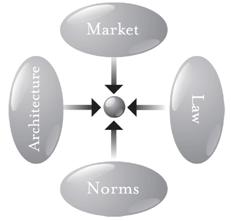
dangillmor
2016-09-08 20:15
and just wait for DRM, the Internet of (Insecure) Things and THAT catastrophe.
davidw
2016-09-08 20:15
bunnie huang's blog
https://www.bunniestudios.com/
The Ware for August 2016 is shown below. Thanks to Adrian Tschira (notafile) for sharing this well-photographed ware! The make and model of this ware is ...
hermanw
2016-09-08 20:15
In France, secondhand tractors that are hackable by the owner are in high demand
dsearls
2016-09-08 20:16
There is a better image of code/laws/norms/markets somewhere in the the Lessig oeuvre.
mrr
2016-09-08 20:16
LOL @hermanw I have a 2nd hand Unlocked Tractor (John Deere)
davidw
2016-09-08 20:16
High-bandwidth Digital Content Protection - Wikipedia, the free ...
https://en.wikipedia.org/wiki/High-bandwidth_Digital_Content_Protection
Wikipedia
High-bandwidth Digital Content Protection (HDCP) is a form of digital copy protection developed by Intel Corporation to prevent copying of digital audio and video content as it travels across connections.
davidw
2016-09-08 20:18
This is the US govt explanation of Fair Use: http://www.copyright.gov/fair-use/more-info.html : "Fair use is a legal doctrine that promotes freedom of expression by permitting the unlicensed use of copyright-protected works in certain circumstances. Section 107 of the Copyright Act provides the statutory framework for determining whether something is a fair use and identifies certain types of uses?such as criticism, comment, news reporting, teaching, scholarship, and research?as examples of activities that may qualify as fair use. Section 107 calls for consideration of the following four factors in evaluating a question of fair use:?"
dangillmor
2016-09-08 20:18
It makes life so much easier to just publish under Creative Commons license...
enoss
2016-09-08 20:19
johnny depp was quoting bill murray in ghostbusters
davidw
2016-09-08 20:19
Repeated because now even more relevant:
Remember when @wseltzer posted the video of the NFL copyright notice and got a DMCA take down notice from the NFL? Good times! http://blogs.wsj.com/law/2007/03/21/law-professor-wendy-seltzer-takes-on-the-nfl/
WSJ
Law Professor Wendy Seltzer Takes on the NFL
dsearls
2016-09-08 20:20
I want to get to the what-we-can-do-to-help part. Just saying.
christophermitchell
2016-09-08 20:21
Prediction: How just is to make sure the sky does not fall
christophermitchell
2016-09-08 20:21
Ugh, Our job is to...
davidw
2016-09-08 20:21
Jack Valenti
Lobbyist
Jack Joseph Valenti was a longtime president of the Motion Picture Association of America. During his 38-year tenure in the MPAA, he created the MPAA film rating system, and he was generally regarded ...
davidw
2016-09-08 20:22
"'I say to you that the VCR is to the American film producer and the American public as the Boston strangler is to the woman home alone.' Jack Valenti said this in 1982 in testimony to the House of Representatives on why the VCR should be illegal. He also called the VCR an "avalanche" and a "tidal wave", and said it would make the film industry "bleed and bleed and hemorrhage". https://news.slashdot.org/story/02/05/31/1622232/valentis-boston-strangler-testimony
jerrym
2016-09-08 20:22
we have Valenti also to thank for the industry's preferred copyright term: forever minus one day
dymaxion
2016-09-08 20:22
And specifically, what you're selling is enforcing consumer behavior
dangillmor
2016-09-08 20:22
Valenti told me once fair use amounted to the right to defend yourself in court, or words to that effect.
davidw
2016-09-08 20:23
Amazon's Jeff Bezos: The Ultimate Disrupter - Fortune
http://fortune.com/2012/11/16/amazons-jeff-bezos-the-ultimate-disrupter/
Nov 16, 2012 - ?My initial reaction was, 'You want me to be working on a Friday night on an .... A favorite Bezos aphorism is ?Your margin is my opportunity.
dymaxion
2016-09-08 20:24
Which is to say that venture capital is actively hostile to society
mrr
2016-09-08 20:24
@mrr uploaded a file:  and commented: This is a 2005... Has a computer board, but does not run apps.
and commented: This is a 2005... Has a computer board, but does not run apps.dymaxion
2016-09-08 20:25
(not necessarily so, but any VC pushing "disruptive" startups is an enemy of society)
jamesvasile
2016-09-08 20:25
A manufacturer's suit is an argument for Bunnie. it demonstrates the harm in a very clear way.
dsearls
2016-09-08 20:25
Valenti also wanted copyright to last ?forever less one day.? https://en.wikiquote.org/wiki/Jack_Valenti#Quotes_about_Valenti
davidw
2016-09-08 20:25
Valenti was once upon our They, @dsearls
dangillmor
2016-09-08 20:26
To Valenti's credit, he was also a supporter of Creative Commons...
dsearls
2016-09-08 20:26
?asserting indeterminacy where now there is certainty."
davidw
2016-09-08 20:26
Aereo - Wikipedia, the free encyclopedia
https://en.wikipedia.org/wiki/Aereo
Wikipedia
Aereo was a technology company based in New York City that allowed subscribers to view live and time-shifted streams of over-the-air television on ...
davidw
2016-09-08 20:26
Aereo Loses at Supreme Court, in Victory for TV Broadcasters - The ...
http://www.nytimes.com/.../supreme-court-rules-against-aereo-in-broa...
The New York Times
Jun 25, 2014 - The United States Supreme Court ruled Wednesday that Aereo, a streaming TV service, had violated broadcast network copyrights ? a ...
dymaxion
2016-09-08 20:27
In the case of AirBnB, it's notable that the margin being attacked was not just that of the hotels, but the structure of communities and real estate value
dangillmor
2016-09-08 20:27
DRM World: The CEO of a DVR company Hollywood sued to death once said (paraphrasing): We could turn this into a toaster if we wanted to.
wseltzer
2016-09-08 20:28
just wait until the Samsung smart fridge rebels when you want to put Apples into it
hermanw
2016-09-08 20:28
algorithmic rebels...yuk
dangillmor
2016-09-08 20:29
Dish Network disabled commercial-skipping for ABC shows after making a deal with ABC -- on existing owners' DVRs.
christophermitchell
2016-09-08 20:29
Another good story ruined by the expertise in the room
davidw
2016-09-08 20:30
In fact: Netflix Super Browse :: Add-ons for Firefox
http://addons.mozilla.org ? Add-ons for Firefox ? Extensions
Mozilla Add?ons
Rating: 3.5 - ?4 votes - ?Free
Jan 13, 2016 - Netflix Super Browse 1.3. by CyrisXD. CURRENTLY IN BETA This extension adds a "Super Browse" hover link to the main Netflix Navigation.
dangillmor
2016-09-08 20:32
Re Facebook's control freakery re content, this is really something: http://www.aftenposten.no/meninger/kommentar/Dear-Mark-I-am-writing-this-to-inform-you-that-I-shall-not-comply-with-your-requirement-to-remove-this-picture-604156b.html
davidw
2016-09-08 20:32
Keurig for litter boxes. Great.
christophermitchell
2016-09-08 20:33
Do we want to have a vote for the window?
christophermitchell
2016-09-08 20:34
It was just starting to get comfortable temperature
mrr
2016-09-08 20:34
Reopen the window!
enoss
2016-09-08 20:35
free the window!
davidw
2016-09-08 20:35
Open Windows(tm)!
christophermitchell
2016-09-08 20:35
Yay chat room!
mrr
2016-09-08 20:35
thanks @brewsterkahle
enoss
2016-09-08 20:36
I think a gofundme for the w3c to get rid of DRMembers would oversubscribe quickly
dsearls
2016-09-08 20:37
+1
jamesvasile
2016-09-08 20:37
@enoss If only w3c would admit to a number
wseltzer
2016-09-08 20:37
?
davidw
2016-09-08 20:37
A bit about Catalog of Missing Devices (an excellent indie band name?) http://boingboing.net/2015/09/21/mit-and-effs-freedom-to-inno.html
enoss
2016-09-08 20:38
@wseltzer is there a number? we can combine this with my hosting company membership drive!
jerrym
2016-09-08 20:38
hmmmm, CF bulb not looking that innovative these days...
jamesvasile
2016-09-08 20:38
@wseltzer Let me rephrasing that as "I doubt w3c would give us a price tag on removing drm"
dsearls
2016-09-08 20:39
Cory, brought to you by Geico!
davidw
2016-09-08 20:39
Not ok Google! Not Ok!
jamesvasile
2016-09-08 20:39
Not sure I'd call that a back door.
jerrym
2016-09-08 20:39
a coal chute?
dsearls
2016-09-08 20:39
Jumping ahead, the level of dislike already aimed at Apple for killing the headphone jack (and no doubt DRMing and special-purposing), something that was open and general purpose, might be an opportunity of some kind.
dangillmor
2016-09-08 20:40
watching the fanbois praise Apple's move is fun in a strange way
wseltzer
2016-09-08 20:41
@jamesvasile @enoss people are smarter than to call it a naked funding grab
mrr
2016-09-08 20:41
They provided an adapter. How can you not copy straight from the analog jack through the adapter?
jamesvasile
2016-09-08 20:41
@dangillmor Does anybody buy that headphone jacks can't be waterproof? http://www.exeze.com/uk/
jamesvasile
2016-09-08 20:41
@mrr The DRM isn't to close the analog hole. It's to prevent unapproved/unlicensed headphones.
dangillmor
2016-09-08 20:41
Samsung is selling one
dymaxion
2016-09-08 20:41
I think there's a side-door into some of this from the "software liability and how to build secure systems" angle
mrr
2016-09-08 20:42
@dangillmor probably subcontracted by samsung
enoss
2016-09-08 20:42
@wseltzer taking it private
dsearls
2016-09-08 20:43
?A strategy or policy report inside the DOD? ? DPR
davidw
2016-09-08 20:43
Before you know it, the entire economy is devoted to supporting people using that fucking shampoo and then there are more users than there are atoms in the universe and it all ends.
dsearls
2016-09-08 20:44
Do we have a link to Cory?s two sentences?
jamesvasile
2016-09-08 20:44
Anti-Sopa fight was effective because Wikipedia blacked out
dymaxion
2016-09-08 20:45
@david.reed: Maybe run the DoD angle by Lin Wells?
dangillmor
2016-09-08 20:46
Lin would totally get it.
davidw
2016-09-08 20:47
"political power is directly proportional to your perceived ability to cause pain.? - @haroldfeld
dymaxion
2016-09-08 20:47
Can we get a bunch of tractors blocking traffic in DC?
cayden
2016-09-08 20:48
@dymaxion: now we're talking! :joy:
jerrym
2016-09-08 20:48
remove something from each tractor so they can't be repaired in place easily. bring the big ones
dymaxion
2016-09-08 20:48
@jerrym: Like the computer?
jlivingood
2016-09-08 20:48
@haroldfeld Perceived power has always been critical - I recall that in stuff like http://globalaffairsblog.tumblr.com/post/31645348355
jerrym
2016-09-08 20:48
say, the computer :slightly_smiling_face:
hermanw
2016-09-08 20:48
@dsearls the text was in the chat
cayden
2016-09-08 20:48
direct action, as they say, gets the goods
hermanw
2016-09-08 20:48
We must set agreements and principles that allow us to resist the song of the Sirens in the future moments of desperation. And I want to propose two key principles, as foundational as life, liberty, and the pursuit of happiness or the First Amendment:1) When a computer receives conflicting instructions from its owner and from a remote party, the owner always wins.Systems should always be designed so that their owners can override remote instructions and should never be designed so that remote instructions can be executed if the owner objects to them. Once you create the capacity for remote parties to override the owners of computers, you set the stage for terrible things to come. Any time there is a power imbalance, expect the landlord, the teacher, the parent of the queer kid to enforce that power imbalance to allow them to remotely control the device that the person they have power over uses.You will create security risks, because as soon as you have a mechanism that hides from the user, to run code on the user's computers, anyone who hijacks that mechanism, either by presenting a secret warrant or by breaking into a vulnerability in the system, will be running in a privileged mode that is designed not to be interdicted by the user.If you want to make sure that people show up at the door of the Distributed Web asking for backdoors, to the end of time, just build in an update mechanism that the user can't stop. If you want to stop those backdoor requests from coming in, build in binary transparency, so that any time an update ships to one user that's materially different from the other ones, everybody gets notified and your business never sells another product. Your board of directors will never pressurize you to go along with the NSA or the Chinese secret police to add a backdoor, if doing so will immediately shut down your business.Throw away the Oreos now.Let's also talk about the Computer Fraud and Abuse Act. This is the act that says if you exceed your authorization on someone else's computer, where that authorization can be defined as simply the terms of service that you click through on your way into using a common service, you commit a felony and can go to jail. Let's throw that away, because it's being used routinely to shut down people who discover security vulnerabilities in systems.2) Disclosing true facts about the security of systems that we rely upon should never, ever be illegal.We can have normative ways and persuasive ways of stopping people from disclosing recklessly, we can pay them bug bounties, we can have codes of conduct. But we must never, ever give corporations or the state the legal power to silence people who know true things about the systems we entrust our lives, safety, and privacy to.These are the foundational principles. Computers obey their owners, true facts about risks to users are always legal to talk about. And I charge you to be hardliners on these principles, to be called fanatics. If they are not calling you puritans for these principles you are not pushing hard enough. If you computerize the world, and you don't safeguard the users of computers form coercive control, history will not remember you as the heroes of progress, but as the blind handmaidens of future tyranny.
jamesvasile
2016-09-08 20:49
"Artists are the moral basis for the DMCA but not its beneficiaries"
davidw
2016-09-08 20:49
TL;DR: And I want to propose two key principles, as foundational as life, liberty, and the pursuit of happiness or the First Amendment:1) When a computer receives conflicting instructions from its owner and from a remote party, the owner always wins. ? 2) Disclosing true facts about the security of systems that we rely upon should never, ever be illegal.
hermanw
2016-09-08 20:50
Why not call this "The First Amendment of Computing"
jamesvasile
2016-09-08 20:51
Can we gin up a scenario involving DRM and guns? "You can only use Remington ammo in that rifle now."
jerrym
2016-09-08 20:51
now you hack the car's firmware...
wseltzer
2016-09-08 20:51
if you're VW
jerrym
2016-09-08 20:51
indeed
dsearls
2016-09-08 20:51
Wouldn?t John Deere be able to do more with third parties if their architecture was open?
wseltzer
2016-09-08 20:52
it's harder to do adversarial audits of VW code given DMCA/CFAA
christophermitchell
2016-09-08 20:52
@hermanw I think it is more like the 4th amendment...
cayden
2016-09-08 20:52
hermanw
2016-09-08 20:53
John Deere is protecting its distributors, who used to rely on maintenance income. More reliable tractors means less income, they complain. Same problem with cars and distributors.
dangillmor
2016-09-08 20:54
Just try to NOT buy a "smart TV" -- almost impossible at this point.
dymaxion
2016-09-08 20:55
There are about 130,000 tractors sold in the US every year
hermanw
2016-09-08 20:56
@dangillmor I dont plug mine in. Only Chromecast.
dymaxion
2016-09-08 20:56
@dangillmor: Production studio monitors are fine, but they're often pricier
cayden
2016-09-08 20:56
i imagine "tractor" also includes riding lawnmowers?
davidi
2016-09-08 20:56
How about if you found a bug in the rectal thermometer software?
christophermitchell
2016-09-08 20:56
Doesn't it make sense to focus on the way car manufacturers can use DMCA to stop security researchers from telling press just how dangerous your car is regarding vulnerabilities?
sumanah
2016-09-08 20:57
for instance
dymaxion
2016-09-08 20:58
@cayden: Those are "farm tractors", so no, I don't think so
cayden
2016-09-08 20:58
gotcha
dsearls
2016-09-08 20:58
Is there a car, motorcycle or tractor maker that would *never* do DRM? If so, how about urging them to get on the bandwagon, and use it as a competitive advantage: ?Your Harley won?t narc on you."
dymaxion
2016-09-08 20:58
christophermitchell
2016-09-08 20:59
Seems like there should be a coordinated campaign around these things - "You Don't Own Your Shit"
christophermitchell
2016-09-08 20:59
Lots of ideas but need to be tied together
hermanw
2016-09-08 20:59
@christophermitchell to copy a highly succesfull campaign slogan :wink: "Take back Control !"
christophermitchell
2016-09-08 20:59
Should try to get a PSA in prominent podcasts that have lots of ads already
davidw
2016-09-08 21:00
Build hacks that users care about ? e.g., crack Netflix so it becomes downloadable ? and brand it as anti-DRM?
shuli
2016-09-08 21:00
Yes, and I think the moral standing of artists bit is a big thing, maybe doing an exhibit at a museum, like ICP or the New Musuem who are trying to get into tech
christophermitchell
2016-09-08 21:01
John Oliver did great show on this subprime car lending - https://www.youtube.com/watch?v=4U2eDJnwz_s
dymaxion
2016-09-08 21:01
@shuli: The Whitney might be a good place to poke
davidw
2016-09-08 21:01
Pull out the insane terms in EULAs and try to get them included in product reviews? (How? I dunno.)
shuli
2016-09-08 21:02
@dymaxion yup!
dsearls
2016-09-08 21:02
+1 to de-pants-insane EULAs.
dymaxion
2016-09-08 21:03
Can you do a subject access agreement in the UK?
christophermitchell
2016-09-08 21:03
Aside from us all wanting people to be more educated, the main reason we want to involve people is to demonstrate power right? To create the perception that we can cause pain?
jamesvasile
2016-09-08 21:03
Writing to your congressman is only effective if it is attached to a real, effective lobbying campaign with a precise legislative ask.
davidw
2016-09-08 21:03
Getting DRM labeled by FTC would be huge.
christophermitchell
2016-09-08 21:03
Educating people isn't necessarily helping in itself, is it?
hermanw
2016-09-08 21:03
If you buy a truck, the truck manufacturer owns the data. You can buy a service from them to get access and analysis.
sumanah
2016-09-08 21:04
Karen Sandler & heart implant code http://www.bbc.co.uk/news/technology-17631838
jamesvasile
2016-09-08 21:04
@christophermitchell Yes
christophermitchell
2016-09-08 21:04
I like the labeling idea
davidw
2016-09-08 21:04
DRM nutrition label?
jamesvasile
2016-09-08 21:04
Labeling seems like an achievable goal but isn't an end in itself.
davidw
2016-09-08 21:04
But don?t call it ?DRM.? ?This is a limited use product."
jamesvasile
2016-09-08 21:05
I find that if I just cross it out and don't sign it, nobody bothers to follow up.
hermanw
2016-09-08 21:05
"This is a software limited use product"....feels more wrong, coercie
hermanw
2016-09-08 21:05
coercive
dangillmor
2016-09-08 21:05
This is a restricted use product.
hermanw
2016-09-08 21:06
+1
jamesvasile
2016-09-08 21:07
Cigarette warning label might be a better model than nutrition label.
mrr
2016-09-08 21:07
Don't sign "Your Name" sign someone else's, Bet they don't even look at it.
sumanah
2016-09-08 21:07
The work that Cory's mentioned, by my spouse Leonard Richardson, is the New York Public Library's new open-source (but accommodating vendor DRM) app & backend that makes it easier for patrons to check out ebooks on their phones. http://www.crummy.com/writing/speaking/2015-RESTFest/
davidw
2016-09-08 21:08
@sumanah is that a NYPL Lab product? I?m a huge fan of the Lab.
jamestraynor
2016-09-08 21:08
"This milk is from cows that are not treated with DRM"
sumanah
2016-09-08 21:08
@davidw it's Labs-adjacent! But, I believe, not technically a product of NYPL Labs.
davidw
2016-09-08 21:08
I am hugely adjacent as a fan, then!
dsearls
2016-09-08 21:09
Ignore that former VW CEO Winterkorn has been shamed along with his former employer. He said the right thing (auf Deutsch) here: http://www.spiegel.de/netzwelt/netzpolitik/cebit-vw-chef-martin-winterkorn-warnt-vor-auto-als-datenkrake-a-957753.html . Might VW be an ally with this? They should be motivated to be good guys about something like this. The GDPR will is also encouraging and coming into force in 2018.
christophermitchell
2016-09-08 21:09
I think gamers should be a potent force
hermanw
2016-09-08 21:10
Maker Movement?
davidw
2016-09-08 21:11
Can we enlist Steam as an ally?
davidw
2016-09-08 21:12
Steam : DRM :: Reddit : SOPA/PIPA ?
dymaxion
2016-09-08 21:12
Doing a hackathon right is hard. Call Willow
jamesvasile
2016-09-08 21:12
@davidw Why would Steam hate drm?
jerrym
2016-09-08 21:12
or Twitch!
dymaxion
2016-09-08 21:12
Stream is a DRM vendor
jerrym
2016-09-08 21:12
all the gamers are there
davidw
2016-09-08 21:13
@jamesvasile probably don?t, but possibly because they have been pretty customer-friendly
davidw
2016-09-08 21:13
Also, it keeps users on their site instead of having to go to EA etc
jamesvasile
2016-09-08 21:13
@davidw Steam has DRM
davidw
2016-09-08 21:14
It also has lots of stuff without DRM.
davidi
2016-09-08 21:14
Micah Sifry is on the board of Consumer Reports
wseltzer
2016-09-08 21:14
Love the idea of a red box warning for products containing DMCA-entangling "effective technical measures"
jamesvasile
2016-09-08 21:14
@davidw That's true too. I just haven't seen evidence they are anti-DRM. But maybe they are.
dymaxion
2016-09-08 21:14
@davidw: But DRM is where their money is
davidw
2016-09-08 21:14
And I assume (without actual knowledge) that they see themselves as competing with the game manufacturers? walled gardens
davidi
2016-09-08 21:15
Write to Micah Sifry <msifry@gmail.com> and tell him DRM action at consumer reports is urgent
davidi
2016-09-08 21:15
Micah is on the Board of CR
jerrym
2016-09-08 21:15
VW: we'll lie to you, we just won't spy on you. good country song in there for Dom and Phoebe
davidw
2016-09-08 21:15
+1 - DRM included as a review category
davidi
2016-09-08 21:17
Marvin Ammori got to John Oliver on NN!
levi
2016-09-08 21:17
@levi uploaded a file: 
wseltzer
2016-09-08 21:18
Prop 65 Warning: This product contains DRM that the State of California has deemed hazardous to your mental health
hermanw
2016-09-08 21:18
"Unsecure in every bit"
sumanah
2016-09-08 21:23
@doctorow You probably already know that one way that designated driving became a widespread US norm is via tiny 10-second examples embedded in popular comedy & drama TV shows. Is there a place for popular entertainment (other than, of course, your own art) to do some work here?
If you want entrepreneurs to start certain kinds of businesses, I assume you could speak at various Y Combinator-type and TechCrunch events and whatnot.
jamesvasile
2016-09-08 21:23
I still have a running Chumby.
dsearls
2016-09-08 21:24
My Chumby was actually *stolen*. Punishment for the thief.
davidw
2016-09-08 21:24
Chumby
https://www.chumby.com/
Chumby
Compact wi-fi device that displays information from the Internet; also works as an Internet radio player, digital picture frame and alarm clock.
jamesvasile
2016-09-08 21:24
It was an old Bunnie product
hermanw
2016-09-08 21:25
There has been a rumour that Tesla remotely blocked a car from being maintained, because they could detect that the car was not in certified garage (GPS). Never have been able to get verification though.
davidw
2016-09-08 21:25
I had no idea that bunnie did the chumby!
dangillmor
2016-09-08 21:25
@sumanah but Hollywood, aka the Copyright Cartel, has for years been seeding anti-"piracy" messages in all kinds of entertainment. they would, of course.
dsearls
2016-09-08 21:25
Slogan: ?the best law to break."
davidw
2016-09-08 21:26
?DRM broke my litter box.? - collect these in some public place?
hermanw
2016-09-08 21:26
Break a popular item, and make an API. Allow apps and phones to manipulate through the API.

sumanah
2016-09-08 21:27
@dangillmor Maybe looking outside Hollywood, to, for instance, the middle tier of hip-hop musicians, or whatnot
hermanw
2016-09-08 21:27
#BrokenByDRM
dangillmor
2016-09-08 21:27
@sumanah yes...
jamesvasile
2016-09-08 21:27
#DRMbarrassed
davidw
2016-09-08 21:29
From a month ago: http://boingboing.net/2016/08/10/american-bar-association-votes.html
amaffei
2016-09-08 21:29
BREAK: Dinner time n music!
jamestraynor
2016-09-08 21:30
take DRM battles "up the stack" and focus on copyright reform?
sumanah
2016-09-08 21:30
appropriate music since we ought to be able to FIDDLE with our devices!
davidw
2016-09-08 21:31
heyo!
enoss
2016-09-08 21:31
@davidw it is registered!
enoss
2016-09-08 21:31
by me for cory I mean
dymaxion
2016-09-08 21:35
Dinner table: how do you represent all of the complexity of a sociotechnical infrastructural goat rodeo (like "control of the Internet up and down the stack", "state and corporate surveillance", or "global warming") so we can introduce new people to the issue, or do decision support work. We're thinking about documents made of humans.
jerrym
2016-09-08 21:42
made of humans? like soylent green? or beach protests with naked humans?
Friday, September 9, 2016
enoss
2016-09-09 00:14
autumn leaves
enoss
2016-09-09 00:14
and weirdly, someone else played that here
enoss
2016-09-09 00:14
(I wish I could remember who and when)
dsearls
2016-09-09 03:12
Night, everybody.
davidi
2016-09-09 10:40
Good morning everybody
davidi
2016-09-09 10:40
bring your badges today
davidi
2016-09-09 10:41
if you have your badge you will be eligible for Valuable Prizes
davidi
2016-09-09 10:41
If you don't you'll be SOL
hermanw
2016-09-09 12:28
Good morning everybody. If anybody is interested: I am recording my practical learning curve (mistakes and where to find the right answers) in switching from W10 to Ubuntu 16.04 LTS with virtual machines for W10 and Liux Mint etc. for Christopher. Happy to share.
davidw
2016-09-09 12:32
cory: "#InternetOfShit"
dangillmor
2016-09-09 12:33
I updated to 16.04 with only a few issues -- but am no longer trying to run Windows and Linux on the same disk (except to have Windows in a VM inside Linux). I carry around a very fast thumb drive on which I installed W10 for the rare occasions when I need to run Windows natively (one app that has no analog in Linux).
davidw
2016-09-09 12:34
@davidw uploaded a file: 
davidw
2016-09-09 12:34
(random meme.)
amaffei
2016-09-09 12:35
SESSION: Starting up
hermanw
2016-09-09 12:35
@dangillmor I run W10 in a VM for 2 apps :disappointed: which i need
jerrym
2016-09-09 12:37
@jerrym uploaded a file:  and commented: Here are the books on the table, just so's we all know the good books on hand.
and commented: Here are the books on the table, just so's we all know the good books on hand.davidw
2016-09-09 12:40
Is this the Freedman Consulting report: A Future of Failure
https://www.macfound.org/media/files/A_Future_of_Failure_-_Public_.pdf
amaffei
2016-09-09 12:40
SESSION: distributed Web w Brewster
cayden
2016-09-09 12:41
nope, it's this one: https://netgainpartnership.org/wp-content/uploads/2016/02/pivotalmoment.pdf
davidw
2016-09-09 12:41
Thanks, Cayden!
davidw
2016-09-09 12:42
?Can we make openness irrevocable?? - Brewster
davidw
2016-09-09 12:42
Principles: Reliability, privacy and fun
dsearls
2016-09-09 12:43
@dsearls uploaded a file:  and commented: Dreamed today about John St. Julien, a departed BigHook alum. Thought I?d share a pic of him, from here in 2011:
and commented: Dreamed today about John St. Julien, a departed BigHook alum. Thought I?d share a pic of him, from here in 2011:davidw
2016-09-09 12:43
Cory: "1) When a computer receives conflicting instructions from its owner and from a remote party, the owner always wins. ? 2) Disclosing true facts about the security of systems that we rely upon should never, ever be illegal."
wseltzer
2016-09-09 12:43
Mitchell Baker: immediate, open, agency
davidw
2016-09-09 12:44
Reliable -> has to come from multiple homes [brewster]
davidw
2016-09-09 12:45
privacy -> reader privacy [brewster]
doctorow
2016-09-09 12:45
Transcript of my #dwebsummit talk http://boingboing.net/2016/06/24/how-to-protect-the-future-web.html
davidw
2016-09-09 12:45
"Reader privacy is harder than writer privacy.? [brewster]
davidw
2016-09-09 12:46
We nailed fun. LEt?s try to get all three next time [brewster]
davidw
2016-09-09 12:47
Javascript is our friend [brewster]
steve_smith
2016-09-09 12:47
What was the peer to peer browswer? Zero something?
davidw
2016-09-09 12:48
Graybeards as a heatshield so the young won?t get shat on when they try to do something new and distributed [brewster]
dsearls
2016-09-09 12:48
FWIW, I regard the Web not as a commercial entity, but the substrate on which anything can thrive, including both public and private marketplaces: a tide that floats all boats. So I strongly object to apologists for advertising saying ?advertising gives us the free Web.? Fuck that. The Web was free before advertising and will be free after the advertising bubble bursts. This doesn?t answer Brewster?s call for other business models. There should be many. But business models should be for stuff that works *on* the Web. Not the Web itself.
davidw
2016-09-09 12:49
Pour Wayback Machine into the decentralized web. 500B pages. [brewster]
hmhgoldstone
2016-09-09 12:49
doctorow
2016-09-09 12:49
That's the one, @hmhgoldstone
davidw
2016-09-09 12:49
series of meetings to spread the idea? [brewster]
davidw
2016-09-09 12:49
scientific publishing [brewster]
wseltzer
2016-09-09 12:49
I'm still wondering what stops the decentralized web from recentralizing. It's harder than it seems to build technological locks on social and economic forces.
dangillmor
2016-09-09 12:49
I thought the NYT piece was really problematic...
davidw
2016-09-09 12:50
brewster: how can we enable people to make money by publishing on the Web? A decentralized mechanism?
dymaxion
2016-09-09 12:50
Much of the web I interact with is logic, not documents. Sometimes this can just be js, but some times that's not a functional model. How does this work in this world?
davidw
2016-09-09 12:50
(MaidSafe wants to enable this. So, of course, did Ted Nelson.)
hmhgoldstone
2016-09-09 12:51
@dangillmor: care to elaborate?
davidw
2016-09-09 12:51
(MaidSafe, that I?m skeptical about, has its own digital currency ? which is one reason I?m skeptical)
doctorow
2016-09-09 12:51
I fear that the emphasis on revenue for all is misplaced, inasmuch as most people never make money in the arts and never have; more important is to ensure that the rare commercial artistic successes have the lion's share of the revenues generated by their work -- which means ensuring that intermediaries (Amazon/Paypal/RIAA/Google/Facebook etc) have less leverage over artists, so the deals they strike are favorable to them
enoss
2016-09-09 12:52
the link I posted uses namecoin, which is a real limitation, but that is surmountable
doctorow
2016-09-09 12:52
The Venn diagram of people who can make good art and people who can manage their business has a sliver-sized sphincter of an intersection, so there will always be a need for intermediaries -- the trick is to ensure that economic power doesn't concentrate in the administrative/distribution side
dsearls
2016-09-09 12:52
@dsearls uploaded a file:  and commented: A problem with decentralized, versus decentralized, is that we made the practical decision from the start to use a client-server architecture, which some of us call calf-cow. We, with our browsers, suckle the milk of html and ?content? (with free cookies!) from server cows. This has encouraged top-down everywhere. We need to break free of that.
and commented: A problem with decentralized, versus decentralized, is that we made the practical decision from the start to use a client-server architecture, which some of us call calf-cow. We, with our browsers, suckle the milk of html and ?content? (with free cookies!) from server cows. This has encouraged top-down everywhere. We need to break free of that.dsearls
2016-09-09 12:53
I meant vs. distributed.
wseltzer
2016-09-09 12:53
The story we keep hearing is cycles of centralization and decentralization. What do we gain from this decentralization that will be lasting?
jerrym
2016-09-09 12:53
two infrastructure suggestions: Ward Cunningham's Smallest Federated Wiki, which has a distribution model for collaboratively created info: http://wardcunningham.github.io/
doctorow
2016-09-09 12:53
Wendy raises an important question here: [see above]
enoss
2016-09-09 12:54
@wseltzer if we keep moving up the stack (I am now convinced) the battle becomes easier and the domains controlled becomes smaller
jerrym
2016-09-09 12:54
and Ceptr, a very powerful platform for distributed trust and info, by the Metacurrency folks, notably Arthur Brock and Eric Harris-Braun: http://ceptr.org/
enoss
2016-09-09 12:54
and @dymaxion disagrees as we have enjoyably dug into!
dymaxion
2016-09-09 12:54
I'm still very bearish in Bitcoin. ZeroCoin is finally fixing the catastrophically bad privacy issues, but it's still hostile to communities at a fundamental level.
dsearls
2016-09-09 12:54
@dsearls uploaded a file:  and commented: Paul Baran?s original decentralized & distributed drawing, from 1962.
and commented: Paul Baran?s original decentralized & distributed drawing, from 1962.davidw
2016-09-09 12:54
What will be different about this decentralized web that will keep it safe from the forces of centralization that centralized the prior decentralized web?
doctorow
2016-09-09 12:55
This is an important, skeptical take on Bitcoin/Proof of Work: https://www.cl.cam.ac.uk/~rnc1/proofwork.pdf
mljones
2016-09-09 12:55
@dsearls Baran papers at Rand good reading: https://www.rand.org/content/dam/rand/pubs/research_memoranda/2009/RM2632.pdf
sumanah
2016-09-09 12:56
@dymaxion incidentally, do you have opinions on Zcash?
christophermitchell
2016-09-09 12:56
If we build a decentralized web, it will be on us to keep it decentralized. I don't immediately understand how others could re-centralize it.
davidw
2016-09-09 12:56
i.e., decentralized architectures always [??] permit centralization in the layers above it.
doctorow
2016-09-09 12:56
There is an alternative to proof-of-work for maintaining append-only distributed ledgers hosted by untrusted parties: Merkle Trees (now used in every Chrome instance for Certificate Transparency) http://www.nature.com/nature/journal/v491/n7424/full/491325a.html?message-global=remove
wseltzer
2016-09-09 12:56
The forces of centralization are often political and economic. They build different gatekeeper/chokepoints
davidw
2016-09-09 12:57
@wseltzer +1
dymaxion
2016-09-09 12:57
@sumanah: Like I said above, I trust Matt and Zooko's engineering pretty implicitly
christophermitchell
2016-09-09 12:57
I'm curious whether we are assuming the ability to route to decentralized web repositories. I think if I said I was in Minneapolis and connecting to a server in NYC, many people in this room could identify the corridors over which my traffic would almost certainly travel.
dsearls
2016-09-09 12:57
There are lots of approaches to distributed ?self-sovereign? identities. Here is one: http://evernym.com/
wseltzer
2016-09-09 12:57
who will trust a self-sovereign identity? why?
christophermitchell
2016-09-09 12:58
@wseltzer I agree - but that is why it is on us to respond, This will be cat and mouse ... hard to imagine a stable end state
dsearls
2016-09-09 12:58
There are lots of ?trust frameworks? as well.
doctorow
2016-09-09 12:58
The forces of centralization operate by convincing people of good will to make small, incremental compromises that cumulatively result in recentralization; GPL's irrevocability kept peoples' own capacity for self-deception from re-closing all the code that was opened; we need an irrevocability layer to lock the web decentralized
hermanw
2016-09-09 12:58
@doctorow Merkle trees are one the key items of a blockchain, are they not? The proof of work provides also the unpredictable outcome who solves it first.
davidw
2016-09-09 12:59
Image result for merkle trees
In cryptography and computer science, a hash tree or Merkle tree is a tree in which every non-leaf node is labelled with the hash of the labels or values (in case of leaves) of its child nodes. Hash trees allow efficient and secure verification of the contents of large data structures.
Merkle tree - Wikipedia, the free encyclopedia
https://en.wikipedia.org/wiki/Merkle_tree
christophermitchell
2016-09-09 12:59
@doctorow That would be make the right to be forgotten people freak out...
dsearls
2016-09-09 12:59
There are so many arguments that go ?It requires centralization? vs. ?It has to be distributed, with no centralization.? Too many to go into here.
doctorow
2016-09-09 12:59
If we're giving away free dweb domains, I know where we can get free certs to go with them https://certbot.eff.org/
dymaxion
2016-09-09 12:59
Any identity layer is going to cause some kind of social control. Be very, very careful about building there.
enoss
2016-09-09 13:00
@wseltzer we should talk about contextual identity. identity today is relatively easily demonstrable to the degree that you need it. when you combine easily demonstrable identity elements (fb/twitter/linkedin/etc), AI and context (you may need more to get a mortgage but not for most things below that) you can solve > 90% of the identity problems easily
dsearls
2016-09-09 13:00
?HTTPS Everywhere? breaks everything running on old servers running old code nobody will update. This includes everything I wrote at http://doc.weblogs.com from 1998 to 2007. I doubt the Archive can run that code. Just pointing out some collateral damage.
davidw
2016-09-09 13:01
Agreed, @dymaxion, but we already have identity layers/services that exert lots of social control, don?t we?
enoss
2016-09-09 13:01
and @dymaxion there are definitely particular needs in identity that are more difficult to address
doctorow
2016-09-09 13:01
@hermanw the problem with proof of work is that it assumes that the cost of compromising the blockchain (by overwhelming the proof of work with brute force) will be less than the aggregate value of the things in the blockchain - but the price of computing and the value of cryptocurrencies(etc) are highly volatile, and there are entities who can capture externalities that make it worth their while to spend stupid money to clobber the ledger (e.g. what's it worth to the Chinese politburo to tank the blockchain and stem the hemorrhage of $$ out of China?)
enoss
2016-09-09 13:01
they take deeper thinking
dymaxion
2016-09-09 13:01
Yup. But identity is uniquely violent
enoss
2016-09-09 13:01
agree
davidw
2016-09-09 13:02
and the values are very difficult to balance.
amaffei
2016-09-09 13:02
SESSION: Dan Gilmore
dymaxion
2016-09-09 13:02
Also, the lesson from a decade of reputation management systems is that no one who has a reputation has time or interest in managing it.
doctorow
2016-09-09 13:02
@dsearls Not sure if you mean the idea of HTTPS everywhere, or the EFF HTTPS Everywhere plugin? If the latter, then that shouldn't happen; HTTPS Everywhere (plugin) just defaults your browser to https if the server makes it available
doctorow
2016-09-09 13:03
Whuffie is dystopian [ref p1473426163001917]
christophermitchell
2016-09-09 13:03
When was journalism not broken? Not being snarky - what is the model we like? Days of competitive yellow dog journalism? Days of 3 major networks?
dsearls
2016-09-09 13:03
@dymaxion can you point me to a link about identity being inherently violent? I can guess what you mean, but I?d rather read something about it. Thanks.
dymaxion
2016-09-09 13:03
@dsearls: Seeing Like A State, James C. Scott.
pepper
2016-09-09 13:04
The Economist on the failure of journalism in this week's cover lede The Art of the Lie: http://www.economist.com/news/leaders/21706525-politicians-have-always-lied-does-it-matter-if-they-leave-truth-behind-entirely-art?cid1=cust/ednew/n/bl/n/2016098n/owned/n/n/nwl/n/n/NA/n
christophermitchell
2016-09-09 13:04
Dan: You don't quote both sides when one of them is lying
dymaxion
2016-09-09 13:04
@dsearls: A bunch of the nymwars stuff is good too
davidw
2016-09-09 13:04
Excellent point, @christophermitchell, i.e., when was it not broken. But now we have a candidate who is unthinkable in prior eras, and journalism is failing to stop him. Of course, it?s not at all clear that this is journalism?s role or fault.
davidw
2016-09-09 13:05
We take the rise of Trump as the failure of journalism. Maybe.
dsearls
2016-09-09 13:05
That would apply to administrative identities, no? Self-sovereign identities are ones we assert as individuals. It?s how we?re anonymous in some contexts, and differently self-identified in others. Is that violent as well?
christophermitchell
2016-09-09 13:06
Trump might be closest thing we have to comic book story arc of how circumstances create the worst villain imaginable.
dsearls
2016-09-09 13:06
Trump is the Mule in Azimov?s Second Foundation: a hacker of others? emotions and a warper of history.
christophermitchell
2016-09-09 13:07
TV news has responded rationally to a market system
christophermitchell
2016-09-09 13:07
They would be crazy not to give Trump the air time when they can sell more expensive ads against it.
dymaxion
2016-09-09 13:08
@dsearls: It depends on the norms and the code. Self-sovereign identities that end up being coercively-linked to wallet nyms don't end up helping, for instance. I'm not saying there aren't good answers here, just that the identification problem carries high risks.
wseltzer
2016-09-09 13:08
They want to keep the horse-race stories going, since they need to have a story every day
jerrym
2016-09-09 13:08
might also be the presence in Lauer of some gender-based unconscious bias, no? https://webbrain.com/u/17lJ
christophermitchell
2016-09-09 13:09
And the press doesn't want to take a hard stand - they want to ask questions. That is what Trump hacks.
davidw
2016-09-09 13:09
[digressive topic, but I feel compelled to say that I think HRC is the most prepared candidate for the presidency in US history and I am an unabashed supporter of her. Which of course does not mean I agree with everything she proposes.]
davidw
2016-09-09 13:09
Dan: Trump has played the weaknesses of the media.
dsearls
2016-09-09 13:10
Dan?s proposal: An outlet for the Debate that delays 5 or 10 minutes, during which well-qualified people, who really knows their subjects, would mute audio when the falsehoods appeared, but revealing the topic and the facts.
christophermitchell
2016-09-09 13:10
@davidw I think we fool ourselves into thinking anyone can be prepared. Our best presidents have not been the best prepared. Not sure one can prepare, but I agree with your further point I think - that she gets treated differently due to her sex
davidw
2016-09-09 13:10
Dan?s suggestion: Tape delay to blank out Trump?s lies, and replace it with a statement of the truth.
davidw
2016-09-09 13:11
@christophermitchell Can someone be unprepared? If so, then there are degrees of unpreparedness, in which case I?ll rephrase my statement: HRC is the least unprepared candidate in US history.
christophermitchell
2016-09-09 13:11
It matters how you refute it
jerrym
2016-09-09 13:12
I have a similar recommendation. Journalists agree that at the third known lie, they stand up and leave the room, or turn off the cameras. The issue is agreeing on what the lies are, but there are plenty of visible Pinocchio/Pants on Fire sites they could use.
jerrym
2016-09-09 13:12
yes, the news should go on strike over publishing known lies
dsearls
2016-09-09 13:12
Can Politifact?s Truth-o-meter do what Dan suggests? http://www.politifact.com/truth-o-meter/statements/
jerrym
2016-09-09 13:12
see Agnotology (deliberate propagation of ignorance) https://en.wikipedia.org/wiki/Agnotology
dsearls
2016-09-09 13:12
Dan?s policy for surrogates is that they never appear on TV, soon as they lie.
davidw
2016-09-09 13:12
Katrina Pierson - Wikipedia, the free encyclopedia
https://en.wikipedia.org/wiki/Katrina_Pierson
Wikipedia
Jump to Trump 2016 - Katrina Lanette Pierson is an American Tea Party activist and communications
hermanw
2016-09-09 13:13
Three Strikes for Politicians
davidw
2016-09-09 13:13
CNN Fact-Checks Trump's Spokeswoman's Lies In Real Time And ...
http://www.ifyouonlynews.com/.../cnn-fact-checks-trumps-spokeswomans-lies-in-real-time-...
Aug 3, 2016 - Just like their fearless leader, Trump surrogates have no shame or humility, so Pierson was right back on CNN on Wednesday morning, where ...
hmhgoldstone
2016-09-09 13:13
Few statements are absolute truth or lie ... Where do you draw the line?
Also, I think this would just feed conspiracy theorists
doctorow
2016-09-09 13:13
Some of this sounds like the way that UK TV journos routinely hardball their interview subjects
jerrym
2016-09-09 13:13
a meta-problem: we are an amnesic society. everything is flow, nothing is curated stock of info. so we re-explain, re-argue everything endlessly. so we are easily spun. here's a 4-min video I did as part of a Shuttleworth Fellowship application they didn't grant me that explains this: https://www.youtube.com/watch?v=KWnio8O0iqk&feature=youtu.be
christophermitchell
2016-09-09 13:14
I think Dan's idea would lead to different channels responding in different ways, further creating rival sets of facts
davidw
2016-09-09 13:14
@lellel : they cover the race, not the issues
dymaxion
2016-09-09 13:14
Explicitly so
christophermitchell
2016-09-09 13:15
I think failure of journalism is that most of us don't want to "eat our veggies." In a market system, there is little money for in-depth smart coverage because we ignore it in favor of candy
davidw
2016-09-09 13:15
horse race coverage is an appeal to our primitive desire for stories. Our new data environment is teaching us ? showing us ? that stories are too reductive.
steve_smith
2016-09-09 13:16
I also follow Italian politics, and Silvio Berlusconi is a recent prototype with very similar characteristics.
enoss
2016-09-09 13:16
no one under say 35 or so gets their news from TV news sources
sumanah
2016-09-09 13:16
@enoss not even in the military or in bad-broadband areas?
sumanah
2016-09-09 13:16
also, do you mean in the US or worldwide?
hermanw
2016-09-09 13:16
Farage and others lied too
hermanw
2016-09-09 13:17
Brexit
enoss
2016-09-09 13:17
@sumanah much more so of course. worth noting that bad-broadband areas skew quite old
enoss
2016-09-09 13:17
and more in the US
christophermitchell
2016-09-09 13:17
@enoss - I think that is too reductive. News on the web is informed by TV news just as TV news is informed by print. These things are overlapping and reinforcing
jerrym
2016-09-09 13:18
"what I say three times is true" is the Bellman's Fallacy, from the Hunting of the Snark: http://www.bmj.com/rapid-response/2011/10/29/bellmans-fallacy
doctorow
2016-09-09 13:18
I trace "balance" to the Reagan years, when Piketty says that the share of wealth in the hands of the top decile attained the tipping point, such that the reactionary right could make a plausible stink about "media bias" when the press said e.g. trickle-down economics are bullshit
enoss
2016-09-09 13:18
@christophermitchell they are, but news sources are SO MUCH more distributed the younger you go
davidw
2016-09-09 13:18
Balanced coverage goes back to the beginning of newspapers in the Us as a way to sel paper. (printers were the first publishers.) They could sell more copies if the paper did not appeal to only one political faction.
doctorow
2016-09-09 13:19
@davidw But US press also has a long partisan history (see eg The Press Democrat http://www.pressdemocrat.com/)
dsearls
2016-09-09 13:19
A problem is that *the story* is a fundamental format of human interest. All stories have three elements: 1) a character; 2) a situation, or series of them, that are problematic challenges for the character; and 3) movement toward a resolution. Two things about that in this election season. First, Trump is a very very interesting character. Second, he has steadily prevailed against a series of challenges. Third, there is movement toward a very clear resolution, in November. Journalism has always been about stories. How many senior editors ask a reporter, ?What?s the story here?? All of them. This is a built-in flaw in journalism that is also anchored to basic human nature.
christophermitchell
2016-09-09 13:19
Barry Lynn says journalists would do better but too much revenue they should get is being skimmed by Facebook, Google, et al.
jerrym
2016-09-09 13:20
ironically, Citizens United creates endless funds spent largely in the mainstream media, yet the f%$#@g media can't cough up the funds to actually commit journalism
doctorow
2016-09-09 13:20
He Said/She Said press coverage of everything from Star Wars to acid rain to AIDS denial to Gulf War I was a feature of the 1980s; in hindsight, it feels like a defense mechanism from reporters whose bosses ordered them not to dismiss/ignore naked bullshit
davidw
2016-09-09 13:21
That?s what I was trying to say, @dsearls. I?m very interested in the clash of the data culture with the story culture.
christophermitchell
2016-09-09 13:21
Agree strongly with Barry - press pushing back on Trump didn't help where they tried to. Though they also did give him more coverage
sumanah
2016-09-09 13:21
[I again recommend http://www.motherjones.com/politics/2016/08/trump-white-blue-collar-supporters "I Spent 5 Years With Some of Trump's Biggest Fans. Here's What They Won't Tell You: How Donald Trump took a narrative of unfairness and twisted it to his advantage" by Arlie Russell Hochschild, with its "deep story of the right" articulation.]
christophermitchell
2016-09-09 13:21
But people that hate the press and don't trust it saw its horror of Trump as a point in Trump's favor.
dsearls
2016-09-09 13:22
On he said/she said, the linguist Deborah Tannen wrote an excellent book, long ago, to little effect:
dsearls
2016-09-09 13:22
amaffei
2016-09-09 13:23
SESSION: Gifts and Honors
christophermitchell
2016-09-09 13:24
@christophermitchell uploaded a file:  and commented: BH2016 Thoughts...
and commented: BH2016 Thoughts...jamestraynor
2016-09-09 13:25
Howdy folks,
Voqal has launched another round of $30k Fellowship grants to individual technologists working towards a better world for all.
Application deadline is September 30th.
Details here: http://voqal.org/initiatives/voqal-fellowship/
Please forward this to anyone you know who may qualify.
Thank you!
christophermitchell
2016-09-09 13:25
@christophermitchell uploaded a file: 
doctorow
2016-09-09 13:26
Trump, like the Muslim Brotherhood in Egypt, like Leave in the UK, and others, is willing to say something otherwise unable to pass through the Overton Window; The Brotherhood said that Mubarak's US backing was based on his friendliness to Israel, not his fitness to rule; Leave said that the EU was in part about depressing wages by importing cheap labour; Trump points out that the system is rigged (nevermind that none of these people will do anything to fix this!); because they are the only ppl who are saying something that is manifestly true that everyone else in the political discourse denies, they gain fast credibility. One solution is to have people of goodwill and integrity ALSO shatter the Overton window - see, eg. Bernie Sanders
davidw
2016-09-09 13:26
Big Hook thanks you for the books, @doctorow !
doctorow
2016-09-09 13:26
@davidw Thank @davidi! It was his doing!
davidw
2016-09-09 13:27
Big Hook thanks you for the books, @davidi . (You do get a little credit for writing the thing, though, @doctorow.)
dangillmor
2016-09-09 13:27
@doctorow yes -- and it's why Sanders did so well (and why Clinton felt obliged to take on some semi-populist trappings).
doctorow
2016-09-09 13:27
Robert Moses: racist supervillain http://boingboing.net/2016/08/22/robert-moses-wove-enduring-rac.html
christophermitchell
2016-09-09 13:27
@christophermitchell uploaded a file: 
rmohan
2016-09-09 13:28
@dangillmor what do you make of the relative failure of truth-checker websites this cycle?
christophermitchell
2016-09-09 13:28
@christophermitchell uploaded a file: 
shuli
2016-09-09 13:29
and that photo is why!
christophermitchell
2016-09-09 13:29
@christophermitchell uploaded a file: 
dangillmor
2016-09-09 13:29
@rmohan one reason is they aren't always right (and people remember that). another is they are being written off by Trump partisans as liberal-biased.
davidw
2016-09-09 13:30
@christophermitchell , you magnificent bastard!
dangillmor
2016-09-09 13:30
(which i suspect they are)
shuli
2016-09-09 13:30
@rmohan the anti-intellectual movement is allergic to fact checking
christophermitchell
2016-09-09 13:31
@christophermitchell uploaded a file: 
doctorow
2016-09-09 13:31
@dangillmor @rmohan Reality has a well-known liberal bias http://i0.kym-cdn.com/photos/images/newsfeed/000/716/623/38b.jpg
christophermitchell
2016-09-09 13:31
@christophermitchell uploaded a file: 
dangillmor
2016-09-09 13:32
@doctorow the extent to which GOP has become wedded to BS is truly amazing...
christophermitchell
2016-09-09 13:32
@christophermitchell uploaded a file:  and commented: Last photo in the series
and commented: Last photo in the seriesjerrym
2016-09-09 13:33
Barry's book is Cornered: The New Monopoly Capitalism and the Economics of Destruction (2010) http://www.amazon.com/Cornered-Monopoly-Capitalism-Economics-Destruction/dp/0470186380/jerrymichalskisr
jerrym
2016-09-09 13:33
(the one David just mentioned)
dsearls
2016-09-09 13:34
There is no overstating how much the combination of AM talk radio and Fox News are the 24/7 bully pulpits to below which large portions of the U.S. population sit and listen to the same thing, over and over and over. Without them, there would not be today?s Republican party (which resembles not at all the one to which my parents belonged), or Trump. But it?s the source of a narrative about the America the needs to be ?made great again.?
davidw
2016-09-09 13:35
And why is there no lefty equivalent?
davidw
2016-09-09 13:35
There?s a shorenstein Center paper by a NYT reporter on how talk radio has set the republican agenda against the wishes of the republican leadership. (I?ll find it soon.)
hermanw
2016-09-09 13:35
@davidw Jonathan Haid "The Righteous Mind" explains it implicitly
dangillmor
2016-09-09 13:36
@sumanah !!!
davidw
2016-09-09 13:37
shorenstein paper: Jackie Calmes http://shorensteincenter.org/conservative-media-influence-on-republican-party-jackie-calmes/
doctorow
2016-09-09 13:38
@doctorow uploaded a file: 
jerrym
2016-09-09 13:38
Sumana is the first double-Hooker!!
jerrym
2016-09-09 13:38
congratulations!!
jerrym
2016-09-09 13:39
let's all join in singing the Bighook hymn!
hermanw
2016-09-09 13:39
And it is her Birthday as well !
nickgrossman
2016-09-09 13:39
no way
hermanw
2016-09-09 13:39
no joke
jerrym
2016-09-09 13:40
it is?? cool
davidw
2016-09-09 13:40
Let?s sing happy birthday.
hermanw
2016-09-09 13:40
This is a Statue of Liberty pose
davidw
2016-09-09 13:40
It?s the scales of justice
doctorow
2016-09-09 13:41
And happily enough, Happy Birthday is in the public domain!
jerrym
2016-09-09 13:41
at long last
christophermitchell
2016-09-09 13:41
BH Meme photos available here: https://www.dropbox.com/sh/ehav4zswstufpkw/AAAcMJhtucNIEmufKKBl2T1fa?dl=0
jerrym
2016-09-09 13:41
davidw
2016-09-09 13:43
The ol Scoff ?n? Sneer. The atmosphere is sketchy but they?ve got 30 ales on tap
christophermitchell
2016-09-09 14:17
@christophermitchell uploaded a file: 
jerrym
2016-09-09 14:20
what, no caption??
christophermitchell
2016-09-09 14:20
Couldn't come up with one - I am captioned out, need to tap into reserves
christophermitchell
2016-09-09 14:21
FYI - I did a bunch of meme type captions on photos of my son - see SportShotChris on instagram
christophermitchell
2016-09-09 14:23
Hoping Elliot will "move it move it" here
amaffei
2016-09-09 14:23
SESSION: Emorional work and emotional labor
brewsterkahle
2016-09-09 14:24
30 seconds of each song of one of her ep?s (that I just bought): https://archive.org/details/01PhoebeHuntWalkAway (the url is security through obscurity).
dangillmor
2016-09-09 14:25
As someone who used to play music for a living (some of it in the CW/bluegrass genre), I'm dazzled by the talent and joy in the music of Phoebe and Dominck...
davidw
2016-09-09 14:26
Suggestion:Emotional labor is the process of managing feelings and expressions in order to fulfill emotional requirements as part of the job role. More specifically, workers are expected to regulate their emotions during interactions with customers, co-workers and superiors.
Emotional labor - Wikipedia, the free encyclopedia
davidw
2016-09-09 14:28
The sociologist Arlie Hochschild provides the first definition of emotional labor, which is a form of emotion regulation that creates a publicly visible facial and bodily display within the workplace.[1] The related term emotion work (also called "emotion management") refers to "these same acts done in a private context," such as within the private sphere of one's home or interactions with family and friends. Hochschild identified three emotion regulation strategies: cognitive, bodily, and expressive.[4] Within cognitive emotion work, one attempts to change images, ideas, or thoughts in hopes of changing the feelings associated with them.[4] For example, one may associate a family picture with feeling happy and think about said picture whenever attempting to feel happy. Within bodily emotion work, one attempts to change physical symptoms in order to create a desired emotion.[4] For example, one may attempt deep breathing in order to reduce anger. Within expressive emotion work, one attempts to change expressive gestures to change inner feelings.[4] For example, one may attempt to smile when trying to feel happy. One becomes aware of emotion work most often when one?s feelings do not fit the situation. For instance, when one does not feel sad at a funeral, one becomes acutely aware of the feelings appropriate for that situation.[4]
davidw
2016-09-09 14:28
. According to Hochschild (1983), the emotion management by employers creates a situation in which this emotion management can be exchanged in the marketplace.[1] According to Hochschild (1983), jobs involving emotional labor are defined as those that:
require face-to-face or voice-to-voice contact with the public.
require the worker to produce an emotional state in another person.
allow the employer, through training and supervision, to exercise a degree of control over the emotional activities of employees.[1]
Hochschild (1983) argues that within this commodification process, service workers are estranged from their own feelings in the
wseltzer
2016-09-09 14:29
@wseltzer shared a file:
2016-09-09 14:29
@wseltzer commented on @davidw's file : Retweet, because it feels relevant again
: Retweet, because it feels relevant againdavidw
2016-09-09 14:29
More specifically, emotional labor comes into play during communication between worker and citizens, and it requires the rapid-fire execution of, emotive sensing, analyzing, judging, and behaving.[10]
Emotive Sensing: Detecting the affective state of the other and using that information to array one's own alternative in terms of how to respond.
Analyzing: One's own affective state and comparing it to that of the other.
Judging: Alternative responses will affect the other, then selecting the best alternative.
Behaving: Worker suppresses or expresses an emotion- in order to elicit a desired response from the other.
wseltzer
2016-09-09 14:30
how many of us are women and also terrible at "emotional labor"?
jerrym
2016-09-09 14:30
Isenberg commits an emotional foul!
wseltzer
2016-09-09 14:30
and also frustrated by conversations that make it male/female
dangillmor
2016-09-09 14:30
"Not the worst offenders..." now there's an introduction!
dymaxion
2016-09-09 14:33
@wseltzer: Yes, it's not always gendered, but the expectation is gendered. If you are perceived as a woman, you will be judged if you don't do emotional labor. Now, some women manage to avoid the impact of that judgement, but that does not mean that it is not there and that emotional labor isn't gendered.
davidw
2016-09-09 14:33
@dymaxion @wseltzer +1 to both, from my POV
wseltzer
2016-09-09 14:34
@dymaxion it's the old "women can't win" -- if they act one way, they're "passive," if another, "aggressive"
dymaxion
2016-09-09 14:34
It lands on other axes, too -- E.g. gay men are often expected to do more emotional labor too, especially if they're femme
dymaxion
2016-09-09 14:34
@wseltzer: It is exactly that
hermanw
2016-09-09 14:35
Emotional labour depletes emotional energy that cannot be compensated by money. I know companies that are acutely aware of this, and deliberately create emotional compensation, for instance by allowing warm groups that care to spend time and money on this.
dymaxion
2016-09-09 14:35
@hermanw: That's true, but also pay for the work
hermanw
2016-09-09 14:35
comma between care and to
hermanw
2016-09-09 14:35
yes, it is both
christophermitchell
2016-09-09 14:36
Also - each of them is pretty fucking funny
davidw
2016-09-09 14:36
+1 @dymaxion. This is what I was worried we were avoiding yesterday.
dymaxion
2016-09-09 14:36
Do not presume that because the load is emotional and not intellectual, emotional compensation can substitute for cash. ( Not saying you do, but this is a common failure mode)
hermanw
2016-09-09 14:36
good pay and emotional support
hermanw
2016-09-09 14:37
@dymaxion in no sense intended, presumed that pay was not an issue
dymaxion
2016-09-09 14:38
@hermanw: Yeah. I've never seen a time when it wasn't, though
christophermitchell
2016-09-09 14:38
Part of the problem is when a moderator does not prefer to recognize those who speak less frequently - something I think David I has made good strides on in my time at BH
sumanah
2016-09-09 14:39
from https://en.wikiquote.org/wiki/Gosford_Park "What gift do you think a good servant has that separates them from the others? It's the gift of anticipation. And I'm a good servant. I'm better than good. I'm the best. I'm the perfect servant. I know when they'll be hungry and the food is ready. I know when they'll be tired and the bed is turned down. I know it before they know it themselves."
sumanah
2016-09-09 14:39
also I think I came up with "glibocracy" in case anyone else likes it
hermanw
2016-09-09 14:39
@dymaxion Maybe that is more of an issue at the frontline where you are living, or anglosaxon. It is relatively rare in the EU, but not uncommon.
davidw
2016-09-09 14:40
@sumanah, is that quote representative of a clear case of emotional labor? That surprises me.
hermanw
2016-09-09 14:40
not uncommon that pay is no issue and emotional support is good. I am working in one of these
davidw
2016-09-09 14:41
+1 glibocracy. A fundamental dynamic of the early ?blogosphere.? It favored the leisured glib class.
cayden
2016-09-09 14:41
i'm into glibocracy too
dymaxion
2016-09-09 14:41
@hermanw: I would strongly and categorically disagree. The tech industry in Europe is no better on the whole at recognizing emotional labor, and their gendered pay gaps are bigger than the in the rest of European industries and on par with those in the US.
jerrym
2016-09-09 14:41
<-- glibocrat
cayden
2016-09-09 14:42
i often struggle in a glibocracy tbh
sumanah
2016-09-09 14:42
@davidw good question. Am considering.
davidw
2016-09-09 14:42
But a glibocracy necessarily (?) shorts emotional labor, doesn?t it? No?
hermanw
2016-09-09 14:42
@dymaxion I do not have data or experience on the techindustry, so I defer to your experience. I do know outside the tech sphere good and very bad examples.
dymaxion
2016-09-09 14:43
@davidw: Not necessarily. It can, but I think there are ways to compensate, and it's also only one component of emotional labor
davidw
2016-09-09 14:44
Since I?m assuming a definition of gllibocracy, and one that reflects my own discomfort with myself as a glib person (or so I think of myself), I?m taking it to privilege those who come up with quick responses, and (as per the meaning of glib), responses that may be more audience-pleasing and reputation-building than true.
davidw
2016-09-09 14:45
?it?s really an uncomfortable feeling to have something projected on me that I totally don?t identify in myself? [approx], says Doc, and the non-white-men in the audience nod.
dymaxion
2016-09-09 14:45
Meta filter had an incredibly useful thread on emotional labor that I encourage everyone to read. There's a PDF version of it now, for easier reading. It's about 70 pages, and I would strongly argue that anyone who manages people should read it: http://www.themarysue.com/emotional-labor-pdf/
jerrym
2016-09-09 14:45
Hodgkins, Simone and Searls -- where I met dsearls
dymaxion
2016-09-09 14:46
@davidw: This interaction is why these folks are up here - they're good enough at this to talk about this, but also in a structural position where they have to deal with this problem.
dymaxion
2016-09-09 14:47
The language of "calling" is really interesting here, in terms of the work it does
davidw
2016-09-09 14:48
Yes, but @dsearls is a care-giver in the ways that makes sense for him. He would probably fail with those with dementia, but there is no one like him for his constant emotional support of people who are struggling to make something that makes the world better. That is emotional work, too.
cayden
2016-09-09 14:48
Yes, especially because the skills required for emotional labor are just that -- skills.
doctorow
2016-09-09 14:48
One of the things that made Burning Man into the locus of my highest highs and lowest lows was a night I spent talking with a reader who came by camp at 3AM, as I was going to bed, and said he was glad he'd found me because he was contemplating suicide. He was an unmedicated, undiagnosed paranoid schizophrenic with a history of self-destructive behavior. Very bright, very screwed up. Stayed up with him for hours, got him to the suicide prevention people at Zendo camp... No one else around and awake in camp. He showed up just as a bunch of other really emotionally tough stuff was going on for me. Still processing.
hermanw
2016-09-09 14:48
Primary motivation differs between people
jerrym
2016-09-09 14:48
the US economy definitely doesn't value care work
jerrym
2016-09-09 14:49
hearing you, Cory
sumanah
2016-09-09 14:49
in 2008 I ran across https://web.archive.org/web/20070216200742/http://greenlightwiki.com/improv/Status which points out that doing the empathy work of making sure one is communicating with other people in a way they'll understand, working to match up with their mental models, tends to lower one's own status relative to those other people. (This helps me understand one reason why the tech industry devalues tech writing, project management, marketing... I also went into this in "User Experience is a Social Justice Issue" http://journal.code4lib.org/articles/10482 )
hermanw
2016-09-09 14:49
McLellands work was based on extensive research funded by th DoD
dymaxion
2016-09-09 14:50
When people love a thing that they've been conditioned from birth to be good at with no consent and have found that this is most reliable way they can afford to eat, we often call it a calling. While it's not the intent of using that word, there is often a history of structural violence that created the person in that position.
wseltzer
2016-09-09 14:50
To put value on emotional labor, we must absolutely take it out of the gendered frame. It's not something women "naturally" do better; it deserves reward when done well by men and women.
sumanah
2016-09-09 14:50
@doctorow Wow. Here to talk with you about that if you need.
hermanw
2016-09-09 14:50
Many tech people are achievement and power motivated
jerrym
2016-09-09 14:50
hermanw, you mean Marshall McLuhan?
jerrym
2016-09-09 14:51
or which McLelland?
doctorow
2016-09-09 14:51
@sumanah TYVM, I'll let you know
sumanah
2016-09-09 14:51
relationships/achievements/connections & US class culture: http://stormyscorner.com/2016/08/the-culture-of-poverty.html
dymaxion
2016-09-09 14:51
@davidw: Yes, he gets to choose to do the social work he's good at, not the work he's expected to do.
sumanah
2016-09-09 14:51
[haven't taken that class, am a little skeptical & curious]
jerrym
2016-09-09 14:52
there are two very different levels for this conversation about emotional work: the management of emotional workers (where this conversation has gone) and the management of emotions and participation in meetings like this one, which I think might have been more the catalyst for this panel
hermanw
2016-09-09 14:52
jerrym No , follow the trail from Maslow (who could not prove his pyramid theory in practice), to his students including Mclelland who did extensive tests for the DoD is the pyramid worked, including withholoding food in submarines to see what would happen. Statistics showed many motives, but 3 dominant, of which most people have one or 2 dominant for 80% of the time.
davidw
2016-09-09 14:53
@dymaxion Yes, of course Doc can do this because he is in one of the most privileged of classes, as am I. Good for him.
dymaxion
2016-09-09 14:53
If your job depends on performing the emotion of "I love to help people", self-report up the power hierarchy becomes complex. Folks who say these things probably believe it, because it's a lot easier to say things like that when you convince yourself first. This is emotional labor in the self.
davidw
2016-09-09 14:54
@dymaxion Can you give an example? I?m not sure what sort of person you?re referring to.
dymaxion
2016-09-09 14:54
@davidw: in which case?
davidw
2016-09-09 14:55
?If your job depends?? ? that comment.
dymaxion
2016-09-09 14:55
(was commenting on @enoss taking about the relationship his customer service staff have to their work, and the folks who Doc has seen doing nursing)
davidw
2016-09-09 14:55
Thank you.
davidw
2016-09-09 14:56
But I worry about projecting inauthenticity on people whose opportunities are restricted and who are in jobs that provide emotional support.
dymaxion
2016-09-09 14:57
We say we appreciate it, but there is a strong correlation between more emotional work and less party. We don't appreciate it in terms of social power.
sumanah
2016-09-09 14:57
I've often said that hygiene is harder than heroics. Being an ambient catalyst for others, being disciplined about deploying empathy even when it doesn't come easily, is harder than just pulling the occasional all-nighter to execute a task.
sumanah
2016-09-09 14:57
@dymaxion less parity, like inequality, right?
dymaxion
2016-09-09 14:58
@davidw: Fortunately, there's an awesome feminist research discourse that's handled that question in depth
dymaxion
2016-09-09 14:58
@sumanah: Yes, starting with pay
davidw
2016-09-09 14:58
As far as I can tell ? which is only so far, and is heavily biased by my being me ? the set of women who helped my wife?s mother as we all sat with her for three weeks as she died this summer ? as far as I can tell, they actually do flourish (find fulfillment, to use an old locution) in helping others. I see no reason to contradict their self-report and their behavior.
sumanah
2016-09-09 14:58
yup
doctorow
2016-09-09 14:59
Lindy West called out her fellow comedians for rape jokes, got a torrent of abuse, stood firm, made her colleagues better http://jezebel.com/if-comedy-has-no-lady-problem-why-am-i-getting-so-many-511214385
davidw
2016-09-09 14:59
Yes, certainly, @dymaxion, the pay inequity reflects a lack of appreciation, to put it mildly. But that doesn?t tell us about the motives and character of the people who are giving care.
hermanw
2016-09-09 14:59
@jerrym my tribe uses this PSM theory in practice, as a common language and a way to optimze who is doing what: we know each others profiles well
dymaxion
2016-09-09 14:59
@davidw: There's nothing inauthentic about enjoying a thing you've spent your life on, but that doesn't mean your choice to do that thing wasn't socially coerced
davidw
2016-09-09 15:00
And I don?t feel good about saying to one of these caregivers: ?Nah, you don?t mean it. You think you do, but you really don?t.?
davidw
2016-09-09 15:00
Not that anyone here would actually do that.
sumanah
2016-09-09 15:00
yeah, so @davidw why are you bringing up that strawman? genuinely curious here.
dymaxion
2016-09-09 15:00
@davidw: The literature has addressed this apparent contradiction in some depth. It's hard, but there are answers
davidw
2016-09-09 15:01
@sumanah I?m reacting to @dymaxion?s " Folks who say these things probably believe it, because it's a lot easier to say things like that when you convince yourself first. This is emotional labor in the self.? And I?m tryng to find out if I am misunderstanding it.
wseltzer
2016-09-09 15:02
+1 @cayden
jlivingood
2016-09-09 15:02
I partially blame economists that espoused the theory that we're all perfectly rational actors, when we're not and all our major decisions are really emotionally-based. One side effect is we put people with emotional skill into service jobs for example, instead of making it part of every job - because every job involves working with people. And I think this emotional skill set has been massively undervalued by western societies as a whole.
sumanah
2016-09-09 15:02
yay learning skills! yay being Carol Dweck compliant and having a growth mindset instead of a fixed mindset!
doctorow
2016-09-09 15:02
During my talk Q&As, I call alternately on "people who identify as female or nonbinary" and "people who identify as male or nonbinary." I let there be silence while we wait for women/nonbinary people to ask questions. I pretend not to notice people who chuckle at this phraseology. I don't acknowledge jokes from (inevitably) men who preface with "I think I am a man" (etc). Some women tell me this has made them feel uncomfortable and I regret it. But otherwise all my Q&As are sausagefests, and when I do this, half my questions come from women
dymaxion
2016-09-09 15:02
Ah, right. For instance, loving your company is a job requirement in most valley startups. If you don't do that work, you get fired for culture fit
dymaxion
2016-09-09 15:03
There's a long discourse on neoliberal work on the self
jlivingood
2016-09-09 15:03
And we have to stop idolizing emotional tyrants (that happen to also create great products). :wink:
doctorow
2016-09-09 15:04
Not letting men (and extroverts) (I am both) jump in while others are gathering their thoughts and their courage is the single best way I know to get a diversity of views
hermanw
2016-09-09 15:04
+1
nickgrossman
2016-09-09 15:04
yep
wseltzer
2016-09-09 15:04
For me, the conversation is *much* better when it's not about gender.
davidw
2016-09-09 15:04
@dymaxion , so you?re thinking about customer support, more than Doc?s example of caregivers. And the culture of ?passion,? which I detest.
wseltzer
2016-09-09 15:04
so please keep the strategies distinct from the tactics
dymaxion
2016-09-09 15:05
Here's a couple of sock puppets explaining work on the self: https://m.youtube.com/watch?v=uQEBDoi5MyE
cayden
2016-09-09 15:05
@doctorow: totally. also valuable in the classroom. coaching others on their teaching my big advice is often "don't be afraid of silence."
doctorow
2016-09-09 15:05
@dymaxion Nice to see some love for Monochrom here!
dymaxion
2016-09-09 15:05
@davidw: That's the really aggressive form, but it's a continuum
dangillmor
2016-09-09 15:05
Adopting this as of right now...
shuli
2016-09-09 15:05
listeners are also internally processing much of the external dialogue and acting on it on a different timeline.
dymaxion
2016-09-09 15:06
@doctorow: A phrasing I really like is "underrepresented genders"
hermanw
2016-09-09 15:06
In my tribe we explicitly discuss who is (not) taking responsibility for either security (group defense), resources (help, knowledge, time shared), care (emotional, correcting each other to improve, room to experiment)
hmhgoldstone
2016-09-09 15:06
@doctorow: do you make those ground rules explicit? Or just do it?
jerrym
2016-09-09 15:07
yang excluded all of these things from consideration
jerrym
2016-09-09 15:07
moved them out of the board room, out of the workplace
doctorow
2016-09-09 15:07
@hmhgoldstone I make them explicit. I announce them in advance ("women, start thinking about your questions now, because half the questions after this will come from women")
jerrym
2016-09-09 15:07
made no adaptations to steward it
sumanah
2016-09-09 15:07
Speaking of making room for more people to listen & be heard: at a future BH it would be interesting to try out these 4 role cards in a session or two, https://adainitiative.org/2013/10/02/running-your-unconference-discussions-effectively-adacamp-session-role-cards/ to disaggregate moderation work into 4 roles:
" a Facilitator, who presents the topic and keeps the discussion moving forwards
a Gatekeeper, who keeps the discussion productive and empowers people who haven?t spoken up to make themselves heard
a Timekeeper, who keeps the session to time
a Note-taker, who makes notes on the session"
jerrym
2016-09-09 15:07
until just recently
jerrym
2016-09-09 15:07
now mindfulness, purpose and meaning are legitimate topics inside mainstream US businesses, as is sustainability
jerrym
2016-09-09 15:07
that's progress
dymaxion
2016-09-09 15:10
@jerrym: I work in a less typical environment, but yeah. We have corporate meditation classes
dymaxion
2016-09-09 15:11
@jerrym: That said, as a Buddhist, I find the financialization of mindfulness worrying. It feels like the colonization of yet more of my life by an extractive regime
davidw
2016-09-09 15:11
I couldn?t quite hear: ?the true cost of jerks in the workplace??
jerrym
2016-09-09 15:12
the mindfulness industry is definitely a concern, but it comes with the rise of mindfulness in our collective consciousness. it's how capitalism processes (and coopts/corrupts) everything
dymaxion
2016-09-09 15:12
Yup
jerrym
2016-09-09 15:12
yes, I couldn't find a book by that title
davidw
2016-09-09 15:13
This one? The No Asshole Rule: Building a Civilized Workplace and Surviving ...
https://books.google.com/books?isbn=0759518017
Robert I. Sutton - 2007 - ?Preview - ?More editions
The No Asshole Rule is a New York Times, Wall Street Journal, USA Today and Business Week be
davidw
2016-09-09 15:13
These are three very reflective, emotionally honest people on the panel.
sumanah
2016-09-09 15:13
https://medium.com/@jeremypreacher/emotional-labor-and-diversity-in-community-management-eb3a4985d71a nuance on the way that being someone who does not notice performing emotional labor is perceived as having "good instincts" as a community manager.
also, a community management wiki warns that, when giving critical feedback to jerks who are used to having demographic privileges, "be prepared for grumbling about how heavy-handed you are... they won't reciprocally pay attention at lower volumes" http://onlinemanship.wikia.com/wiki/Straight_White_Affluent_Male_Native-Born_Protestants_Are_Uniquely_Oppressed#.3D_9
hermanw
2016-09-09 15:14
@jerrym see mail
amaffei
2016-09-09 15:15
SESSION: Commitments
enoss
2016-09-09 15:16
corollary to @kfc 's point. the measure of a culture in a workplace is how long jerk's last in the company or culture
amaffei
2016-09-09 15:17
Matt: Work on RFI to look at distance to reservation. Stand up tribal international carrier.
dymaxion
2016-09-09 15:17
The biggest compliment I can give to Etsy as a workplace is that in five months I've only had two jerky interactions, and in both cases men stepped up and apologized for the jerks and in one case the problem is being deeply fixed
sumanah
2016-09-09 15:17
wow cool!!
amaffei
2016-09-09 15:18
Heather: 3 shows or stories this fall with BH participants
amaffei
2016-09-09 15:19
Dan G: Recommitment to continue to work w Brewster on Re-decentralizing Internet and ability to innovate.
doctorow
2016-09-09 15:19
I bought all her music too
dsearls
2016-09-09 15:20
If you?re doing Ostrom, include Lewis Hyde?s Common As Air. It?s a corollary to her work.
amaffei
2016-09-09 15:20
Sumanah: Read and blog about Ostrum book-reading (Nobel Prize Lecture, Governing the Commons, 45 Page report on how we create institutions (Sep, End of Year, Sep
amaffei
2016-09-09 15:21
Brewster: Recommit w 3 speeches connecting w doer communities
jerrym
2016-09-09 15:21
sumanah you may find useful resources on Ostrom here: https://webbrain.com/u/16Za
sumanah
2016-09-09 15:21
Right. I think a good place to start would be to read her Nobel lecture http://www.nobelprize.org/nobel_prizes/economic-sciences/laureates/2009/ostrom_lecture.pdf , and then those of us who are still interested could move on from that to one of her books, to be decided -- maybe "Governing the Commons: The Evolution of Institutions for Collective Action," her 1990 classic. @dsearls should I read "Common As Air" before/during/after?
nickgrossman
2016-09-09 15:22
lol!
sumanah
2016-09-09 15:22
And I'm committing to reading & blogging about https://netgainpartnership.org/wp-content/uploads/2016/02/pivotalmoment.pdf , the consulting report "A Pivotal Moment: Developing a new generation of technologists for the public interest" that Bruce would like us to read, and blogging about it by the end of Sept
amaffei
2016-09-09 15:22
DavidW: Get Cory in touch with ...., See if we can do "more Bighook" stuff during the rest of the year, dinners, little-hooks, etc.
dangillmor
2016-09-09 15:23
dinner +1
sumanah
2016-09-09 15:24
I'd enjoy having dinner with Big Hook folks in NYC. And my spouse is a really good cook.
dangillmor
2016-09-09 15:24
Bay Area BigHookers, let's do one there...
cayden
2016-09-09 15:24
I'm in @dangillmor
dymaxion
2016-09-09 15:25
@sumanah: My place should be set up for dinner for eight soon
sumanah
2016-09-09 15:25
Thanks, Jerry!
dsearls
2016-09-09 15:25
New York and/or Los Angeles-SoCal Hookers too.
amaffei
2016-09-09 15:25
Pepper: Will look into having Facebook support BH.
cayden
2016-09-09 15:27
@dsearls: i'm often in LA, as my partner is starting a PhD at UCLA, so let me know
amaffei
2016-09-09 15:27
: To talk more.
dsearls
2016-09-09 15:28
Let?s have a dinner here at our Santa Barbara place (a link not to share outside), next Jan or Feb. We?ll work out a time with Joyce: http://www.paradiseretreats.com/tranquila/photos.php
mljones
2016-09-09 15:28
@sumanah @dymaxion @dsearls can easily host a good number too, plus all the affordances of an academic institution
dangillmor
2016-09-09 15:29
+1 @wseltzer please let us know what we can do specifically...
amaffei
2016-09-09 15:29
Wendy: Institution building at W3C. Reach out to BH more for conversations as part of this.
jerrym
2016-09-09 15:29
wseltzer have you synched with Ethan Zuckerman about his ideas on building institutions?
amaffei
2016-09-09 15:31
Brewster: Have an exec director club w high tech non-profits via informal dinners
doctorow
2016-09-09 15:31
@doctorow uploaded a file:  and commented: W3C membership fees for US-based members: https://www.w3.org/Consortium/fees?countryCode=US&quarter=07-01&year=2016#results
and commented: W3C membership fees for US-based members: https://www.w3.org/Consortium/fees?countryCode=US&quarter=07-01&year=2016#resultssumanah
2016-09-09 15:31
@brewsterkahle what's your take on http://flossfoundations.org/ & its mailing list?
jerrym
2016-09-09 15:32
amaffei Brewster has already been doing those dinners
dymaxion
2016-09-09 15:32
A friend just put up the syllabus for her course on activist engineering at Olin. Everyone trying to change the world through technical systems should read everything in this list: http://aplusa.org/courses/critical-designer-slash-activist-engineer/
sumanah
2016-09-09 15:33
I didn't catch what @enoss just said about muckraking?
amaffei
2016-09-09 15:33
Elliot: Help organize membership in W3C via some of his customers (and D. Reed)
amaffei
2016-09-09 15:34
Doc: Offers his house in SB for Bighook Dinners.
davidw
2016-09-09 15:34
Participants at the first BH: http://isen.com/bighook/2000/intro/bh00_who.html
wseltzer
2016-09-09 15:34
Space in Arlington for Boston-area BH dinners
dsearls
2016-09-09 15:35
That link is excellent for remembering who was doing what way back whens.
davidw
2016-09-09 15:36
People at the first who are at this one: Scott B., Roxane G., Dewayne H., Jerry M., David R., me.
davidw
2016-09-09 15:36
You can recognize us by the red flair hanging from our badge.
amaffei
2016-09-09 15:36
Nick: 3, 1) Help w Corys campaign ; 2) Backing folks that are working to de-centrializing the net -- work w young people and blockchain, 3) personal commitment to "engage even when I feel overwhelmed"
amaffei
2016-09-09 15:37
Jerry: Make more 5-minute universities on BH books. Jerry suggests that others consider doing similarly.
doctorow
2016-09-09 15:38
All my book recommendations, going back 10+ years: http://boingboing.net/author/cory_doctorow_1?tag=books
dsearls
2016-09-09 15:38
Jerry?s five minute university is not Fr. Guido Sarducci?s. But it
jerrym
2016-09-09 15:38
the two 5minUs I've posted to YouTube are about The Great Transformation http://therexpedition.com/2013/08/how-we-used-to-live-together/
jerrym
2016-09-09 15:39
and The Institutional Revolution http://therexpedition.com/2015/12/trust-at-a-distance-the-odd-way/
dsearls
2016-09-09 15:39
I will read and review The Power Broker, and post the pointer on the list.
jerrym
2016-09-09 15:39
(the YouTube links are in the blog posts, which offer more context)
dangillmor
2016-09-09 15:39
@dangillmor shared a file: and commented: W3C membership fees for US-based members: https://www.w3.org/Consortium/fees?countryCode=US&quarter=07-01&year=2016#results
and commented: W3C membership fees for US-based members: https://www.w3.org/Consortium/fees?countryCode=US&quarter=07-01&year=2016#results2016-09-09 15:39
@dangillmor commented on @doctorow's file : Can't afford that...
: Can't afford that...davidw
2016-09-09 15:40
Zephyr Teachout for Congress! Woohoo!
jerrym
2016-09-09 15:40
Father Guido and other things like 5 min universities in my Brain here: https://webbrain.com/u/19ql
wseltzer
2016-09-09 15:40
@dangillmor I'd like to think about how W3C can support individual / smaller members without getting a different kind of capture
davidw
2016-09-09 15:40
My 8-min interview with Zephyr, at a familiar location, last year: https://www.youtube.com/watch?v=MlDVvZZdMq8
enoss
2016-09-09 15:41
@wseltzer @dangillmor through patronage by companies like us!
amaffei
2016-09-09 15:42
Barry: Continue to support Zephyr Teachout
amaffei
2016-09-09 15:42
for Congress
davidw
2016-09-09 15:43
https://secure.actblue.com/contribute/page/zephyrforcongress (repeating the url from above)
dsearls
2016-09-09 15:43
Had I exercised my 3-minute card, I would have asked for help with making Customer Commons a Big Thing. I explain the challenge here: http://j.mp/mitermz . Contact me if you?re interested, or to volunteer others who would be ideal for the work. Thanks.
amaffei
2016-09-09 15:44
Lucy: 1) Have a conversation w Pepper, 2) Start a conversation about repositories for code and code review that would take in small projects.
amaffei
2016-09-09 15:44
Barbara: Follow through on all connections made. Read the books and attempt to do a review
jamesvasile
2016-09-09 15:44
Just donated to Zephyr. It's been on my todo list for a while, so thanks for the nudge.
dymaxion
2016-09-09 15:44
@lellel I've got a few thoughts there; you might want to hook up with the Mozilla open source code review project
amaffei
2016-09-09 15:46
DavidR: 1) Help Harold w DMRC(sp?), 2) Talk to government people about helping Cory about DRM.
dangillmor
2016-09-09 15:46
Just re-donated to Zephyr's campaign...
amaffei
2016-09-09 15:46
DavidR: 3) As search for next job proceeds will look at other people that need with creative design, etc. (looking for takers)
dsearls
2016-09-09 15:47
David asked me to share a link to an example of a post by a BH list member that got sourced (without mention of BH) elsewhere. Here is a Linux Journal column I wrote that contains most of an email by David Reed: http://www.linuxjournal.com/content/can-we-save-wireless-regulators
dangillmor
2016-09-09 15:47
@enoss done, and done
dangillmor
2016-09-09 15:49
And here's a column that stemmed from a post by a BH list member (Harold Feld): http://www.slate.com/blogs/future_tense/2016/08/25/fcc_support_for_hackable_wireless_routers_is_a_win_for_all_of_us.html
amaffei
2016-09-09 15:50
Have a conversation w Brewster to see how payload can be inserted into packets in a network at many (20-30K) small systems around the world to defend against massive attacks profiling systems. (and to possibly prototype it at next BH)
amaffei
2016-09-09 15:52
SteveS: 1) Will reply to BH messages more frequently. 2) Learn about DRM and get word out, 3) Personal commitment to make more space for other people in his life.
amaffei
2016-09-09 15:55
MattJ: 1) Write at least 2 pieces that will be placed on http://archive.org. Going to be the best history professor. 3) Report back about "Data Past, Present, and Future" course he gives at Columbia U.
amaffei
2016-09-09 15:58
Scott: 1) Make introduction for Cory (DONE), 2) Point students to more news articles about changes in the cyber-world. (asks BHs to send pointers to useful articles to BH issues list so that these can be used.
doctorow
2016-09-09 16:02
"Private until breached"
hermanw
2016-09-09 16:02
Has anybody experience with Semaphore (Slack alternative from SpiderOak)
amaffei
2016-09-09 16:03
Desiree: 1) 2) Followup on Wendy's and Cori's need to be in front of ISOC, 3) To use 3M card to help emotional work to help others to speak, 4( Look at how to cut the BS in Internet Governance.
jamesvasile
2016-09-09 16:05
I was a mentor for Outreachy when it first opened. It was started by Karen Sandler, a fellow Software Freedom Law Center alum. It's a good program and I encourage you to support it.
amaffei
2016-09-09 16:08
Elliot: Will accept nominations for Internet Governance chair.
amaffei
2016-09-09 16:08
Elliot: ICANN chair
amaffei
2016-09-09 16:09
Andy: Will put up a Prezi with a voiceover describing what this is all about by the end of the year.
sumanah
2016-09-09 16:32