 |
|

|
This website is a record of BigHook2000, a meeting to discuss the future of communications networks, specifically "The Network We Really Want", held in Woods Hole, Massachusetts, September 22-24, 2000. This record is based on techniques developed by Sterling Insights. It includes text and images that were created to reflect the proceedings of each BigHook2000 session. The text, which represents a documentor's synthesis of the discussion, was created by Rita Sterling. The graphic images, like the one on the right, were created by Joe Sterling -- these are interspersed within the text. You can click on these for enlarged version -- in many cases, the graphical details significantly enhance the story. In addition, there are photos by Matt Oristano and Skip Andrews.
Greg Amadon is the founder of TeraBeam Corporation, which provides fiberless optical access at up to gigabit speeds. Greg hired an all-star management team at TeraBeam and then stepped away from daily operational responsibilities. He is now looking for the next big entrepreneurial opportunity. Skip Andrews is Sterling Insights’ COO. Skip's 20 years of information technology business experience includes work on website usability, Oracle database design and teaching personal and professional creativity courses. Robert Berger is founder, Chairman and CTO of UltraDevices, Inc., a broadband wireless start-up using unlicensed spectrum and open source software. Bob has served on advisory boards of Covad, AboveNet, Sandpiper and others. Woody Boyd built the world's largest interactive voice response system for Home Shopping Network, then turned his attention to bringing low-cost Internet access to India, El Salvador and other places on the southern side of the Digital Divide. Scott Bradner is the co-director of the IETF Transport Area, and co-chair of the IETF working group on IPv6. Scott is a natural teacher, a columnist and a frequent speaker at technical conferences. Scott has been involved with data networks at Harvard University since Usenet had one newsgroup. Dick Campbell is the owner of Bang-Campbell Associates, an acoustics consulting firm based in Woods Hole. Dick helped a Lucent team create a conductor-only, all-synthesized orchestra that debuted at Telecom99 in Geneva. Doug Carmichael is founder of Shakespeare and Tao Consulting. He wants to know, "how to manage our species without turning it into a fascist project." His background is in physics, psychoanalysis, consulting, and scenarios. Anders Comstedt is CEO of Stokab, a municipally chartered dark fiber provider in Stockholm. In this role, he advises Stockholm on issues like telecom deregulation and business development. In past incarnations, he held positions at Telia and Ericsson. Tim Denton runs an Ottawa-based consulting practice focused on telecom policy and regulatory issues. Tim reads widely in science and technology, hates monopolies, and hikes in the Gatineau hills near Ottawa. John Dohm manages the Venture Planning group at Digital Coast Partners. Before that, John was a founder of Deloitte & Touche's e-Business Strategy and Technology Infrastructure practice. Jeff Feldman is CEO of Everest Broadband Networks, which brings broadband services to buildings. Jeff launched the company from Pequot Capital Management, where he managed early-stage investments in broadband communications. Tom Freeburg is Corporate VP and Chief Futurist of Motorola Labs, where he heads the Technology Outlook Laboratory. Tom holds 50 patents that span many of the basics of wireless data transmission. Stockton Gaines is the CEO of Acorn Technologies. Inc., which helps early-stage technology companies cross the Valley of the Shadow of Risk. Roxane Googin produces the High Technology Observer newsletter and consults with high-tech portfolio managers to keep them ahead of large structural changes in technology. Chuck Gritton is CTO for the NETS division of Tellabs, focusing on telecom services. Previously, Chuck was at AT&T Bell Labs (now Lucent) and Coherent Communications (now merged with Tellabs). Dan Grossman works at Motorola in Mansfield, Mass., where he tends the lower layers of the Internet via his work on standards and service guarantees. Steve Guich is general partner of Renaissance Capital, a telecom and technology based hedge fund. He is also an active neuroscience researcher at UC Irvine. Bijan Halavi is president of PPI Capital, which has public and private investments in telecom infrastructure. He also manages family real estate holdings in Los Angeles. Dewayne Hendricks is CEO of Dandin Group, Inc., which is developing ultra-wide-band (UWB) digital radio service. Given US regulatory restrictions, Dewayne's first customer is the nation of Tonga. Dewayne is a member of the FCC Technological Advisory Committee. He has helped build wireless Internet infrastructure in Kenya, Tonga, Mexico, Canada and Mongolia. His e-newsletter, the Dewayne-net Technology List, surfs the edge of wireless technology and policy. Bob Henrick is President of OgilvyInteractive, a branch of Ogilvy & Mather. Bob's checkered past includes running internal Lucent ventures, designing next generation consumer wired and wireless appliances, and hiding US submarines. Tim Horan heads telecommunications research at CIBC Oppenheimer. Previously, Tim held telecom analysis positions at BancAmerica, Robertson Stephens, and Smith Barney. In the distant past, Tim was a civil engineer. Christian Huitema is architect for Microsoft Windows Networking and Communications. Before that, he was chief scientist at Telecordia’s Internet Architecture Research lab. Christian is a trustee of the Internet Society, and previously chaired the Internet Architecture Board. David Isenberg is founder of isen.com, inc., a problems provider in a world with too many solutions. David grew up in Woods Hole. John Jordan directs electronic commerce research at the Cap Gemini Ernst & Young Center for Business Innovation in Cambridge, Massachusetts. John produces an e-newsletter on the intersection of technology, strategy, and economics covering new business models, network effects, and other connected economy phenomena. Pete Kaminski is a founder of Yipes, an Ethernet-over-fiber service provider. Before Yipes, Pete was the architect of NETCOM's NetCruiser and publisher of the Public Dialup Internet Access List (1993). Steve Kamman does telecom equity research at CIBC Oppenheimer. Previously, Steve did business development at MCI, and strategy work at Andersen Consulting. Takuhito Kojima is President of Fujitsu Business Communication Systems in Anaheim CA. Previously, Kojima held senior executive positions at Fujitsu Switching Systems in Kawasaki, Japan. Bob Kostelak does business planning and initiative management in the office of the president of AT&T Network Services. Bob has spent 16 years at AT&T where he was a key member of the Opportunity Discovery Department. Lawrence Lessig is a law professor at Stanford. Larry's 1999 book, Code and Other Laws of Cyberspace, details his interest in the architecture of the net and the values that this architecture embeds. Larry is running for at-large representative to ICANN. Adina Levin is product strategist for Vignette Corporation, a company that does e-business applications. Previously, Adina worked at Fastwater, a start-up e-commerce consulting firm, and at CAP Ventures. Bob Lucky is head of Applied Research at Telcordia and chair of the FCC Technical Advisory Committee. Previously, Bob was with Bell Labs, where he led development of LuckyNet, one of the first high-speed digital research networks. Carolee Marano is conference coordinator and web designer for BigHook2000. She also runs The Write Stuff promotional services. Previously, Carolee was AVP at the Israel Discount Bank of New York, where she worked on international banking automation and interface projects. Jerry Michalski founded Sociate, which helps tech companies design where they're going. Jerry also speaks, writes, invests, and publishes his Brain (www.thebrain.com) online. Jerry is former managing editor of Release 1.0 -- under his stewardship, it became known as The Influential Release 1.0. Dave Nadig is co-founder of MetaMarkets.com and an analyst for OpenFund, the first interactive mutual fund and the first fund in the MetaMarkets two-fund portfolio. Mike O'Dell is the Chief Scientist for UUNET, a WorldCom company. He is responsible for network architecture and technical strategic direction. Mike previously worked at Prisma Computers and Bellcore, and served eight years as founding editor-in-chief of Computing Systems. Matt Oristano recently sold his high-speed wireless Internet venture, SpeedChoice, to Sprint. Before that, Matt built the first American-owned cable TV system in Great Britain. In the early eighties, Matt owned and operated cable systems in the United States. In 1984, Matt tried to build a wide-area broadband data network -- "before it was cool (or even economical)." Tom Petzinger is founder and CEO of LaunchCyte, a Pittsburgh-based incubator that develops business opportunities at the intersection of life sciences and information sciences. Previously, Tom spent 22 years as a Wall Street Journal reporter and editor writing about everything from organized crime to commodity trading. ("Those two things weren't all that dissimilar," Tom reports.). Richard Prytula is a principal of TechnoCap, a Canadian firm investing in network technologies. TechnoCap's investments include Hyperchip - a petabit router start-up, VIPswitch, which is building equipment for terabit optical MANs, and YottaYotta, a yottabyte network storage company. David P. Reed made formative contributions to the architecture of the Internet in the '70's, most notably the "end-to-end architecture principle", which was re-discovered as the Stupid Network by latter-day revisionists. David has worked as chief scientist at Software Arts and Lotus Development Corp., and as senior scientist at Interval Research Corp. Ernie Robson is CEO of Vidya.net, Inc., which develops multimedia products based on new telecom technologies. Ernie is also founder and former partner of The EOP Group, a Washington, DC regulatory affairs and business strategy consulting firm. Ernie can read and speak French and Russian, and has some knowledge of Japanese, Italian, Ancient Greek and Sanskrit. Raj Sandhu is the founder of NewSpeed, a venture investment and business development company focused on telecom infrastructure. In the past, he was a venture partner with The Chatterjee Group, an investment manager for Soros Fund Management, and a partner at SG Cowen. Bill St. Arnaud is Senior Director of Network Projects for CANARIE Inc., Canada's national research network. At CANARIE, Bill led development and implementation of CA*net 3, the world's first national optical R&D Internet. David Stanwood is the founder of Stanwood Piano Innovations, an internationally renowned piano rebuilding shop, with clients ranging from Keith Jarrett to Paul Shaffer to Rudolf Serkin to Steinway itself. David holds several patents for piano key balancing techniques. Steve G. Steinberg is a technology consultant for the investment firm Gilder, Gagnon & Howe and principal of Steinberg Consulting. Previously, he was a technology writer for the Los Angeles Times, The Industry Standard, and Wired, where he wrote the definitive "Netheads vs. Bellheads" essay (Wired 4.10, 1996). Joe Sterling is the founder of Sterling Insights, Inc., which specializes in Graphic Facilitation,Visual Synthesis, design and facilitation of collaborative Strategic Modeling events, and Organization Development projects for clients including Toyota, Peregrine Systems, Mainspring, Ernst & Young, and Solar Turbines. Rita Sterling is a principal at Sterling Insights, Inc., where she leads change management projects in financial services, manufacturing, and technology. Before she joined Sterling Insights, Rita was the global leader for change management at Solar Turbines. Rob Tannor is founder and chairman of LightSpeed Fiber Network, which builds metropolitan fiber optic networks to provide connectivity to IXCs, CLECs, ILECs, wireless providers, ISPs, ASPs and cable television companies. Rob is formerly CEO of S.N. Tannor, Inc., a NYC-based electrical engineering and construction firm. Mark Vange founded Gemsoft, an electronic game development company, which was recently acquired by Circadence, which provides more general solutions for bandwidth-constrained services over the Internet. David Weinberger publishes JOHO: The Journal of the Hyperlinked Organization. David comments on technology for National Public Radio’s All Things Considered and writes for Wired, Knowledge Management World, Intranet Design Magazine, and others. Simultaneously, David is president of Evident Marketing, Inc., which helps high tech companies figure out what they do and how to talk about it.
BigHook2000
is named for a story that the late Woods Hole scientist, Albert
Szent-Gyorgyi told. Before Szent-Gyorgyi came to Woods Hole he won
the Nobel Prize for discovering Vitamin C. In Woods Hole, he found
out a lot about muscle contraction, that is, how biology turns carbon
and oxygen into physical force. Then he worked on cancer, that is,
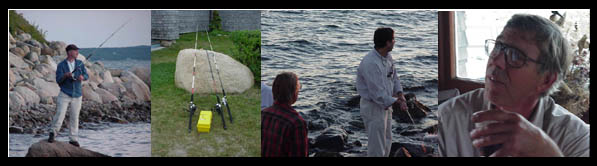
how cells decide when to divide. He went for the big problems. On the weekend of September 22-24, 2000, we fished with big hooks. |



|
Host Facilitator Graphical Facilitation
by Audio Engineer Audio Engineer |
Musicians
Photos by . . . Catering Bartending Fishing Guide Wisdom Support Major Domo of Juniper
Point |
 |
BigHook Main
BigHook2000 Recap Home | Context | Summary Fri Eve | Sat Morn | Sat Midday | Sat Eve | Sun Morn Photogallery | Scribegallery | Music isen.com, inc. | Sterling Insights Copyright 2000 isen.com, inc. |