 |
|

BigHook2000
Summary
Purpose
Participants
Process
Outcomes
Points of Agreement
Thoughts on the Future of the Network
Values Built into the Architecture of the Network
Future Scenarios
Open Questions
The purpose of the BigHook 2000 event was to convene a discussion among architects, developers, users and observers of communications networks, especially the Internet, to explore the question, "What is the network we really want?" The driving idea was to look beyond the expedient network, the profitable network, the network we could have with today's (or tomorrow's) technology, to ask ourselves if we could have any kind of network we wanted, what would it be.
The 50-some BigHook 2000 participants can be thought of as belonging to one or more of four groups:
- The creators of the Internet steeped in an Internet Engineering Task Force (IETF) culture of "rough consensus and running code" and informed by experience-based technical knowledge accumulated during a lifetime of Internet care and feeding.
- Second, developers who are building new network technologies, products and services that use the Internet to create value for themselves, their companies, their customers and humanity.
- Third, the financial community that is funding commercial development of the Internet in with an interest in finding and funding products and services of the future.
- Fourth, observers and commenters who write and speak about the dynamics of the Internet from technological, economic, regulatory, historical, and social perspectives.
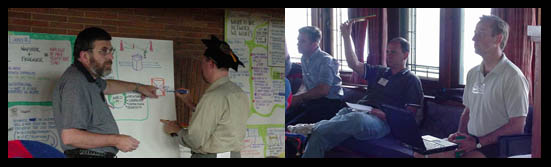
The participants gathered at The Airplane House in Woods Hole, MA for two and half days in an informal, yet aesthetically intense setting. The meeting room was a large semicircular living room with fireplace, Frank Lloyd Wright furnishings, and 180 degrees of stained glass windows overlooking Atlantic waters between Woods Hole an Martha's Vineyard. During five sessions, each one 2 to 3 hours, the participants were together in a "talking circle" exchanging questions, opinions, experiences and views of the future.
The event was produced by isen.com, inc. David S. Isenberg hosted the event. Carolee Marano was conference coordinator. BigHook2000 was facilitated by Bob Kostelak, with assistance from Doug Carmichael and the team from Sterling Insights. The primary role of the Sterling Insights team was to capture in graphics and text the proceedings of the event which comprise this web-enabled documentation. The event was audio taped by Dick Campbell.
The dialogue on the future of communications networks was wide, vigorous and somewhat chaotic. Many of the participants brought strong opinions. Among the most senior technical experts there was passion, deep knowledge of the technical aspects, disdain for amateurs, and pride in their mastery and efforts to build today's Internet. If there was one take-away it was that the technology embodies social values, and these social values drive the technology.
In addition, there was rough consensus that:
- We just got the discussion started.
- There are huge open issues that deserve further exploration.
- It's important to expand the discussion of trends and issues affecting network development.
The dialogue was heated, but there were a number of points of agreement:
- today's Internet is a huge and fundamental good;
- there is excitement and guarded optimism about the future of the Internet;
- there is significant trepidation about unintended consequences, and the actions of large clueless organizations of the past, such as governments and large corporations;
- there is optimism about the progress of wireless/radio and fiber access technologies;
- there is deep respect for the end-to-end principle, even by those who believe that TCP and IP functionality could be further optimized;
- The Internet of today hardly resembles the Internet of five years ago -- the Internet of 2005 is likely to be almost unrecognizable as an evolution of today's Internet.
Thoughts about the Future of the Network
Because of the profound growth of the Internet, in the number and diversity of the Internet's users, and due to the central place that the Internet is assuming in the global economy, there are huge impending discontinuities. Look forward to:
- breakthroughs that make wireless, fiber, and other transmission technologies more and more powerful and ubiquitous (especially in regions with Internet-friendly regulatory regimes);
- huge economic interests, at risk of losing long-standing business models, to lobby for political and economic -- hence technological -- control of the Internet;
- attempts by incumbent organizations to "embrace and extend" the Internet (i.e., proprietarize it);
- waves of disruptive technologies brought by new companies that will change business models in unanticipated ways;
- more debate over the values built into the architecture of the Internet including issues of privacy/anonymity, intellectual property ownership issues, the changing nature of transactions, etc.
Values Built into the Architecture of the Network
Certain values are built into the architecture of the Internet. These implicit values include:
- the end-to-end principle, which turns the Internet into a Petri dish, a lump of clay, a blind man's "elephant" -- allows the Internet to become whatever its users want it to be, limited only by throughput, latency, packet loss and the economics of deployment and scalability;
- openness born of the end-to-end principle, which gives the Internet a democratic, even libertarian quality, and which threatens closed societies (e.g., the Taliban, the Chinese government, orthodox Judaism, fundamentalist Christianity, etc.) that want to insulate their members from content and experiences deemed unsuitable or threatening;
- meritocracy born of the so-called hourglass model (which depicts a multitude of underlying transport technologies connected to a multitude of applications via one single IP protocol), which lets new winners emerge in underlying transport technologies -- without reference to applications -- and which lets new winner applications emerge -- without reference to underlying technology.
Several plausible scenarios for future Network were implicit in the conversation, but none were explored very deeply or explicitly. Some of these included:
- Official future scenario: everyone will be more productive and connected. The Internet is helpful to mankind, promulgates openness, democracy, value creation, capitalism, and other positive values for humanity;
- The collapse scenario: society won’t be able to pay for the infrastructure growth that the Internet demands. As demand increases at the edges 2x, infrastructure investments in the middle will increase10x. As global resources shift to support an ever hungrier infrastructure, overall economic capability is fundamentally weakened.
- The co-option scenario: the very neutrality that allows the Internet to be successful also allows it to be hijacked by larger economic and political forces, either the forces of the past that wish to re-establish their formerly-successful vertically integrated business models, or emergent forces born of a frictionless, winner-take-all economy that wish to consolidate power;
Note that there are certainly other scenarios in this space . . .
Far more questions were opened than answered at the BigHook2000 event. Some of these include:
- What is the Network We Really Want? (We just began to understand the question and barely scratched the surface of the answer space.)
- Who will pay for the growing expense of building the network's infrastructure?
- What is the role of society in Internet development and ownership, i.e., what do we have societies for?
- What do we want the FCC, Congress, the courts, the states, etc., to do?
- Who will step in as the Founding Fathers of the Internet become unable to contribute?
- How should the Founding Fathers respond to interest groups that want to usurp, bend or extend the Internet for their own purposes?
 |
BigHook Main
BigHook2000 Recap Home | Context | Summary Fri Eve | Sat Morn | Sat Midday | Sat Eve | Sun Morn Photogallery | Scribegallery | Music isen.com, inc. | Sterling Insights Copyright 2000 isen.com, inc. |