 |
|

Session 5 -- Sunday Morning, 9/24
- Sunday
Morning – Welcome Back
- Charles
Speaks
- Connecting
Economics and Architecture
- Tolls
and Trolls
- Dan
Grossman Speaks
- Mike
O’Dell Speaks
- Takuhito
Kojima Speaks
- David
Weinberger Speaks - Value Free Network (Column)
- Values
Built In
- Larry
Lessig Speaks
- Awards
Ceremony
- Tom
Petzinger Speaks
- Adina
Levin Speaks
- Acknowledging
One Another
- Jerry
Michalski Speaks
- The Network I Want
1. Sunday Morning – Welcome Back
Bob: This session we will continue with the discussions we have been having. Look in your packet for your 3 min. chit to play.
David Isenberg: It spent two days right next to your heart so there should be some stuff to convey.
Question: But has it been near the brain? [laughter]
Bob: We will start with Charles.
Charles Speaks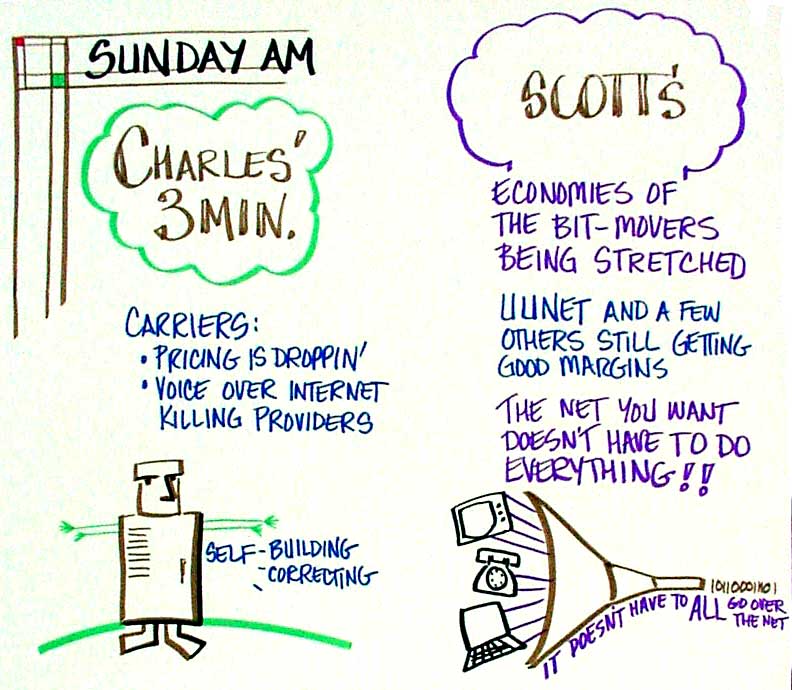 Charles:
What hit me last night was the comment re: carriers. We all know margins
are declining. Voice is the application they get more profit from. They
are killing the profit margins of the various operators. The second thing
was, when they build a network they have to build it faster than the demand
is coming in on the edges. The third was a book: you can overbuild the
infrastructure and collapse your civilization. I need to read that book.
Charles:
What hit me last night was the comment re: carriers. We all know margins
are declining. Voice is the application they get more profit from. They
are killing the profit margins of the various operators. The second thing
was, when they build a network they have to build it faster than the demand
is coming in on the edges. The third was a book: you can overbuild the
infrastructure and collapse your civilization. I need to read that book.
Charles: What we need to build is equipment that is self organizing, self provisioning and self constructing. Is that what we mean: an intelligent stupid network? If we get away from application based processing, we'll have to help the phone companies get some of the margin dollars back. We can't add intelligence directly to the network or that will destroy the model. We can build building blocks so end users can build applications more easily. My wife is a tax attorney. She is seeing a big issue how jurisdiction are trying to tax the e-commerce transactions that are going on. I'm afraid that will negatively impact what we are trying to do. That is a fear I've got.
Scott: Two things. The economies of the people who will be moving the bits in the future are stressed. We don 't know how to do this. I don' t know how the carriers will make money. A lot of the companies are trying to drive for the lowest price bid which seems to equate to the lowest level of quality. I deeply worry about who will pay for this in the future. The network we want, doesn't have to do everything. There's no reason we have to do all of our communications over the network for example TV. There are other things done better other than on the net.
3. Connecting Economics and Architecture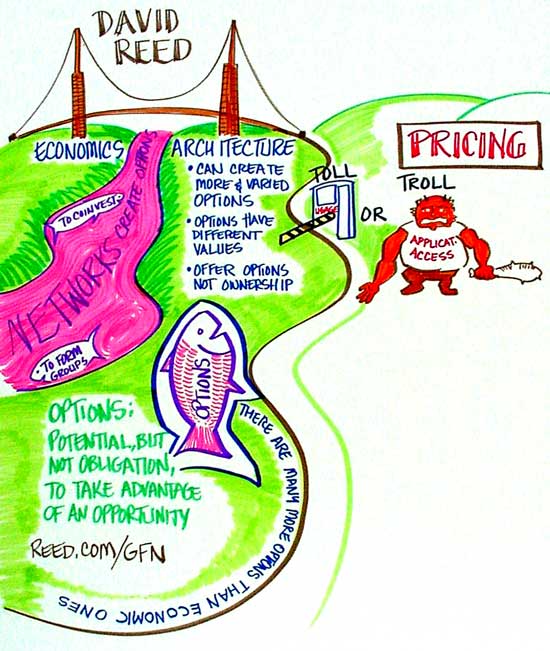 David
Reed: I want to talk about what I think I want to do about the network
of the future. The message of this is to try to get people to climb on
the bandwagon of connecting economics and architecture in a more intimate
way. I think the people who have done network economics so far, don't
get it. They assume that the architecture is not fundable. They try to
pound that round peg into a square hole. There's a theme that network
creates options, network structures create options. The other is about
creating ownership rights. An option is the right but not an obligation
to invest more massively in the future. Real options is what businesses
can do. A networks create an information option. The first option was
to create a packet where you wanted. I have recently wrote about how networks
create options to form groups. It is not easy to form a group in the telephone
network. There are some other options. Creating the network like a petri
dish is an opportunity to co-invest. When you go to a Finance guy, they've
been trading through securities, it's exactly the same process that has
provided options. We have done the same thing in the network. An option
is non-linear. It's irreversible operation. We are talking about the potential
emergent behavior of the network. The option element creates the emergent
behavior. The architectural answer is to create more options and more
value options and not create properties with boundaries.
David
Reed: I want to talk about what I think I want to do about the network
of the future. The message of this is to try to get people to climb on
the bandwagon of connecting economics and architecture in a more intimate
way. I think the people who have done network economics so far, don't
get it. They assume that the architecture is not fundable. They try to
pound that round peg into a square hole. There's a theme that network
creates options, network structures create options. The other is about
creating ownership rights. An option is the right but not an obligation
to invest more massively in the future. Real options is what businesses
can do. A networks create an information option. The first option was
to create a packet where you wanted. I have recently wrote about how networks
create options to form groups. It is not easy to form a group in the telephone
network. There are some other options. Creating the network like a petri
dish is an opportunity to co-invest. When you go to a Finance guy, they've
been trading through securities, it's exactly the same process that has
provided options. We have done the same thing in the network. An option
is non-linear. It's irreversible operation. We are talking about the potential
emergent behavior of the network. The option element creates the emergent
behavior. The architectural answer is to create more options and more
value options and not create properties with boundaries.
Questions:
Tim: These are powerful and important ideas. I'd like David to be able to talk some more about this. How does the group feel?
Ernie: So ask him: If you had more time, what would you say? [laughter]
David Reed: I have not been able to talk about the group forming options in less than an hour.
David Isenberg: I would recommend you go to David Reed's longer talk at URL: www.reed.com/gfn.
Comments: Ownership is just a special case of an option.
David reed: The tradeability of options is the interesting innovation. The fact that you can create a market for options is interesting.
Comment: One of the potential solutions to congestion is to recognize that different options have different values and price accordingly.
4. Tolls and TrollsChristian: We use to have application pricing on which was like a bridge with trolls. The bridge was guaranteed. Application pricing is exactly that. If you are in the business of doing networks, you don't finance your network by saying I have a network and I will do margin on the side. I'm losing money on transmission but I'm making it big on application.
Tim Horan: With value based pricing, you should get better utilization of the net. The point being on the pricing, that is a big problem through the last decade. Telecom folks don't understand their cost. It will work itself through at some point.
Mike: The note about Telecom folks not understandingtheir cost but they make sure they don't disclose it. People talk about opportunity cost, this is opportunity equity. Regarding network based structures, historically it has been very difficult to monetized metadata i.e. data about data. There's never been a really good way to monetize arbitrary metadata. Intrinsically there's no reason they couldn't be able to. The interesting thing is you can now extract value from metadata.
Comment: When I worked at MCI we tried to determine our cost. The fundamental problem is at any given instant a packet is either worth everything or nothing and it depends on the state of the net. When the congestion is gone, that bit is worth zero. You know what your cost are but there's no relation to what you should be pricing.
David Reed: The allocation of the cost to the customer is unclear.
Mike: The expansion of the network does not happen in infinitely small piece. There's quantizing noise in the system. The problem is the functions are continuous. They don't describe the behavior.
Comment: The toll at different times should have different pricing.
Mike: That depends on the reason you have a toll. If the goal is to try to control the demand on the bridge, your model is right. If the goal is to recover the cost of the infrastructure, then dividing it evenly by all the users is the right model.
Comment: I totally disagree.
David Isenberg: If the goal is what the service is worth to the customer, then Scott is right.
Ernie: People know their cost structure is nonsense. You estimate as well as you can. There are some flaws but for a business purpose, it isn't bad. There is an economic theory, an economic model which is a two part tariff. You have a fixed price and a use based on top of that.
Comment: We've never been able to gather the state data. The network has to provide a cost per packet. Up to this point, I can handle your traffic without any incremental cost to me. At some point I have to develop more infrastructure.
Ernie: There's a way to do that too. At the margin where that extra bit that you don't have exists right now, you have to go buy it.
Tim Horan: What is happening with the electric generation, the pricing will go way up.
Christian: Prices in the market are there as a feedback mechanism. We could build the feedback mechanism. The more you use it the more you have to pay. We need to figure out these feedback mechanisms. Whatever the generation, the average computers will have equivalent power to your pipes. You will have potential demand that can burn out your pipes so you have to have feedback mechanisms.
Raj: The mechanisms already exist. You buy the level you want. You don't charge someone for the new plant that has to be built. Prices actually go down after the steel plant is built. It is getting harder to build these networks and manage them because vendors are creating systems that are more complex and more difficult to manage.
David Reed: I did not mean that we should get into a discussion of network pricing models. The options are new frameworks for getting investing effort and getting returns. Network pricing is an interesting topic but what I wanted to discuss is the other kinds of options that the network creates.
5. Dan Grossman Speaks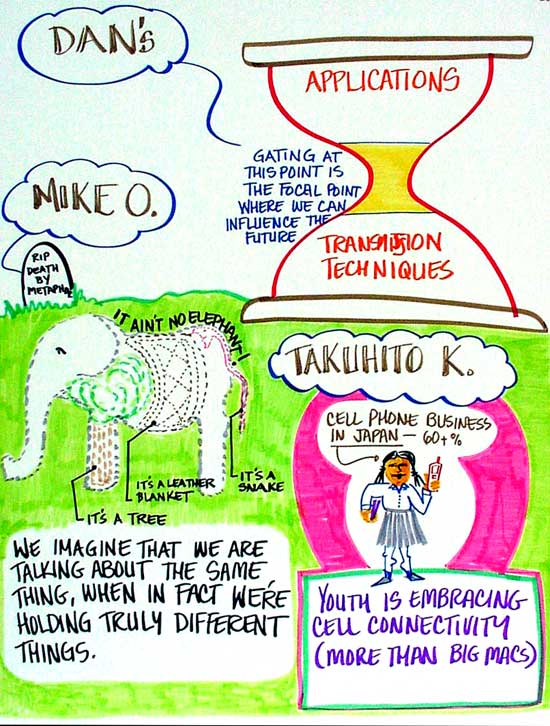 Dan:
I wanted to touch on the metapoints I was going to make. We talked about
the hourglass model of what a network is. The bottleneck of the hourglass,
the internet layer is really the control point so everything we might
want as a society from the network, is gated to some degree by the capabilities
of what is going on with that bottleneck. We need to think harder about
what we really want that layer to do. Can we do that with some future
internet protocol?
Dan:
I wanted to touch on the metapoints I was going to make. We talked about
the hourglass model of what a network is. The bottleneck of the hourglass,
the internet layer is really the control point so everything we might
want as a society from the network, is gated to some degree by the capabilities
of what is going on with that bottleneck. We need to think harder about
what we really want that layer to do. Can we do that with some future
internet protocol?
Dan: The internet we have today is designed to support what I call elastic traffic. The application on your computer will be looking for as much bandwidth it can possibly get. We have some kind of feedback signal saying you can have this much and no more. We want to be able to do is to have those 2 kinds of applications co-existing in the infrastructure.
Comment: It's a slippery slope you are one.
Dan: The disagreement we have 2 different kinds of applications? Is the disagreement that we can do it in the same infrastructure?
Comment: The net doesn't have to do everything.
Comment: I have not found an application that can do this.
Comment: The applications are taking an old view of the world.
Dan: Even the variable rate ones, you want to be able to express what you want from the network. Some applications will be very sensitive. You can make routing decisions.
Mike: The problem with all of this is everyone wants things to be different but no one talks about real behavior you can change.
Comment: If you have good caching at both ends, I'm not sure you need to.
Comment: That doesn't help interactive voice.
Comment: That's right.
Comment: It is true that if you can apriori claim some amount of bandwidth, it makes your job as an application easier. Making that claim has a significant impact on his network. I've run real time video games which are at the cutting edge of requirements. There's nothing inherent in the data when you analyze it from an application perspective. What is it that the user really needs? It is possible for any application.
Comment: Without being able to getting a busy signal, you can't guarantee service.
Dan: That's part of the model. A lot of the gaming community who started on the cable have shifted to the DSL because they weren't happy.
Comment: A majority of the games are written with a LAN mentality.
6. Mike O’Dell SpeaksMike: One of the things that has been going on here because some weird things are happening. I think it's death by metaphor. It's all his fault. He started it with the blind men and the elephant. The blind men have a hold of the same thing and don't know it. People have hold of different things and believe it is the same thing. It is a tree, a rope and a leather blanket and that is the reality. That distinction is very important. The internet is anything but stupid. If anyone had explained that this is what it would take back in 1980, everyone would have run away.
Mike: This notion of the religious pursuit of the stupid network puts you in great peril of violating Einstein's dictum which is things should be as simple as possible but no simpler. The analogy: building real networks…it is easy to make things work on the white board. On a white board, any physicist is a scratch golfer. To a theoretical physicist, golf is trivial. In the real world, the world is very uneven. To build real networks you have a lot of clubs in the bag. There is no one right answer for any question. There are certain right clubs to use based on the topography. Building and operate a big network is like having many people playing golf at the same time. You have a bunch of different technological tools for the net. The blind adherence to this notion that the only way to build networks is to stick glass in the side of routers. You don't want our airplanes stopping at all these different airports. The value of the plane is where it doesn't stop.
Mike: So, the world of building networks is more like playing golf. I don’t play golf but I hear that you use a bunch of different clubs for a bunch of different situations.
Bob: In the Cain Mutiny the lieutenant at one point talked with the ensign saying that the navy is a system designed by genius to be run by idiots.
7. Takuhito Kojima SpeaksTakuhito Kojima: Nice place, smart people, very good discussions. I used to be the responsible for the cell phone business in Japan. I ask, in Japan, why so many cell phones? There is rapid growth. These young people talk with their friends. We have so many MacDonald hamburger shops but now young people are buying more air time than hamburgers. What kind of smart people could anticipate this kind of thing. There may be a gap between what the smart people think and what the not smart people do. [laughter]
Mike: The thing that builds on that is that Nextell are running this system…in most of the other worlds, you can decide to use a cell or a pager…Nextell looked at how people actually choose to communicate. The reason Nextell is slaughtering their competition is they design based on how people actually want to interact. The integration of those channels all in one thing has enabled new ways for people to organize themselves which has been a profound change.
Jerry: So why isn't this group thinking about those questions this weekend?
Tim D: Next year's conference.
Comment: You need the top down approach to figure out what the network does.
No.
Comment: The Nextell model is bottom up.
Comment: It was serendipity…this was a byproduct of the implementation.
Tom: Let's look at what really happened with Nextell. There were a variety of implementation issues. They looked at what was emerging in cell. When we built it, we had no idea what it was going to be. That's what I am afraid of. If we sit down and limit the network to doing only the things we think of first, I guarantee you we will miss all the killer applications. We had no idea it would change communication patterns like it did.
Comment: Let's not complain about things that didn't work.
Roxanne: We live in a world of constraints. We won't get anything we want if we don't understand those constraints. They are technical and financial. There's also unintended consequences. Design to some level and then revisit for the next level.
Jerry: We are not collecting up what we know that have been insightful.
Tom: We have a word for good unintended consequences: serendipity.
Tom: If you shot every good engineer that ever had a failure, and never let him do another thing, we wouldn't have all of these inventions.
Tom: Unless you put together a network that can do as many things as you can think of, then you won't enable the potential applications that you don't know about.
8. David Weinberger Speaks - Value Free Network (Column)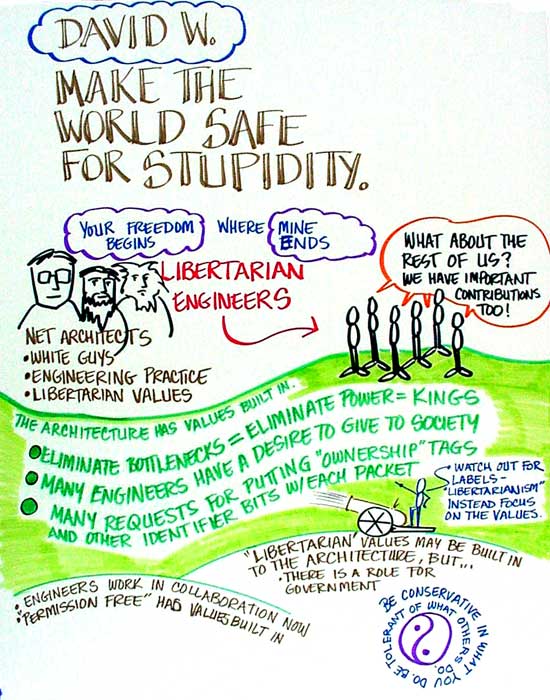 David
Weinberger: People are using different definitions of the network. I'm
in favor of using the more broader definition of the net. What sorts of
applications, communities, type of world we want to have are the relevant
questions.
David
Weinberger: People are using different definitions of the network. I'm
in favor of using the more broader definition of the net. What sorts of
applications, communities, type of world we want to have are the relevant
questions.
David Isenberg: Even thought the discussion has been useful, I'm upset that we haven't heard more from the social side of the house. We've heard some from the economics side. I'd like to hear more from the social scientists. I would even like to invite Mike to realize that are some other viewpoints. There are some really big issues that we could just as excited about and just as productive about that we haven't covered yet. I'd like to leave that on the floor time and get 3 min cards from people who want to talk about this. David Weinberger has the best newsletter of anyone here. And he's one of the most insightful people.
David Weinberger: I hate people who read things but I'm going to do it. This is a draft of a column. My aim in life is to make the world safe for stupidity. The interesting stuff is what you don't know. It is designed for people who are more like me.
(Note to the Reader: We received from David Weinberger and edited version of the column he read at the event. This version reflects changes to the column based on the feedback he received at the event.)
VALUE-FREE NET
[I've edited this column to reflect some of what I learned from Bighook's spirited (= the word "asshole" was used at least twice) discussion of it. In other words, I took out a distracting red flag after taking lots of lumps for it. - David W.]
The basics of the infrastructure of the Internet are all a matter of choice. Designed by humans, the standards and protocols necessarily represent human values. For example, the Net could have been architected to ensure that intellectual property is protected, that all interactions are tagged so they can be traced to individuals, so that some packets have priority and thus can be sold to those with cash to burn. (Actually, for the last named there is an unexploited Net capability.)
Who are the humans who make these decisions? Ultimately, it's a set of Internet "long beards" who generally share some characteristics: white, male,
Western, highly technical. Certainly there are organized opportunities for others to comment, but even though this lets in a somewhat more varied group, inevitably those whose comments count are also technically-minded.
There are some true generalizations about the value systems of engineers. We could argue for a long time about what precisely those values are, but they seem at least to have something to do with a belief in open communication and a preference for opinions that are fact-based. There's much more to be said -- and argued about -- but for now we only need agree that just as journalists tend to favor free speech and artists value creativity, engineers tend to share some values.
So, the most important artifact of human culture in decades if not centuries is being designed by a cadre of long beards who generally share some implicit values. Scary? Maybe. It turns out that while the guiding values have definite political implications, their justification are technical, not political.
I had a chance to talk about this with Scott Bradner, a literal Internet long beard, at the odd but charming "Big Hook" confab put on by David "Rise of the Stupid Network" Isenberg at Woods Hole, MA. We spent much of the weekend veering into technical minutiae (to which my contribution was to doze off quietly) while trying to come up with a way for the engineers to talk with the liberal arts majors. Scott admitted that the infrastructure is loaded with values. But, the check on those values is less the ability of outsiders to propose other values than the commitment of the designers to build a system that doesn't require modification to be extended and configured for particular uses. The designers' aim is to move packets along briskly while enabling you to add your layers of censorship or IP protection or multimedia streaming or pornographic body suits without requiring the Internet infrastructure be rearchitected.
Ah, but as Tom Lehrer once wrote of the German scientist who build rockets for the Nazis during WWII and for the US afterwards: "Once they go up, who cares where they come down ? That's not my department, says Werner von Braun." Lehrer's question holds for all technical and scientific endeavors: Is the supposed lack of values itself a value?
Of course. Just ask China or the Taliban or orthodox Jews or many Christian communities, all of whom see value in protecting the community from "assault" by temptations and other bad influences. Had the engineering principles that led to the Net's design conflicted with the basic libertarianism of its designers, it might well have been designed differently ... or at least it might not have seemed like such an exciting project to so many engineers. If the Net subverts the plans of the Taliban, the Internet long beards will by and large cheer. (As of course will I, but that is precisely not the point.)
So, while the values implicit in the architecture of the Net are, at least to a large extent, dictated by principles of efficient design, they simultaneously instantiate a set of political values generally shared by the engineering community. The most important "unintended consequences" of the Net -- a permission-free environment for creating and sharing information -- are in fact predictable, foreseen and intended. Ultimately, the technical community creating the Web cannot escape responsibility for the predictable consequences of the Web, even though this community often would like to hide from this by claiming they're just engaging in "good design." Comment: I'd like to know how many people here actually think they are libertarians? (a few)
(End of David Weinberger’s Column)
Comment: I think your concept is fascinating and don't forget the physical world does constrain us to a large degree so it's not that they have that much freedom.
Mike: The problem is that the state within the network grows polynomially with the size of the network. The work required to compute it grows even faster. If you want a big network then you don't get to put much into it. That's the tradeoff.
Dan: There are other architectures that have made very efficient use of information.
Doug: I'd like to give an example re: Nextell, there was an emotional appreciation of the beauty that was going on there by letting the suppliers communicate in that system. The consequences, however, are quite devastating. Lowest price wins out very quickly in this environment. People have to decide if they want to stay in that business or not. It is taking cost out of the system It is rationalizing it. The question is where does the profit go if the system is driving everyone toward low cost production?
10:08
9. Values Built InDavid Reed: I do agree that there are a set of values used in making these choices. I don't agree that it is necessarily libertarian. I don’t' think libertarianism is inherent in engineers. I suffer from the label but don't view myself as libertarianism.
David Reed: The overall desire is to not create bottlenecks. It is also an anti-power thing. I don't think the desire to eliminate power is libertarian. If you look at the history of engineers, almost all of the successful engineers have a tremendous passion to give something to society which is incompatible to libertarianism. So you can't be a libertarian and be a designer.
Scott: You talked about the fact that packets could have info about their content attached to them. Mike is right that this would be very difficult to do. It is not a hypothetical example. Disney wanted to put info in to suggest this is copyright material. Others have wanted to put an ownership tag on intellectual property rights. Others have wanted to put the name of the owner on the content of a packet. Even though this is hard to do, it is also a political choice as to whether to do this.
David Weinberger: We all know what the affect will be in gross terms on closed societies. If the net were being designed by orthodox Jews, who believe that gossip is a sin, etc., there would be different decisions about how to design the net.
The fastest widest network has implicit values in it.
David Isenberg: I want to call on Larry Lessig.
10. Larry Lessig SpeaksLarry: I have lived through the battles that come from a session like this. Here's some sympathetic criticism. You need to distinguish between libertarianism and whether the network has values. I agree that we need to discuss the values implicit in the net. I think engineers have given us extraordinary values designed into the net. Libertarianism says that governments have no role or minimal role to establish structures. That is distinct from the very strong points you are making regarding the values. Let's talk about: here's a set of value, let's talk about what the values are, and what can be enabled by embracing these values. What changes are happening to the networks.
Larry: Other people are placing technologies into the network that have different values. I don't think we get far by labeling these values Libertarian. All we do is get into a debate. I have fought this idiotic war. What we should be talking about the values. That is the debate that will be helpful. The world will instantly stop listening when we get into a debate.
David I: The libertarianism comment was an attempt to identify the values and that is the right focus as you say. I should say just buy Larry's book and don't lend it to friends. [laughter]
Jerry: This (column) will get out to a lot of people. It will influence peoples' thinking. You are tarring a lot of people with this label and they now don't want to talk to you. You are polarizing people in an extreme way. The mandate for the net was begun by the military. You make the stereotypical statement that engineers are geeks who work in isolation but they are working in cooperation.
David W: I will happily leave out the libertarian comments. But I believe there are values implicit in engineering.
Dan: Tell us please, how are we going to have this conversation about values?
David W: I don't know what to do about it.
Dan: What kind of structures do we have as a society to discuss these values underlying the network we want?
Comment: There is a lot of cooperation involved which means innovation across a wide base that doesn't require permission.
Comment: Permission free environment is a political topic.
Mike: Be conservative in what you do and be tolerant of what other people do. The premise is to stay out of the way. The result of that is it lets people who want to make different rules, go ahead and use it to do so.
Comment: I find this discussion trivial.
10:23
Christian: What you say about the internet being built by engineers is not entirely true. Not so much engineers as academics. Their main goal was to share information in a cooperative way. The design was done by the chief engineer. But the adoption of the technology was done by a committee that was much larger.
Larry: This is a critical point. What Christian is saying is important. As it moves from academy into the commercial world, there are a different set of values that are being imbedded. What is important to look at is what are those values.
David W: I disagree that the issue of value has been discussed.
Dan: Where do the values come that drive what we want for the next IP and TCP?
10:30 am Break
11:05 am
Bob: Welcome back. We had a spirited time in the last session. Before we begin, David has a presentation.
11. Awards CeremonyDavid Isenberg: We will break the award ceremony into 2 pieces. We have a fishing pole for the "best fishing". Of the people here, how many fished? (6) How many caught fish? (5) The one that caught the most was Skip (6 or 7). Anders caught the same. Anders caught the most unusual fish. We don't know what it is, not even Bob. We'll flip a coin between Skip and Anders. (Skip won.)
Bob K: We have about a half an hour to go through a few more 3 min. presentations. I have 5 more people that will go. We will start with the 1st 3.
12. Tom Petzinger Speaks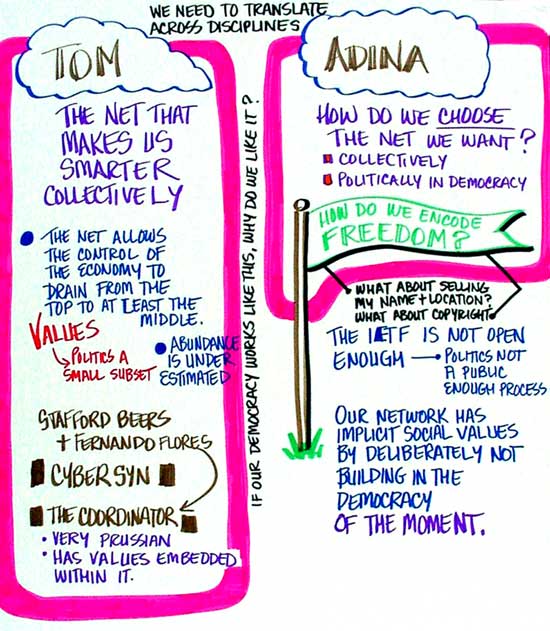 Tom
P: I'd like to talk about the future of the new economy. The net I want
is the one that makes us all more intelligent collectively. Decision making
used to be in the hands of corporate executives but now the decision making
has now been distributed across a large number of diverse agents acting
on the basis of local information. One of my scars was writing that recessions
are no longer inevitable. They certainly may happen but they aren't inevitable.
You no longer have a lock step march of decision makers as in the past.
Tom
P: I'd like to talk about the future of the new economy. The net I want
is the one that makes us all more intelligent collectively. Decision making
used to be in the hands of corporate executives but now the decision making
has now been distributed across a large number of diverse agents acting
on the basis of local information. One of my scars was writing that recessions
are no longer inevitable. They certainly may happen but they aren't inevitable.
You no longer have a lock step march of decision makers as in the past.
Tom: The moral of the story I am about to tell is that politics are only one small piece of what we call values. Fernando Flores at age 27 was the finance minister in the Marxist Allende government in Chile. He created the design with Stafford Beer for a system called cybersyn (synthesis). This was the Marxist government's way of linking all factories in a network and controlling & coordinating their production so that at any time the government would know exactly what output was and how to allocate inputs. Fernando goes to jail and studies the theory of speech acts. He gets out of jail and goes off to Berkeley and becomes a professor engaged in the theory of speech acts. Then he starts a software called the coordinator. It was the most Prussian piece of work flow software. There was no politics in that decision. There was no libertarianism or fascism but there were a lot of values inherent in the design of that software.
Comment: Are they still using that software?
Tom: Not in many places.
Comment: You should read his latest book.
[horn being blown by passing ship] Comment; Conference lost in fog. [laughter]
13. Adina Levin SpeaksAdina: When you talk about what the network is that we want, then how do we decide it and what are the structures to get us there? The values underlying are the freedom for choices. We make choices through capitalism to invest and decide how to spend our time. We certainly have private choices socially. Another dimension of what we want is getting together politically and doing it within democracy. We want to encode freedom. There was no association mention of democracy as our decision making model. We've mentioned a number of times the thrust to freedom at the bottom of the hour glass. This includes privacy, restriction of use of information, These are problems not encoded at the central point of the hour glass. Since democracy is encoded in our society, that might be one of the ways we get what we want. It could be a topic of conversation. We haven't addressed this so far.
Steve: I've enjoyed throwing bombs but I want to apologize. I do respect what Motorola has done. I do think the network will give us some things we want and some that we don’t want. But I want to address price. It applies to the engineering cost. It's to some extent a cost minimizing network. One of the things I believe is that over time, price and money costs will become a means of allocating network assets. I also believe this is inherently unfair and capitalistic. In some ways it is also communistic.
What you will have is an end-to-end price. Then I can securitize those prices. You can then sell that revenue stream.
Steve: The scary thought about pricing. When you go to Amazon, they look at a cookie and price it according to what they think you will pay. Right now we have a model in the stores that everyone pays the same price.
Comment: The airlines has the price different based on people.
Doug: Re: the discussion re: recession and Greenspan. There's a possibility that we could be in a recession and not know it. For example, we have 3.1 million in jail. 25% of all the people in jail are in the US. If you added them to the labor pool, we would be in a recession.
Doug: Another example, Greenspan says this is a non-inflationary time. In fact we are in a classic inflation. We are in a highly inflationary world. We can create a public image of what we are doing but not tied to any reality.
Tom P: I think we are understating economic growth by a large factor because of our metrics. Those metrics don’t begin to reflect the economy, to count the value creation. We have a cornucopia of goods. It is ghastly. Everyone is choking on stuff. The beer manufacturers increased the size of the case without increasing the price. Then they made the mouth of the bottle larger. Stuff/junk is stacked at the stores and in our homes.
Tom P: 1937 Theorem: in the absence of transaction cost there's no economic justification of the firm. The firm is essentially evaporating (the big firm). Why do we have firms at all, these gigantic vertically verticals. What he said was: "Because what I didn't realize was that as transactions decline outside the firm, they also decline within the within the firm. That's why we can have banks and other get like that.
David Reed: There's an interesting similarity about measurements. Tom says we are understating growth because we don't measure it right. Doug said that we are understating our problems because we aren't stating them right. I asked a similar question, if we have all of these phenomena are we applying the right measures to be able to control the economy. All the measure that we traditionally use don't make sense here. Is that good or is that hiding some huge problem that we don't see?
Scott: I want to talk about democracy as a decision mechanism for technology. It reminds me of the saying that science is too important to be left to the scientists. This is an important area. People say that the IFP decision making process is not open off because it doesn't involve the political sphere and the people who don’t know about it. Somehow we need another mechanism.
There are people who are saying that internet standardization would go under political control. We have talked about designing a network that has implicit moral values by not having any. By staying out of the way.
While I happen to believe in democracy, I don't believe the best solution for everything is the democracy of the moment. We have systems to override the democracy of the moment. I don't know how to do that in the technical sphere. Building the network has to involve the engineers. They can't ignore them.
Adina: Re: e-911 service where the phone company people are building out this service the revenue stream they expect is to sell my name and phone number and location to a marketer. If that's the case, why don't I have a property right on my location? The digital millennium copyright act which is a law that defeats any level of copy protection. We can debate the particulars of those issues some more, but I say they have a political dimension.
Larry: We are all raised to believe that democracy is at the core of what we do. We are all skeptical at the same time. I think we are at a moment where values are up in the air, getting coded, getting changed. We have no good social mechanism for thinking about this. There's something we need to do to get to an answer about this. We need to learn and practice in our own domains a way of discourse to talk across disciplines. We need to be able to translate across the disciplines. There has been some implicit economic speak here and some is bullshit and some is coherent. The fact that we find it is so difficult to talk across disciplines is a signal of why Scott is right that the level of democracy is hopeless.
Comment: I think that the risk we run is from these cataclysmic side swipes. The fact that we can't tell where we are in our economy is a problem. I don't know how we get together to involve society in these choices.
14. Acknowledging One Another David
W.: I made a rhetorical mistake but we had an interesting conversation.
I don't want to say any names.
David
W.: I made a rhetorical mistake but we had an interesting conversation.
I don't want to say any names.
Mike: Hey, I was the asshole, you can name me.
David W: It took a lot of heated useful conversation to get Mike to admit that actually when he looks at what he's done to advance the net, he sees it as good overall. It was a fucking good thing to do. We can't advance the conversation if one of the sides can't take the value stand that overall this was a good thing that we did. I want to thank you. Let's admit that and move on and make it a value statement.
Mike: Thank you. But, never confuse being smart with being lucky. Part of this conversation was how do I feel about all of this? The problem is depending on the day and what happened, and what part of the elephant last crapped on my desk, I feel very differently about it. [laughter] I've taken a very retreatist view because I don’t know how to cope with it. So while it is true that misguided people who think they are in charge on whatever front, can do a great amount of mischief, at the end of the day, nature neither seeks nor abides your opinion. It works from first principle. When you want it bad you get it bad and most people want it in the worst way.
11:37am
15. Jerry Michalski SpeaksJerry: I'd like to share an image of where the net might be in the future. Willhelm Godfried Leibnitz was probably the last person alive who could know all of his disciplines of his day. Then the disciplines went their own way. All of the disciplines are way past their maximum of separation. Leading authorities are now beginning to talk about the same phenomena but in their own language and history.
Jerry: What I like about this field is that there were people of different disciplines. Most everything can be explained if we can find the simple equations. We can then do a variety of things. The yin yang is the perfect diagram. We need to be able to hold paradox - east west, mystical and very fast things, male female. Being able to hold this paradox will help us stay sane. There are a serious set of values that have developed over time. Then technology came in as a tugboat. The internet is a series of technologies that will have a similar sort of impact.
Jerry: I don't like the hour glass model because it implies we have a bad bottleneck. I believe we are moving forward in the world where the superconductor will continue to exist 100 years from now but it might be legislated out of existence. If we could have this kind of conversation all over the world cross-disciplined we could make a difference.
Roxane: We live in a republic, not a democracy and that has impacts on how things work. The network we want is the one that helps us understand one another. [clapping]
16. The Network I Want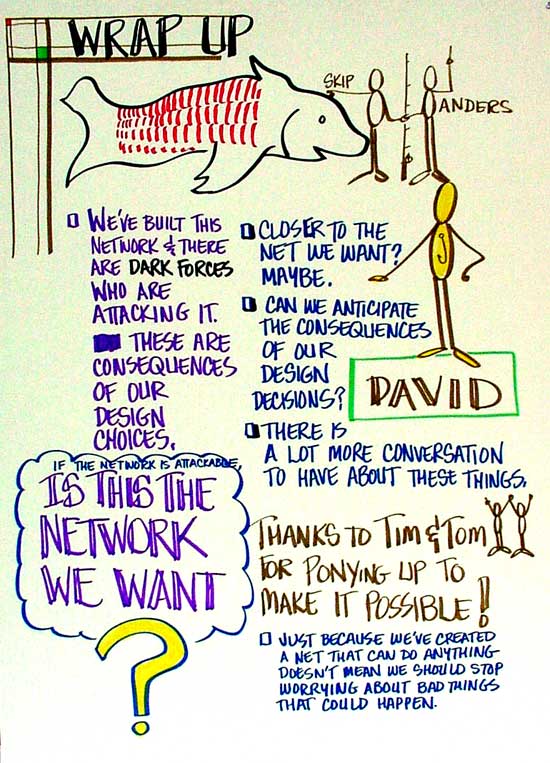 [David
I. quietly looking at the group]
[David
I. quietly looking at the group]
Mike: [to David] You will end up being insufferable. [laughter]
Ernie: But we'll understand you better. [laughter]
David: Thanks. This has been great.
I don’t' know if we are closer to the network we want. I think we understand the question a little bit better and the network we have a little bit better. I'm concerned that the network that many of us in this room have helped build, these people have poured their life into building a network that they saw was the right network to build, and by golly it is pretty darn good. But a network that allows bad things to happen, is that the net we want? Now, I'm into democracy and free speech but at the same time we have to ask ourselves as responsible individuals, can we anticipate some of those consequences? (We run the risk of the networking looking like the interstate highway system in the sense that we created design decisions that not only have great consequences but also undesirable consequences.) Maybe we can't but should we be trying to? I think maybe we should. To that extent, we've got a lot more talking to do. I think we'll do some more of this.
Comments: Good. Amen.
David I: It's been really good. It's been scary. I've been waiting for the disaster but it hasn't happened. Usually it takes me a week or two to understand what happened at any conference. This was not about a conference about technology. I can't extract key points so I won't do that. I am increasingly concerned that we have built this great architecture but the architecture itself allows the dark forces, the Disneys, the AT&Ts, the big companies that aren't necessarily going to be productive. Disney was an FBI informant against the people he thought were communists.
David I: The question is, we have this network that is attackable and perhaps even usurpable. That's a direct consequence of the architecture. Have we designed the network that we really want?
David I: I want to thank Tim and Tom for making this possible and all of you for making this possible. I have a few momentos to give out. As you can tell I'm making this up as I go along. The sponsors might notice that it's just scam to stay in the coolest house in woods hole, bringing in my favorite friends and musicians, go fishing, …
David: This is the network I really want.
[lots of laughter and clapping]
Comment: the truth comes out finally.
David I: I have Leo's badge from Telecosm I want to present it to Matt Oristano with deep affection. I'd like to present the 2 heresy awards to Dan Grossman and David Weinberger. Finally I have 3 other Joe Weed CD’s and the Colorado Quartet. They played in Woods Hole and they were perfect.
Dick Campbell made this CD. He has donated this. This goes to Adina. Joe Weed has let me use his music. CD’s go to: Doug Carmichael, Bob Berger, Kojima-san.
Now we come down to the real serious prize (the large fishing hook). I'm only going to give this to the recipient for one year and they have to bring it back next year. This goes to Mike O'Dell.
This is deep symbolism. You now have to go out and catch the big one. Thank you very much. [clapping]
 |
BigHook Main
BigHook2000 Recap Home | Context | Summary Fri Eve | Sat Morn | Sat Midday | Sat Eve | Sun Morn Photogallery | Scribegallery | Music isen.com, inc. | Sterling Insights Copyright 2000 isen.com, inc. |