 |
 |
|
|
|
||
|
BigHook2001
September 5-7, 2001 Woods Hole, Massachusetts |
BigHook
Home | 2001 Collage | Context
| Scribegallery
Wed Midday-a | Wed-Midday-b | Wed Eve Thu Morn-a | Thu Morn-b | Thu Midday | Thu Eve | Fri Morn
|
The
Boundaries
|
|
|
||
Session 1b: What boundaries? What network?
Wednesday, September
5, 2001
The first panel . . .
-
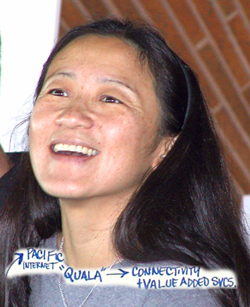
Gigi Wang, who is going to attempt to give the Asian perspective.
-
Malcolm Laws, who is responsible for global telcommunications publications at Advanstar, who is going to do the rest of the world.
-
Peter Cochrane is going to do the "what network and what boundaries" question from the longitudinal perspective because he actually strung wires on poles once not too long ago.
-
Andy Maffei is going to tell us about the boundaries of the network in the vertical dimension.
Peter Cochrane:
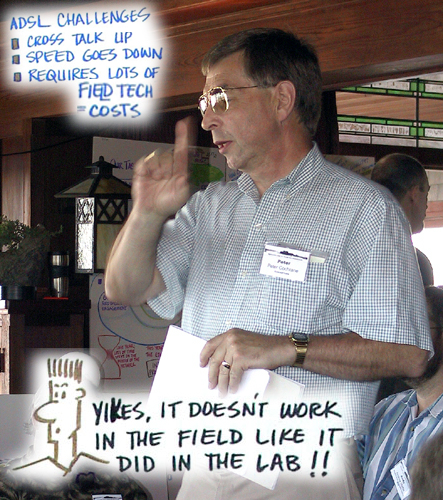
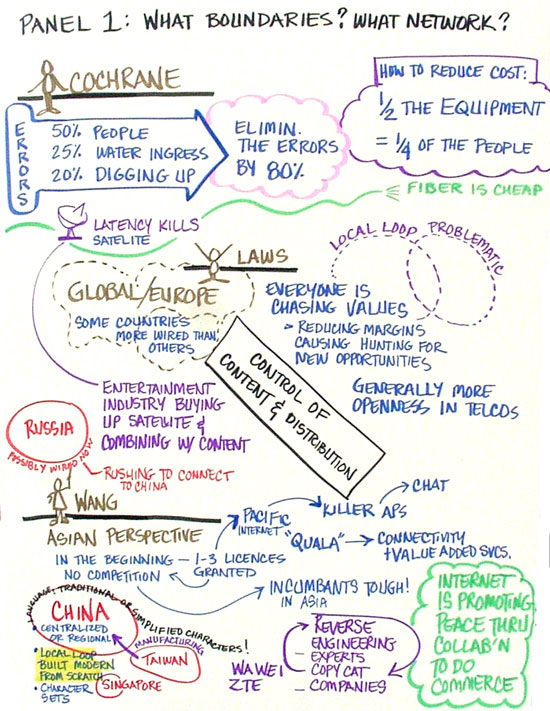
Here's an observation as to kick off this session. The number of faults
in a network is critically linked to the number of people. Get rid
of the people and the network gets more reliable. So how do you get
rid of the people?
Simple. When you have cooper, which by the way has to be totally eradicated,
it goes like this: 50% of the faults in the telco network get down
to the people that you employ. Another 25% of the faults in the network
at least are down to [water?] ingress. The remaining 20% or so, in
England are due to Irishman that dig up the cables, I don't know what
nationality (laughter). If we can get rid of the people and if we
can get rid of the [water?] ingress by using fiber, and you remotely
program a fiber network as opposed to manually programming a cooper
network, you can get the fault liability of the network down by 80%.
There is now another interesting law. It goes roughly like this: if you halve the [pieces of] equipment in your network, you need a quarter of the people. So if you do sensible things like say, "Well, in a given nation we have several thousand switches because the switches have to be in the centers of population because of the transmission and signaling throw of cooper," what would you do with fiber? You would pull back switching functionality, you could get away, not as in the UK where we have 6700 switches, but [with] 60 switches. Suddenly you tag that lot together and instead of having 242,000 people in the company initially, [or] 110,000 people in BT today, [instead] you'd only need 30,000 people to provide that network. The bottom just drops right out of the car.
Now there is another good reason for wanting to do all of this and especially when we get to IP networks-it is called latency, it kills you stone dead.
Satellite has
never and will never be a significant means of communications on this
planet. The latency kills you. You get at least 350 milliseconds delay
on any connection. Fiber across the Atlantic, 50 milliseconds delay.
Handset delay 140 milliseconds codec delay. What are we going to do?
We need to get our network down to about 3 hops. The network has to
be local looped and nothing else. The product becomes the local loop.
We can't do that because we have lit fiber, the ability to pull back
to a very few points, cook down on the latency and get tremendous
gain.
Right now there are some shocking statistics. Differences in countries
are very interesting. There is a big difference between Europe and
the US. Everywhere you go in the US you see wire strung up. You don't
see wire strung up in Europe by that degree. Everything is buried.
The installation costs are much higher but that hole in the ground
is the number one asset of the phone company and they won't relinquish
it. And they left it blocked with cooper so no one else can get at
it.
In Europe, over
90% of the fiber in the ground is not carrying traffic, it is out
there dark and in the UK something new over 85% of the population
live within 500 meters of an optical fiber. A good illustration, you
know, in this room we have the ability to bring down the slice of
network because we are a communication intensive group.
 Coffee
brings down networks every morning and afternoon in countries and
cities all over the planet. It goes like this, you get a conference
of 1000 people, everybody is listening to the speaker, 10:15 coffee
arrives, 300 of these (cell phones) come out and the network crashes.
That is a metaphor for what is actually going to happen as we start
to wear more and more of this technology. As technology starts to
come together as boxes dockside, at airports, in supermarkets or wherever,
we are going to find things coming together and people coming together.
The only solution I can come up with is to get the fiber into this
room, get a fiber into this locale and have micro and pico cells of
communication. It really is that dead simple. Fiber costs nothing.
It is the civil engineering that costs the money. In Europe the civil
engineering is largely being done because the holes exist. I think
that I've run out of time.
Coffee
brings down networks every morning and afternoon in countries and
cities all over the planet. It goes like this, you get a conference
of 1000 people, everybody is listening to the speaker, 10:15 coffee
arrives, 300 of these (cell phones) come out and the network crashes.
That is a metaphor for what is actually going to happen as we start
to wear more and more of this technology. As technology starts to
come together as boxes dockside, at airports, in supermarkets or wherever,
we are going to find things coming together and people coming together.
The only solution I can come up with is to get the fiber into this
room, get a fiber into this locale and have micro and pico cells of
communication. It really is that dead simple. Fiber costs nothing.
It is the civil engineering that costs the money. In Europe the civil
engineering is largely being done because the holes exist. I think
that I've run out of time.
Isenberg: I'm being a very strict time Nazi here. Who wants
to go next?
Malcolm
Laws: I think that David kind of set me up a bit. I will try
not to take on global-it is a bit too much. I will talk a bit about
Europe. You may or may not know much about Europe. Most of you have
traveled there. You know that at the very least that it is a complex
structure. There are 15 nations in the EU itself and a number of different
legislations and a lot of it overlapping.
Increasingly borders, boundaries, are breaking down, national and
ethnic, and reforming in different ways. This means that we have a
very fluid environment in which some countries and some parts of countries,
Sweden is a good example, are very advanced in their employment of
technology. Others that you might think should be advanced are not.
A lot of it comes down to regulatory and competition infrastructure.
And what is happening in Europe is that we have a traumatic episode
going on in the telcom industry. It is not just a question of margins
collapsing, of the Internet changing the way we do business in the
telcom industry. It is not just about 3G debt, which is haunted the
headlines in newspapers for some time. It is not just about disappearing
valuations and it is not just about falling CapEx.
Rather it is
about restructuring of the industry. In some ways I would suggest
in Europe it is slightly ahead of what has been happening in the US
with respect to the 1996 Telcom Act. The Act has at least introduced
the idea of competition but it hasn't been effective, certainly in
the local access networks.
In Europe we have tried to introduce competition in the local loop.
It hasn't work terribly effectively. But the result has been a more
dramatic collapse in the activities of the telcos themselves, so they
may be forced and in some cases already being forced into mergers,
consolidations, or disaggregations of their operations in a way that
is not yet happen to the incumbents in the US.
A good example is Sonera, the Finnish Telco, which is looking to basically
sell its network or it will sell itself. Then there is KPN, the Dutch
incumbent, which recently failed to merge with its Belgium counterpart.
In the UK, BT as a result of its debt load is trying to spin off its
wireless business, and it is not sure whether to sell off its own
network infrastructure.
Everyone is chasing value in this industry. We have heard about the
hardware providers and whether they've got a future. They are chasing
value and in other parts in the industry not just in hardware. The
system integrators are looking into chasing value in the network operations
arena. The network operators have seen their margins collapse are
looking for value elsewhere, the services to move up the value chain.
Man: Can you clarify what you mean by chasing value? You mean, looking elsewhere other than you use to have it or…?
Laws: As
margins have been reduced (basic bandwidth margins, basic voice services
margins) the providers of these services are looking elsewhere. So
we are seeing a shift and a potentially new structure of open networks
emerging in Europe. Now to some degree this has happened in the U.S.
But again the competitive paralysis in the local loop is calling that
into question. In Europe it is not happening not because the legislation
working, but because the incumbents are starting to feel the pressure.
That means there will be major changes in the way services are priced.
That is one of the issues I would like to address. What kind of model
are we talking for the industry? What kind of characteristics might
we be seeing? It is interesting that at the same time the telecom
operators are looking to disaggregate, separate their network from
their service delivery, the entertainment industry is doing the opposite.
Increasingly Hollywood is looking to capture the distribution channels
in this market. Satellite and cable operators in particular are also
looking to capture the content and distribution in the same chain.
So the industry is being ripped apart. Is this good or bad? Are we
going to in Europe enjoy a similar model to the US or are we going
to lag 2 years behind? Despite what I said, there is still a sizable
gap between take-up of services and Europe and in the US. US is far
more advanced. And can Europe listen to its consumers?
Man: I think that I missed a point [about the] move towards
more openness but Hollywood is doing something else . . .
Man: The entertainment industry, of which Hollywood is a part,
is looking to combine content with distribution. Hollywood is looking
to do it with its video business, which is out of its control. From
the cinema into the home, they need to grab that somehow. Satellite
operators want to control the content as well as the distribution
of their content. The whole Direct TV thing is a great example-it
is all about controlling access.
Man: It is sort of anti openness.
Man: It is anti openness, it is an economic necessity to those
business[es]. It is ironic that you see these things both happen at
the same time. Which approach is going to work best?
Gigi Wang: When I do this I want to open it up for people can ask questions, because it gives me more direction. I am the one representative from Asia here today. I'm curious, how many people here have actually been to Asia on something beyond vacation, where you actually worked? That is amazing.
Isenberg: Wow. How many haven't?
Wang: How
many of you know how to say thank you in Chinese? Oh, not bad. What
I'm going to do is just talk about just my experiences there, instead
of talking so much theory or so on, just what I have learned on the
ground there. What I started out in 1995 is I moved to Asia, I moved
to Singapore and just by a total fluke I had worked for only 6 months
with Bob here in the US at his ISP. When I went to Singapore they
had 1 ISP there, which was of course the Telco's and they wanted to
open it up for competition. So guess what, they give one license.
So let's give a second license, it is the Internet, right?
I got hired and I thought that it would be a part time job. I walked
in the office and there were 2 admins and I was the only person. I
was the expert now in the country. Things were really interesting
during that period. First of all, they created one license a year
after Singnet started, which is the telco one. That was ours, that
was Pacific Internet.
Then later that year they granted another license, so there were three
licenses for about 2 or 3 years, and they thought that was real competition.
I kind of laughed because I said, you know there are three here in
Singapore and you have 400 in San Francisco-you don't know what competition
is.
And so it was a real interesting environment. The government was really,
really supportive and they still do give a lot of subsidies to get
people on it. And you see a really high penetration of usage there
because the government really helps. You don't see the same in Hong
Kong and you see many of the Hong Kong leaders actually belabor that
especially the people who really support technology. They talk about,
gosh you know they wish that their government was a little bit more
supportive like Singapore so they would be as advanced. This is interesting
because I think that Peter was saying that he heard from some people
that Hong Kong was actually more advanced than Singapore. I haven't
found that to be the case because the government is much more supportive
in Singapore. Who was the person that said connectivity is the driver?
I disagree with you but I didn't hold up my red card.
Reed: Connectivity. I want to be very clear, I don't mean connectivity
as in bits. I mean connectivity as in the ability for me to communicate
to you, that kind of connectivity.
Wang: But you know, back to what you said about cars. A car
is not the application.
Reed: There wasn't a killer app for the automobile. There wasn't
a single reason that people bought them, automobiles, other than vehicles
to go someplace.Wang: I think there were many, many killer apps rather
than just one.
Man: There was not **a** killer app . . .
Wang: But what we did find in Pacific Internet was that there
were really separate killer apps for each target group. We went to
each target group and created a killer app. And what was really interesting
was when we first started Pacific Internet we thought, "Oh there
is no way that we could compete with the Telco, but we are just going
to try. and the way that we did it was by finding killer apps for
each of the markets. In 6 months we actually caught up with Singnet
who had been in business for 14 months longer than us. So it was really
finding applications. For teenagers, they were all in chat groups,
all these girls from Singapore were flirting with the guys in the
UK, that was the biggest application in that group. And so a couple
of things, so those are just starting observations and maybe some
basis for some future questions and discussion.
Man:
Do you think that China can [???] by virtue of having a enough infrastructure?
 Wang:
Oh yeah! If I have enough time I will get there. Fast forward, what
I wanted to talk about earlier is . . . 5 years later I got recruited
to go back to Singapore to start another service provider which is
Qala, which stands for Quality Agent, Local Access. Qala is probably
is going to close its doors, if not it is just going to sell its customer
base to existing services providers. We learned a lot this year, you
know we came out of the gate and people offered us 60 million dollars
in funding. We said no we are only going to take 12 because we are
going to build value. Now we are begging for 20. Anyway, the things
that we learned is that we started out as a organic broadband service
provider. We learned that connectivity is not it, you have to do value
edit services because it was such a commodity. Things that we learned
is that we couldn't build a network fast enough so we resold.
Wang:
Oh yeah! If I have enough time I will get there. Fast forward, what
I wanted to talk about earlier is . . . 5 years later I got recruited
to go back to Singapore to start another service provider which is
Qala, which stands for Quality Agent, Local Access. Qala is probably
is going to close its doors, if not it is just going to sell its customer
base to existing services providers. We learned a lot this year, you
know we came out of the gate and people offered us 60 million dollars
in funding. We said no we are only going to take 12 because we are
going to build value. Now we are begging for 20. Anyway, the things
that we learned is that we started out as a organic broadband service
provider. We learned that connectivity is not it, you have to do value
edit services because it was such a commodity. Things that we learned
is that we couldn't build a network fast enough so we resold.
And we learned that the incumbents are really, really nasty. They
did all sorts of tricks, wouldn't sign agreements, so we couldn't
get revenue, couldn't do our business models.
Just one last thought. I don't think that incumbents are that bad.
I've fought incumbents several times. We always say, we know it better,
but we really don't know, and we really actually don't have the infrastructure,
we don't have all those years of experience. I fight all the time
with Bob about Microsoft. You know something better than Microsoft
Office?
Man: Office isn't the issue with Microsoft.
Wang:
Well, he and I fight about Office. We use it and there are a lot of
problems but give us something better. It is the same thing with the
incumbents. We cannot live without them. And until we actually do
something better we shouldn't say it.
Man: I mostly agree with what you are saying but I don't agree
with the idea that you can't have a better Office. We cannot have
a better Office unless there is competition. If there is no competition
we will never have a better office.
Wang: I had some China stuff. You guys can ask me later about
China stuff.
Man: How about China? (laughter)
Isenberg: Let's hear from Andy Maffei and we can get back fertilizing the ground for future discussion. Andy what is your fertilizer?
Andy Maffei: OK, I have to get my thoughts together. I seem to have spent most of my time helping people get their network cards up and running. There is a lesson there someplace, but I'm not sure what it is. If we walk away from this conference we have to take that lesson with us somehow.
What I'm going to do for you is just to describe a project in oceanography. I'm not quite sure how it fits in, but I'm sure it fits in. This is doing it underwater.
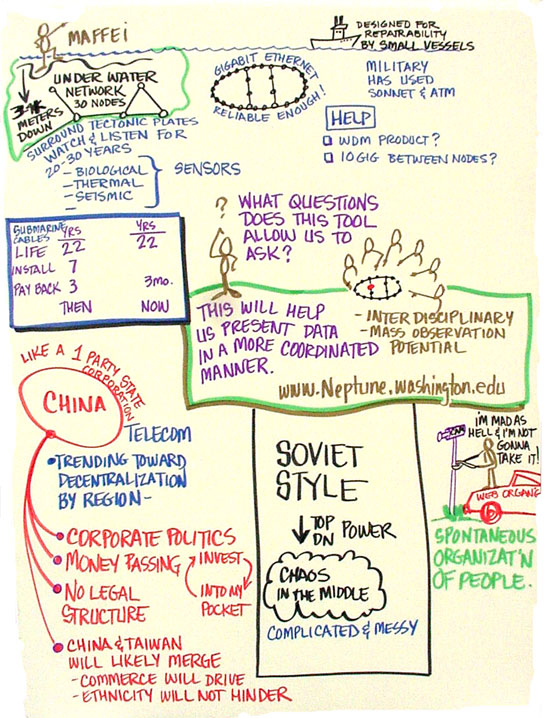
There is a project
in the Pacific Northeast, a joint US, Canadian project to install
a fiber optic network that will encircle the Juan de Fuca tectonic
plate. The idea is to deploy thirty nodes under water, down 3 to 4
thousand meters.
Man, incredulous: Thousand meters?
Maffei: Yes, in the Pacific Northeast. The design for each
of those nodes will have Gigabit Ethernet switches in them.
So there is the solution, but I need to go with the problem first.
The problem is that the way that oceanography is done today is that
you take a group of researchers and put them on a ship and sending
them out for 30 days, they follow a cruise path collecting information
with sensors and robots and all sort of things but you get that one
time slice and that one space, that one line that goes around.
Or you have a buoy that is placed out in the middle of the ocean that
either sits in one place or it drifts around a little bit and you
have sensors attached to that. Or perhaps you have satellites that
are looking at the surface of the ocean and getting those first few
millimeters of the ocean to analyze.
But to really understand the oceans and how they work what you really
need to do is to expand your temporal and special dimensions. You
have to be able to take a chunk of ocean and look at it in a decade
type time series. That is what Project Neptune is proposing to do,
to put this fiber optic network in and have it last for 20 to 30 years
and run an Internet on it.
Man: What sensors are you actually deploying?
Maffei: Many, many different sensors, there are many applications
that, first of all along the tectonic plates the spreading zones are
where we have these hot vents, with the biological communities that
are there. NASA is interested in those actually in terms of when they
send a ship to Europa and start looking for life, there is a lot of
evidence that says that life began in these locations. They want to
know how to go look for it. You also have chemical sensors, seismic
sensors, acoustic sensors, all sorts of sensors.
Man: Is it going to be connected to the rest of us?
Maffei: Yeah, it will be connected to the rest of us. The idea
is that the submarine cable system has 2 shore points, 1 in Canada
and 1 in the US. It will be connected to the Internet with appropriate
firewalls.
Woman: PrimalOoze.com
Maffei: One of the stories here is that when the first design
went out we were talking about going with SONET. When you take a submarine
cable system and look at the commercial stuff that is available to
build one, it is basically SONET-based using WDM. We began to think
that if we made it Ethernet based, can we make this network reliable?
It doesn't need to be reliable as a the telephone system, it doesn't
have the same requirements, but can we make it reliable enough that
it will be worthwhile? We talked about the 10 times factor. When you
take a look at the two technologies, SONET verses Gigabit Ethernet
backbone, you [pay] 10 times less to build a network. And we actually
convinced ourselves that the reliability would be adequate.
Man: Why 30 nodes?
 Andy:
The 30 nodes-the distance between the nodes is 100 kilometers because
that is the distance that you can repeat the Gigabit signal. As it
turns out those are actually 30 scientifically interesting nodes.
You go along the edges and there are also bore holes in the middle
so we have a couple of legs that run between, so we have an oval with
2 legs running through it with those nodes-it just turns out to be
the right number.
Andy:
The 30 nodes-the distance between the nodes is 100 kilometers because
that is the distance that you can repeat the Gigabit signal. As it
turns out those are actually 30 scientifically interesting nodes.
You go along the edges and there are also bore holes in the middle
so we have a couple of legs that run between, so we have an oval with
2 legs running through it with those nodes-it just turns out to be
the right number.
Cochrane: I can't think of anything on a telemetry project
that would get me to think in terms of sonet . . . why would you even
consider sonet?
Man: The vendors would say this is the only thing that………integrated
cables and power systems………..you go to Alcatel, or
you go Cable & Wireless and you say we want you guys to deploy
this . . .
Man: The major difference is that the SONET [requires that]
you have all your transmission facilities and mux facilities on shore.
We are talking about putting switches down, down below so that makes
it….
Man: Can you put new sensors down and hook them up automatically
to the existing net?
Maffei: We already do that. There is an observatory installed
on the coaxial submarine cable that runs between the US and Hawaii
halfway between-it is called the H20 system. It has a junction block,
and we routinely go down with a remotely operated vehicle and plug
and unplug sensors into it.
Reed: You know you should look at something that Peter knows
about, which is that there are ways of coupling off of fiber into
short distance RF. Certainly you can't make that go through the water
very far but if it means that you don't have to have a plug . . .
Maffei: In fact, we have an inductive Ethernet that we use
for our [??], our [???] underwater vehicles, with docking stations
that we do with inductive Ethernet.
Man: May I challenge on the that? It may be a slip of the tongue
but I would have thought that the maximum depth that you are looking
at would be sort of like 6 miles or 10,000 meters.
 Maffei:
For this area, my understanding is that it is 3 to 4,000 meters in
depth.Man: Is there a network run by the military in the same area?
Maffei:
For this area, my understanding is that it is 3 to 4,000 meters in
depth.Man: Is there a network run by the military in the same area?
Man: There
is the SOSUS network. There have been all sorts of questions about
the military in terms of submarines and sort of thing and when you
get to the close up level there is a lot of concern about that. When
you go to the higher levels of the Navy they said that there is not
really . . .I haven't been [involved]
Man: I know that there is a pretty large acoustic and seismic
network that they put in place, so they had engineers that did it.
Man: It is the only place in the world where there are no real
estate issues.
Maffei: Getting ashore can be terrible. There has been a huge effort put down in permitting for the shore stations, a lot of advance work on that. I just have a few questions-things that we need help with. We are interested in reducing our fiber count between nodes, so we would like to find a WDM product that can transmit the multiple gigbit path between us. We are also interested in whether we can use 10 Gig between the nodes, whether the technology is going to be there for us. You know one of our big problems is just putting these things in pressure housings, they have to be small.
Cochrane:
Can I ask you a really dumb question? You are doing telemetry here.
This is all low bit rate stuff. Why are you going so fast?
Maffei:One reason is video. But even with that it is overkill.
We are also are talking about a 30 year time scale.
Man: Watch it. The reliability lifetime of systems goes down
rather rapidly with speed. The commercial undersea systems are guaranteed
for a 22 year life with no more than 3 failures that are electrical
or optical over a transatlantic distance.
Maffei: One of the differences in this system is that we are
designing it so that it is repairable, so that a small ship can go
out and life up a node and actually replace the electronics.
Man: All of the systems are like that.
Maffei: They require a cable ship though, which is very expensive.
Man: 30 years doesn't exist in this business.
Man: In 30 years people won't know about Gigbit Ethernet or
anything.
Man: If it is one tenth the cost that we are otherwise looking
at, why not just deploy one system and keep the savings in the back
pocket and when it goes to hell just replace the whole damn thing?
Man: It doesn't work that way.
Man: If it is cheaper, do the same thing that people do with
pencils, use them until it works and then throw them out.
 Maffei:
Well we are trying to build the modules, the pressure housing so that
we could actually replace the electronics. What we would hold on to
is the fiber.
Maffei:
Well we are trying to build the modules, the pressure housing so that
we could actually replace the electronics. What we would hold on to
is the fiber.
Man: Another way of saying that is put two of them down at
the same time if the cost is labor and run them independently. Don't
connect them together. This is what people do.
Maffei: Is it OK to connect, to bring the fiber is up to a
housing and it has the raw fibers in it, you say don't even put the
fibers together.
Man: If you connect the two independent systems together, it
is reliability engineering, one can impact the other.
Cochrane:
When I got in to the undersea cable business, we were putting in new
transatlantic cable in every 7 years. The lifetime was 22 and the
pay back period was like 3 years. Now you have a very interesting
situation where the pay back period is 3 months and 1 year from now
the next system that goes in is 10 times bigger than the one that
you just put it in but the lifetime specification is still 22 years.
Eric Best: I'm marveling at the deep insatiable curiosity of
human beings. That is something that the Internet wants to be-an instrument
for the fulfillment of insatiable curiosity. I'm curious to know what
you can ask because of this technology that you couldn't have asked,
and therefore you wouldn't have thought to ask, but now you are thinking
to ask?
Tom Freeburg: Every time anybody in human history has put together
something like that and people have asked the questions, in 10 years
we found out what the questions were and they weren't any of the ones
that we had thought of.
Maffei: One of the motivations for the Neptune project is that
the science has to drive it. When we get funding from the National
Science Foundation, the scientists drive it. There is a feasibility
study has been published, there is a Neptune site, you can go and
read it. There is a lot of science behind it.
A lot of it centers
on the interdisciplinary relationships. Now that you can study biology
and chemistry and this physical phenomena and the seismics, you will
begin to notice the relationships. There has been some speculation
as to some experiments along those lines.
There is this other problem in oceanography, a hidden agenda for the
past 15 or 16 years. People go out and get data in a myriad of different
formats, and then it gets stuck under desks and no one ever sees it
again. Or it gets written up once and it just sits around. This is
true of many sciences but in oceanography it is an even greater problem
because it is so varied in all the sciences that it deals with. So
one of the hopes for something like Neptune is that once people start
connecting up to the same networking, you set standards for data delivery.
By making it easy for people to do that, you have a chance that you
might have compatible formats for this different type of data.
Adina Levin: Have you been talking with people whom the GIS
systems when they are working on Internet standards for differently
source GIS data? [GIS means] Geographical Information Systems; people
have been working on Internet standards that take fish data, water
quality data, and air data taken from different places.
Maffei: There is a lot of work in oceanography on Geospatial
Data Systems and I don't know who it is coordinated with, but there
are a lot of people looking it.Victor Blake: The problem is, I mean
you put this whole thing in now and none of those problems will be
solved. It is all about software. It has nothing to do with how big
a network that you put in. It is the same reason that huge carriers
can go out of business-it is just a bunch of wires if you don't do
anything with it.
Cochrane: I think there is a key driving point, which is hidden
here: none of these disciplines talk to each other.
Man: People who use the word 'grids' are talking about these
kinds of things. I forsee that very soon science is going to be done
by lots of different people, so that experiments involving mass observation
-- 10,000 people participating or 5,000 people participating-are going
to change how science gets done, and what questions start to be asked
and answered. I imagine that some quite shocking questions are going
to be asked and answered by people using mass communication.
David Reed: I have one question, why only 30 nodes, why not
like 3000?
Maffei: There would be a different architecture.
Isenberg: David Reed for NSF director!
Reed: Remember I said that my question is always scalability,
why can't you scale them up to ……?
Man: . . . very expensive
Man: You could consider this a prototype.
Man: [But] if you are building the railroad then you should
be building the highway system . . .
Man: Can I give you an answer? The torpedo-like housing that
you have to make to withstand the pressures are nominally expensive,
like a quarter a million bucks a piece.
Man: Build a network with only 30 torpedo-like nodes and build
3,000 connections into it, how much for the interface for the connection?
Let high school and college students around the world . . .
Maffei: The URL for Project Neptune is www.neptune.washington.edu
Man: Can we go back to China?
Wang: It is pretty funny that I'm actually from Taiwan, I was
born in Taiwan. So it is interesting going to China. I visited a friend
from College. He was the assistant to the Ambassador and he actually
wrote the apology letter [for the U.S. airplane that collided with
the Chinese fighter and made an emergency landing on Hainan Island].
So I went to visit him in Beijing, the week after that. Now whenever
I go to Hong Kong immigration it takes me 10 minutes instead of 1.
OK, American citizen, Chinese from Taiwan, interacted with the Ambassador
or something . . . I think that they really watch closely, it is still
very much a police state.
A couple thoughts
about China: all the people in Asia right now, it is like everyone
is just headed towards China. Singapore's economy is going down because
Singapore is such a copy-cat-they don't do anything on their own,
they support everyone else. So if the US is going down, Singapore
is going down. Taiwan is loosing all of its manufacturing now to China.
The semiconductor stuff, there is a whole group of business men in
from Hong Kong and China who are basically trying to create the Taiwan
Silicon Valley. Taiwan had all of the semiconductors; they are doing
it right around Shanghai. And even the Taiwanese people who own the
factories in Taiwan are jumping on it too cause they are trying to
fight it.
Man: Is this because of labor rates?
 Wang:
Yes, labor rates, primarily because Taiwan is really expensive. With
regards to telecom, everyone is also seeing the growth rates in China.
This year it is up to a 26 billion dollar market. For those people
who are in networking equipment, how many of you have heard of [Quaway???]?
[Quaway???] is the largest networking equipment company in China and
they are basically trying to . . .
Wang:
Yes, labor rates, primarily because Taiwan is really expensive. With
regards to telecom, everyone is also seeing the growth rates in China.
This year it is up to a 26 billion dollar market. For those people
who are in networking equipment, how many of you have heard of [Quaway???]?
[Quaway???] is the largest networking equipment company in China and
they are basically trying to . . .
Man: They go from 0 to [manufacture] in 6 months for any kind
of wire line equipment.
Woman: And then [???] is the second company, and the third
company is call ZTE. Keep your eyes opened for that one. They are
all trying to come to the US. So what you are going to see here is
the network equipment companies are going to do the same thing the
modem manufacturers did in Taiwan. Once they redevelop the technology,
Taiwan started copying and shipping much cheaper stuff here, and they
are doing the same thing. I don't know if you guys went to Interop
or Supercom but Quaway had a humungous, humungous [booth] and they
are starting to hire all of these PR [people].
Man: Just to add on to that, it also happened to PBX's in China.
They brought all the foreign PBXs, and reverse manufactured. Everybody
in China just buys Chinese PBXs now.
Woman: A little anecdote, going back in history: when I worked
for Pacific Bell in the early 90's there was a company, I won't mention
names, and they showed us where they wanted to put ISDN lines and
T1 lines. It was really high security going into this room, and they
just figured that they were just telco service reps, and we wouldn't
know what they were doing. They were trying to copy Sun servers. This
was in [silicon] valley.
Man: What is the fixed line penetration in China?
Wang: I don't know, I can't tell you off the top of my head.
Man: 30%?
Man: Less than 10 %.
Man: It is dominated by mobile phones.
Woman: Yeah, mobile phones are what is growing.
Man: But even in the West it took a 100 years to get 28 million
phone lines. In the UK it is taking 11 years to get 45 million mobiles.
Woman: Isn't that what happened in East Germany?
Man: Yes.
Man: Can I give you a little anecdote about not China but Russia.
The Soviet Union didn't have a good feeling about radio stations-BBC
and all that-so they forced wiring for radio in every single building.
Scott Bradner: A totally different side of the problem: I spent
a week in Taiwan a couple of weeks ago. One of the big issues there
is character sets. The mainland Chinese Government has declared that
they own the Chinese language on the Internet. It is a national sovereignty
issue. There are huge problems with the internationalization of domain
names and content. The Chinese are particular worried about the fact
that you can the same name appearing not just in different character
sets but different sets of characters. [There can be] entirely different
words meaning the same thing. They want it automatically translated
in the DNS. It is an incredible mess. It is something that is affecting
their Internet.
Man: This will slow them down then?
 Bradner:
It will just confuse the hell out of them. It means that they are
playing higher-level politics trying to accomplish technology by pressure
rather than logic.
Bradner:
It will just confuse the hell out of them. It means that they are
playing higher-level politics trying to accomplish technology by pressure
rather than logic.
Man: Super!
Isenberg: Actually it brings up the whole issue of the viability
of the DNS system which . . .
Man: Yes, let's discuss this because………
Isenberg: Well that will come up, I'm sure.
Man: What they want to do is not DNS, they want to stick a
glob the size of a hotel in the side of the DNS and call it the DNS
and make a directory look up system on the side of the DNS.
Wang: One little thing that I actually didn't realize this
but I learned in the past year is that China and Singapore use a simplified
Chinese. Hong Kong and Taiwan use Classical Chinese, which is a lot
more involved.
Man: They both using both.
Man: It is called Traditional and Simplified. The Chinese Government
has mandated Simplified but in reality a lot of the Traditional is
still used. In Taiwan the Traditional is used a lot. The Government
says it is good because it tweaks the mainland Chinese Government.
Both environments need them both. They want to be able to put in,
the domain name in using Traditional or Simplified and automatically
find the same place. But there are 10 different ways to say the same
word in Traditional and one way in Simplified.
Man: Just one observation on China, the authority in control
diminishes experientially from Beijing. 100 kilometers away from Beijing,
the government doesn't exist.
Man: You mentioned the question of whether it is centralized
in Beijing or perhaps provincial. Back quit a few years ago when AP-NIC
was worrying about providing IP addresses into China, the provincial
governments wanted sets of IP addresses, and specifically argued that
Beijing shouldn't. There was a fight between the central government
and the provinces over getting IP addresses.
Isenberg: Roxane. Ladies and gentlemen, meet Roxane Googin
who was here last year, who actually was the strongest pessimist in
the room [saying that] the economy was heading for a train wreck.
I don't know where she got that idea. Anyway Roxane, your question?
Man: If you tell us where the economy is going this year, it
would be pretty helpful.
Isenberg:
Tell us if we're at the bottom yet, please.
Roxane: One of the things that we spoke about optimistically
was how the Internet could possibly foster world peace through communications.
I mean literally. So what is the Internet doing between Taiwan and
China? Is it helping or hurting?
Man: It is helping. The businesses that you just mentioned,
the new Silicon Valley outside of Shanghai, is largely funded by Taiwan.
The Taiwanese network managers in the Taiwanese NIC and the Chinese
NIC are working very closely together. There is actually fostering
a lot of communication, there is a lot of direct connections between
them over the Internet, though the fibers don't go directly, I don't
believe.
Man: But I don't think that the Chinese army really cares about
communication, they want to control the world.
[Groans]
Wang: It is actually very interesting talking to my friend
that worked for the Ambassador because I met up with them before the
[Hainan] incident and he was saying all these positive things. He
is like, yeah! They are really progressive, the leaders, Jiang Ze
Min is really cool, bla bla bla. And then right after the incident
he is like, they are all crooks, I can't wait to get out of here.
Man: Basically the Chinese want the whole world to be speaking
Chinese and they want to dominate the rest of the world.Wang: Not
everyone. It is such a diverse country; it is so different . . .
Man: It is a police state. It is a totalitarian, power hungry
police state.
Man: It ain't that simple.
Man: It resists easy characterization because one of the biggest
economic players are the members of the Army working on the side.
So to suggest that the Army and the mechanism of the state is somehow
totally separate from their economy underestimates the degree to which
[the situation] is a big fat ball of spaghetti right now. There is
no one strand. You can certainly find people within the government
who would love to expand and take over Taiwan immediately, but you
can just as easily find people who want to see entrepreneureal zeal
unleashed, even within the context of a police state. I wouldn't over
characterize the Army as having one motive. They are so integrated
with the economy right now in ways that you don't see from the outside.
Man: Even though they have been told to back off.
Man: Yeah!
Wang: Here is a thought about China, there is a VC, Walden
ventures, Walden International. One of the guys there in Walden in
Hong Kong, one of things that he said which really struck us was,
"I've been going to China for the last 20 years, and each time
I go I learn more and then each time I go as I learn more I realize
how much dumber I am." And that is the thing about China. It
is so big, so different, and we just know bits and pieces and that
is it, but no one really has a total grasp of how everything works
over there.
Man: Are you telling us that China is foreign?
Wang: Is foreign? Yeah, it really is!
Man: Do you know the latest trick that they do? CSFB hosted
a conference for Taiwanese officials, [and the Chinese government]
banned them from doing any business in China? They threw them out
of the bond offering and told them never to . .
Man: That
was because they hosted a meeting with the Taiwanese leadership, which
was a really stupid thing to do. I mean, it is shoving it up the mainland's
nose and they sneezed.
Man: Getting back to the telecommunications systems, because
that seems to be one of the reasons we are together, what about the
telcommunicatios in China today? How is competition developing in
China, for instance?
Wang: There is a lot of money there. They are effectively decentralizing.
I think it looks like it is getting stronger. Each of its regions
is making its own decisions. Here is a really interesting story that
I heard:. Some big city in the Southern part of China had all these
switches. They had a Siemens switch, they had an AT&T 5E, they
had a Northern Telcom, they had like 8 different switches in the same
city. We are going, that is really dumb because it makes it that much
harder to operate, right? And then what finally came out of it was
the fact that the local government or local person that was choosing
the switches chose a different switch so that he got 8 trips out of
China to go to each of the locations.
The decision making is getting decentralized, so instead of trying
to conquer the whole world, some of our strategy is to go locally
and buying good connections and do one area at a time.
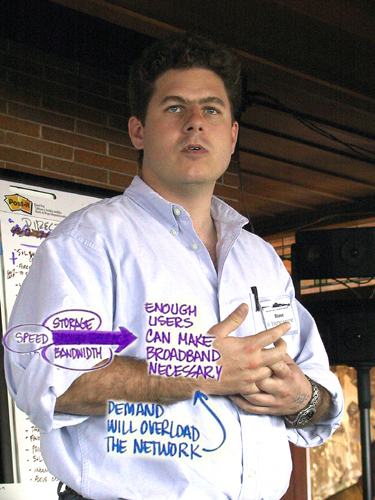 Stephen Kamman: I try to cover that market because I try to
figure out who is selling into it. Also, my father is a diplomat,
so I spent most of my life outside the US. Most of you who have worked
in a large corporation and can conceive of the idea that you would
have 6 different projects, all working on the same issue under different
people with different agendas, each trying to propose their own different
solution. So rather than seeing China as a one-party state, the best
way to look at it, (having spent 7 years in Russia too) is very much
like a major American corporation.
Stephen Kamman: I try to cover that market because I try to
figure out who is selling into it. Also, my father is a diplomat,
so I spent most of my life outside the US. Most of you who have worked
in a large corporation and can conceive of the idea that you would
have 6 different projects, all working on the same issue under different
people with different agendas, each trying to propose their own different
solution. So rather than seeing China as a one-party state, the best
way to look at it, (having spent 7 years in Russia too) is very much
like a major American corporation.
There is only one leader, there is only one party line, and then within
that there are a lot of competing agendas that still get worked out
but they get worked out in terms of that weird political stuff that
we go back to our offices every day and deal with. What is going on
in the telcom section right now is that there is the regulator out
there who's got his own pet telcom that he is trying to protect. Then
another ministry like the railways, I think, got control of rights
of way and tried to build another telcom. And they have been battling
each other for ages. The provinces are out there busily trying to
build local loops.
Man: Well we also have our friends in the Army, also trying
to . . .
Kamman: The Army was backing the railway company and then they
pulled the Army out of business. Legally the Army doesn't do business
anymore. (a) Think of it in the context of corporate politics. Bob
in Sales is fighting Jane in Marketing and that is literally what
a lot of this is about. (b) Think of this like Tammany Hall -- I don't
want to do telcom because it is a great way to employ a lot of people,
throw some money in the ground and a lot of it bleeds out the other
end, back into my sons pockets. (c) There is no coherence, the damn
country is too big. Everybody out there is just trying to get their
little piece of nut.
Man: What is the legal structure and how is that involved .
. .?
Kamman: There is no legal structure. It is the guy who happens
to be . . . Man: There is no legal structure in a corporation. It
is whatever Jack Welch decides this week to the extent that Jack Welch
can force his lieutenants . . .
Isenberg: One of the most powerful observations that I've heard
of about existing incumbent telcoms in the last couple of years, is
when Larry Lessig called the incumbents Soviet style. In fact what
you are saying is exactly true about the competing interests and the
chaos, in part due to lining their own pockets or accrete power to
themselves. There are 6 different hot projects that spring up. One
year it is IP Telephony, the year before that it was telemarketing,
and the year before that it was who knows. I just want to reinforce
that this is so absolutely true . . .
Man: And China is no better or worse.Isenberg: True. The Soviet
style is this single party, top down, chaos in the middle, kind of
thing.Man: That is where we all work everyday!
Man: It is not just China and Russia and the RBOCs. I worked
for a very progressive company, America Online. It is a big corporation
like any other and it is exactly what you described. People always
wear at least 2 hats, if not more. You are taking care of yourself,
and your family and your corporation. On any one day you pick your
agenda about what you want to do. When we go to professional conferences,
we each get to pick what conferences we want to go to. Sometimes we
go for our company and sometimes we go because we want to check out
Woods Hole. If anybody denies that they're not being truthful with
themselves or the rest of the world. But there is nothing wrong with
that. It is complicated and messy and it is hard to predict. When
you come to conclusions about China, you are going to end up with
an Internet just like our Internet which is just a bunch of shit that
is a big mess.
Shirky: I want to invite a little geopolitical speculation.
You have heard a lot about decentralization, regional control. Control
falls off as you move away from Beijing, the mountain is high and
the emperor lives far away. Can China, as the country exists now,
survive the Internet? Or does the ability to operate regional power
centers and have communication autonomy mean that in a post-Communist
world China has become several separate states?
Wang: In China, other than a few areas like down near South,
people don't have that desire to break off. I mean, there is a very
strong sense of, I'm Chinese. It is always power of the group. Even
thought I'm from Taiwan, ever since I was little, my dad told me "you
are Chinese, one quarter of the world is Chinese."
Shirky: That sounds more like an ethic identity. Would you
be happy to see Taiwan swallowed by the current government?
 Wang:
Scary thought, don't tell my dad I said this. Actually I always thought
so since I was younger. But dad if we are Chinese, how come we are
not with China? We should be part of them.
Wang:
Scary thought, don't tell my dad I said this. Actually I always thought
so since I was younger. But dad if we are Chinese, how come we are
not with China? We should be part of them.
Man: Talking
with a lot of Taiwanese, I would assume that it would never be a thing.
They all assume that China and Taiwan would be united. Some Taiwanese
feel that it would be under their control.Wang: The politicians are
trying to keep it separate, not the businessman.
Peter Ekelund: I work for a gentlemen who father and son are
rather a famous Scandanavian packaging company. This was in the '80s.
It was still the Cold War out there and he had a very simple rule.
I think that all Western businessmen should take to his advice, which
was that even Communists should pay their bills. That usually makes
them honest. It is when they are not paying the bills, which has created
all kinds of financing schemes.
Jonathan Thatcher: I would like to take a slight tangent just
for a second on communication. Talking about Taiwan, talking about
China. Yet one language is written in most of Asia, certainly spoken
is different. Malcolm you were talking about cultural differences
in Europe. I'm really curious. I haven't been out of the United States
for a number of years. From an outsider's perspective, how is the
Internet changing international communication? Is it hanging the way
people behave? In mainland China, is it taking power out of [the hands
of] those who want to control all communication or limit communication?
Or in Russia? What is happening with that?
Wang: At least in Singapore it did. When we first started PI
there was only one ISP. We had meetings with the regulatory board.
They wanted us to route all the traffic through one central point.
There were always discussions on that. Oh yeah! It was great! They
handed us a list of 40 web sites that we were suppose to restrict.
There were 3 young guys in their 20s who checked out those sites and
gave them to us. They had the best job in the country! Now they've
stopped restricting it so much. We ran everything through a proxy,
but I notice that the new service providers don't use a proxy anymore.
It is like they have given up on trying to control it, and it has
really opened up communications a lot.
Man: They just closed down 3,000 ISPs.
Woman: I thought it was Singapore. They are going to try and
do it but they are going to find out that it doesn't work.
Anders Comstedt: Maybe Peter would know more about this. I
know from Russian friends who are oil tycoons in Russia [who have]
pipes all across Siberia, that there is a big rush from the Russian
side to connect China, to [route IP] traffic through this. They are
building fiber around this oil pipe across Russia. Apparently now
there is only one connection going to China.
Bradner: There are a number of connections, but they all have
to go through China Telecom.
Man: And Russia is trying to get in on them.
Bradner: This is a control issue.
Man: There is only one connection because the Chinese only
want one connection.
Bradner: They want one connection-it is the Great Firewall.
Man: This is just a funny aside. I heard on the radio last
week that the Taliban in Afghanistan wants to restrict access to the
web. The announcers were laughing. They said that nobody in Afghanistan
has access! What are they worried about?
Man: There are some satellite connections in there despite
the claim that they are never useful.
 Cochrane:
I was wondering if I could give you one extra example from Europe
that I think is going to spread. It started off in France and then
the British emulated the experience and it was about gasoline prices.
We are talking $4.50/$5.00 per gallon of gasoline so the tax is huge.
The population of taxi drivers, lorry drivers, where it was very punitive,
got together on the Web, they spontaneously embargoed all shipments
of gasoline and diesel oil from any of the refineries. This brought
France to a standstill. They brought the UK within a week of starvation,
where food couldn't be supplied. Tony says, "I'm sending the
troops in." Everybody disappeared with a notice left behind,
[saying] "We'll be back, we flexed our muscles." Now the
new target is speed cameras. In the UK, they decided that if they
deploy, 35,000 speed cameras on the road, they can make a really good
business. You can go on the web, you can find where the speed cameras
are. Now there are groups organizing themselves at 3 o'clock in the
morning and they are going out with pipe cutters. They just lop down
dozens of the speed cameras. They only cost about $35,000 pounds to
put up, $50,000 dollars. We get groups of people who get really pissed
with the police and they go out and lop off these speed cameras and
they don't put them back up again.
Cochrane:
I was wondering if I could give you one extra example from Europe
that I think is going to spread. It started off in France and then
the British emulated the experience and it was about gasoline prices.
We are talking $4.50/$5.00 per gallon of gasoline so the tax is huge.
The population of taxi drivers, lorry drivers, where it was very punitive,
got together on the Web, they spontaneously embargoed all shipments
of gasoline and diesel oil from any of the refineries. This brought
France to a standstill. They brought the UK within a week of starvation,
where food couldn't be supplied. Tony says, "I'm sending the
troops in." Everybody disappeared with a notice left behind,
[saying] "We'll be back, we flexed our muscles." Now the
new target is speed cameras. In the UK, they decided that if they
deploy, 35,000 speed cameras on the road, they can make a really good
business. You can go on the web, you can find where the speed cameras
are. Now there are groups organizing themselves at 3 o'clock in the
morning and they are going out with pipe cutters. They just lop down
dozens of the speed cameras. They only cost about $35,000 pounds to
put up, $50,000 dollars. We get groups of people who get really pissed
with the police and they go out and lop off these speed cameras and
they don't put them back up again.
Man : So everything should be on the web!
Cochrane: So it is a very interesting and subtle breakout of
civil insurrection against things that the population don't like that
the government is doing. And I think that we are going to see more
incidents of that actually happening.
Tim Denton: Someone asked about the effect of the Internet
on cultural policing. I was born and raised in Quebec, in Canada's
and North America's authentically fascist state, Quebec. Where the
tribe is good and the non-tribe is bad. Where English language publication
is officially restricted and suppressed. These are just legal fact.
I was in a crowd for a weekend conference with French Canadians. The
discussion of the effect of the Internet was really, really interesting,
because the Internet has just got around all Federal and Provincial
barriers. Kids are getting on the net encountering the fact that so
much is in English. If people want stuff in French, they can. Nothing
prevents it. And it was being discussed in this crowd as changing
people's attitudes towards language. It was from a kind of badge a
tribal identification to just, this is a medium of communication,
just relax and go with it. So for whatever it is worth and Richard
probably can confirm or contradict, here's the hearsay evidence I
got last year.
Richard Prytula: We have 2 different things going on. You still
have the situation 5 hours north of here in Quebec, where there is
no Bell Canada, there is Bell Ontario and there is Bell Quebec. And
the 2 networks are separate. And they are separate because Quebec
could separate at any time. When it gets nationalized they want to
get the dough off it, OK? And so you have 2 extremes. You don't have
to go to China, you can just go 5 hours North of Quebec.
Best: I'd
like to add a footnote on how the Internet has changed the International
discussion. At this meeting in Sweden last week there are 2 observations
that apply. One is that Manual Castells is making his point that in
terms of reaction to globalization, it is organized in and around
the Internet where it can be both global and local and it doesn't
self-destruct by bringing all of the elements together in a single
place. His point was, if you get everybody who cares about an issue
together in one place, they fall fighting but if the people agree
with each other, can find each other in an benign environment like
the Internet, they can then organize around their agreement. And a
Swedish woman underscored this later was saying that the world has
never been homogenous, but that people are finding it much easier
to disagree with whatever they want to disagree with and they have
the channels for it. As she was saying, how am I going to be represented
at a global level if I don't wish to be represented by a national
identity but my opinion. She wants to be represented as a woman, as
a young woman, as an independent thinker, whatever. And I think there
is something about the atomization of being, of individuals who can
then come together in this different way, concentrate a view, and
then make it known from channels of vulnerability.
Man: There are two things there at the same time. One is what
you are describing and the anti-globalization riots in Genoa-and there
have been some demonstrations elsewhere in Europe. There are international
groups that mobilize and they use the web quite effectively. At the
same time both in Germany and in France are the examples of legislative
attempts to restrict access to the web. The very famous examples in
Germany are Compuserve's Managing Director being locked up because
pornography being available on the site. In France Yahoo is selling
Nazi memorabilia and now has been prevented from doing that. So there
are 2 things going on at the same time.
Man: They gave up.
Man: They
gave up but they led the attempt by the French still stands and they
are still insisting . . .
Man: And the Italians . . .
Man: That judge in fact announced just yesterday that he is
going on and taking additional cases.
David Reed: But I think this is interesting. I come at this
having formulated Reed's Law. I am focused on this. Those are not
contradictions. The ability to form active groups, whe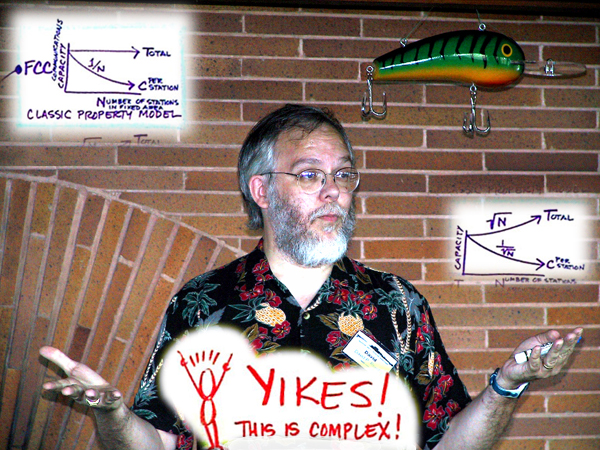 ther
good, bad, related, opposing, is much richer and we are seeing all
kinds of that. What has gone away is the notion that you are part
of what Vonnegut called a Grand Falloon, which is, Hoosiers, people
that think that they have something in common but really don't, you
know like Chinese. Actually Chinese do have this family structure
so they are different than the people in the US who have really nothing
but geography to unite them.
ther
good, bad, related, opposing, is much richer and we are seeing all
kinds of that. What has gone away is the notion that you are part
of what Vonnegut called a Grand Falloon, which is, Hoosiers, people
that think that they have something in common but really don't, you
know like Chinese. Actually Chinese do have this family structure
so they are different than the people in the US who have really nothing
but geography to unite them.
Steve Kamman: At some point I wanted to go back to Anders question that I left. We've got a blank slate when will build fiber to a neighborhood and use wireless from there. I wanted to ask that question at some point, if you gave me a large country, how would I build fiber on, if I just have 100% mobile telephony and when I use data on wireline networks. That was one question that I wanted to ask. On the other side, this is an interesting conversation. Maybe we could go back to it.
The next thought
is on group forming. One thing that I wanted to point out is we talk
about all these people getting together and fighting globalization,
or whatever, they are all using email, there are not using the web.
Maybe I find it through a web site. But all that communication is
not going through the web. They are going through email, they are
using the Internet and they are using one application that everyone
keeps using. This is Reed's Law but it using email which has been
around for years.
Reed: Well actually it has started to use things that are much
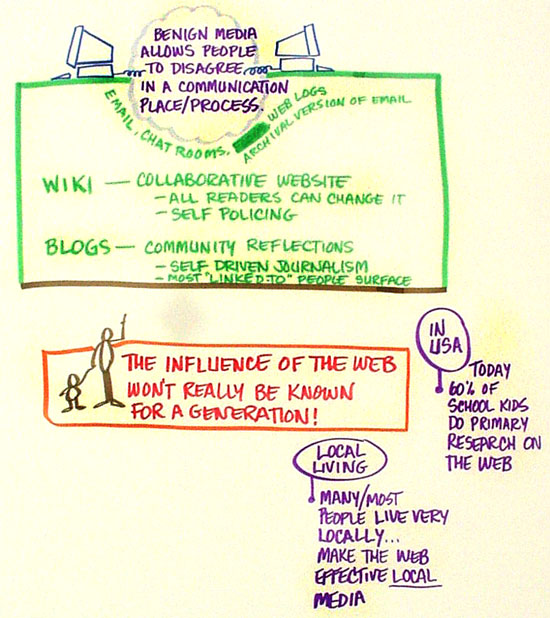
different than email in the sense that they are like chat rooms or
they are like wikis or they are like instant messaging or blogs. Blogs
are like moving out in this civil discussion very rapidly.
Man: Can somebody explain blogs?
Shirky: Think of it as a personal diary on line. The weblog
software makes it really easy to continue posting snippets sometimes
very heavily linked, snippets of what you did today, something interesting
that you found or whatever else and the web log organizes it by stamping
it with date, who posted it and so forth. Unbelievably simple technology.
Man: Why should I care? Cause it seems to be a hot thing and….
Man: The Internet wants to be Narcissus' mirror.
Reed: Actually it is. The best way to think about it, is that
the linked form of blogs, which is when people constantly post a stream
of commentary and links to other things that are being constructed,
like other blogs, what that causes is a more archival version of email.
So if there is some conversation about a revolution in China or one
of Peter's things, the organization around destroying the GATT community,
then you can go back and find other people that have the same opinions
you do even if the reason somebody linked is because they disagreed
with somebody. It is much more social.
Isenberg: No, I want to ask Pete, what is a wiki, and how is
it different from a blog, and how many people have heard of a wiki?
OK, what is a wiki and how is it different or similar to a blog?
 Peter
Kaminski: I wish I had a shorter URL for my wiki. Maybe we could
send that out. A wiki is a collaborative web site in which anybody
who comes to read the web site can change it. There is typically very
little access control and very little structure around who gets to
change information, so information can change pretty fluidly. So you
get a community that gets built around information instead of around
the people that form the group.
Peter
Kaminski: I wish I had a shorter URL for my wiki. Maybe we could
send that out. A wiki is a collaborative web site in which anybody
who comes to read the web site can change it. There is typically very
little access control and very little structure around who gets to
change information, so information can change pretty fluidly. So you
get a community that gets built around information instead of around
the people that form the group.
Isenberg: In an era of viruses and hackers, why is that good?
Hack attacks, why is that so….anybody can change….
Man: Interestingly enough the community ends up policing itself
. . .
Woman: How do you spell it?
Man: w-i-k-i.
Man: It is a Hawaiian taxicab basically.
Isenberg: Bob has been burning with a question.
Robert Berger: The thing about the blog, why we care about
blogs, or why you should care about blogs, is because it ends up as
a community. One person posting his journal on the web is not interesting
at all, but what happens is you get a community of blog readers. Everybody
reads everybody else's blog and wants to get mentioned in somebody
else's blog and it turns into kind of a one to many email conversation
where you are potentially emailing people in the future that you don't
know that you are talking to yet.
Man: I would like to suggest another reason blogs are important,
which is that in the same way that in 1994 about 99% of the web sites
were badly scanned photos of peoples cats and lists of their favorite
band, with 1% of the web site for Yahoo, blogs have further lowered
the threshold to the writable web. What we are seeing is 99% Narcissus'
mirror and 1% really interesting self-driven journalism that comes
from an access that you could not have predicted and once you discover
it, you cannot not go back and look.
Bob Lucky: This is a comment from 10 minutes ago.
Isenberg: It is clearly important!
Lucky: One of my great disappointments, and I just have to
exude my frustration here, is that we are discussing how the web changes
the world, how it changes the psychology, how people get together
and disagree and stuff like that. And we did that for 5 years and
now suddenly it has gone out of favor. People are saying, "Hey
that didn't happen, you guys promised all this world changing stuff
and you are a failure." And I think that it is one of the things
that we have to confront at this meeting. You guys love to talk about
his stuff but the world has resisted all that stuff. Governments didn't
fall, the barriers didn't come down, none of that stuff that you said
was going to happen, democratization of the world . . . They say,
"It didn't happen," and I would like to put the issue on
the table.
 David
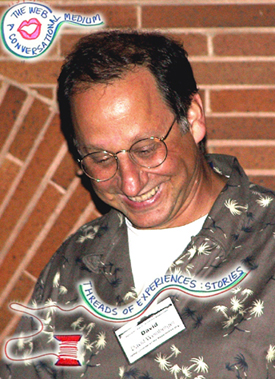
Weinberger: Yes, that is true. But this is a generational thing
so we can look at how the Web has change our attitude toward global
politics, but what actually counts is what it is doing to our 8 year
olds, who get to go on Amazon, read other people's reviews without
regard to nationality, and to joining communities, finding people
with similar interest without regard to political boundaries. That
is not going to have an effect for another 20 years at least. In a
bigger but similar sort of way, you can compare blogs to guitars 30
years ago, when everybody learned to play guitar. How many people
in this room can play guitar? How many people were at the first Woodstock?
OK, I'll be quiet. Pretend everybody here plays the guitar. It is
the wrong crowd….well can anybody that plays guitar write Perl?
[laughter]The guitar was the democratizing instrument that drove down
the quality of music except for the 1% who . . . we are two months
into the guitar revolution with blogs . . . and we haven't changed
the world [yet].
David
Weinberger: Yes, that is true. But this is a generational thing
so we can look at how the Web has change our attitude toward global
politics, but what actually counts is what it is doing to our 8 year
olds, who get to go on Amazon, read other people's reviews without
regard to nationality, and to joining communities, finding people
with similar interest without regard to political boundaries. That
is not going to have an effect for another 20 years at least. In a
bigger but similar sort of way, you can compare blogs to guitars 30
years ago, when everybody learned to play guitar. How many people
in this room can play guitar? How many people were at the first Woodstock?
OK, I'll be quiet. Pretend everybody here plays the guitar. It is
the wrong crowd….well can anybody that plays guitar write Perl?
[laughter]The guitar was the democratizing instrument that drove down
the quality of music except for the 1% who . . . we are two months
into the guitar revolution with blogs . . . and we haven't changed
the world [yet].
Man: This whole blog thing, I don't know if you know how Goggle
works, but when you type in 'the economist' it gives you the economist.com,
the magazine, not 10 million sites about economists. It looks to see
how many other sites link to this site. The way they figure out whether
scientific papers are important is how many other people's sites link
to them. The thing that is interesting in this blogging thing is,
in theory, that if lots of people start blogging then you can find
the most important people in the world by figuring out who is most
linked to.
Man: Most popular….
Kamman: Why do I want to be on the right blogs? Because it
creates truly global status that can translate into monetary gain
and then you can say we have changed society.
Man: So these are all mini killer applications.
Thatcher: To a degree we are going back to my comment earlier
that raised the red flag about the fact that the existing web is pretty
much useless for me as I look to go get information. There is so much
information available and the number of hits on Google are so large
that it is almost impossible to find specifically what I'm looking
for. But in the midst of that chaos, what we are talking about is
people are finding ways to create applications, own wikis, own blogs,
call them whatever you want that is starting to organize that chaos.
I would argue right now, not necessarily effectively but hopefully
over the next decade or 3 or 5, in a way that becomes more effective
and more natural so that everybody can find the things that they are
looking for in an intuitive way and get to the information they are
really interested in, rather than the information they are not interested
in.
Man: You have to change your intuitions first.
Man: I don't argue, we don't even have the tools yet and I
think that the tools are going to be coming.
Reed: I am responding to Bob's thing, not directly to the blog
thread. So some of you guys are looking forward as to what might change
the world. But there are some things that are substantially changed,
not just politics. You notice the case that in the US some large percentage
of school children, probably 60% or more, do all of their primary
research on the web. And more importantly, this is accepted and encouraged
by their teachers as opposed to discouraged. And so something big
changed there.
Man: And they are doing it collaboratively. My daughter has
6 I.M. messages up as she is doing it, logged in with her friends.
Ekelund: I'm sure that is all right but I must confess I am
a bit skeptical. People, the vast majority of people, in any given
country live very local lives. I know in the United States you move
around quit a lot, far more than any other people in the world. But
most people live very locally. In fact when I had a High School class
reunion, well over 70% of the people still live in exactly the same
area. I think that is one of the challenges that if you are going
to make the Internet with all of the possibilities and I don't disagree
with that, but if you are going to spread into the big [world] then
you better make sure that local . . .
Freeburg: Two quick points. I went to the same kind of a class
reunion but after I got done finding out that I was the only member
of the High School class that ever lived outside of the borders of
the US. Then I asked about the kids. Every one of them have a much
more global sense. I'm sorry it is too late for us to learn. And back
to Bob Lucky: I'm sorry we have changed the world. The WorldWide Web
and the Internet have changed society and we haven't recognized a
lot of it.
Lucky: What I'm saying is the perception is that we didn't.
I mean if you read the popular media these days . . . there is a story
in The New York Times just last week about how people aren't browsing
the web too much any more. I agree, we have changed the world but
the perception is you guys didn't change as much as you claimed you
would and you are a failure.
Man: This struck me a couple of weeks ago, the front page of
the San Jose Mercury News had a column that said broadband uptake
declines dramatically. And you look at the graph and the graph is
going down and you go, shit people are logging off the broadband?
I cannot believe that! I looked at the caption on the thing, and it
is the derivative.
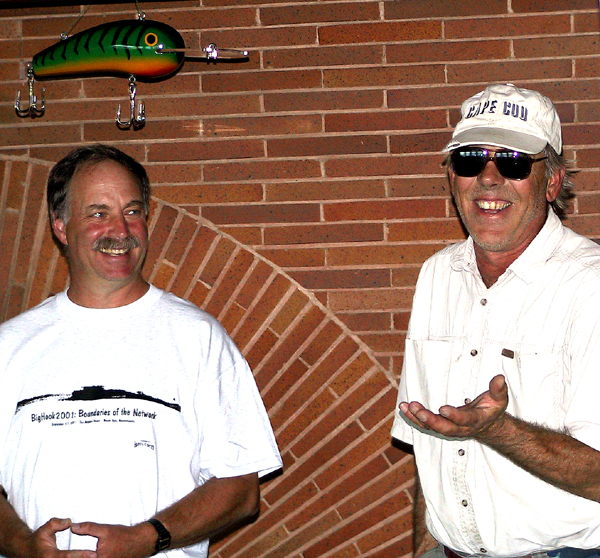
Isenberg: You were looking for bad news! OK let us cut it off now, we are almost ready for dinner. Before we go, let's get off of this telcom thing and on to the important thing, fishing!
I want to introduce Bob Suitor. Bob is the Big Hook fishing guide in residence.
Suitor:
Any fisherman from last year? This year you might catch something!
Isenberg: He caught some last year, that is not true! If you
are a novice, if you have never fished, if you want to learn how,
if you don't know how to cast, if you don't know how to tie a lure
on a line, he is your man. If you know how and want to catch a big
one, he is your man.
Woman: How about if you don't want to?
Isenberg:
If you don't like to, he is not your man!
Suitor: This is only for a select group who wants to fish,
who enjoy it. Dave can tell you that you shoulda been here last week.
Isenberg: Fishes witching hour is between sunset and dark usually
or between first light and sunrise.
Suitor: The dawn patrol sometimes did pretty well, I mean,
we are up just about dawn til, what time are you serving….
Man: Breakfast you mean?
 |
Isenberg:
Breakfast is at 7, I think. So there is enough time between dawn
and breakfast for fishing. You can even fish and miss breakfast
if you are really into it. Now everything is here between 5:30
and 8:30 PM, so there is enough time for the fishing, for eating,
drinking, socializing, etc. The bar is opened as of right now.
Music!
|

Page
last modified: November 13, 2001
(return
to top)

|
BigHook
Home | 2001 Collage | Context
| Scribegallery
Wed Midday-a | Wed-Midday-b | Wed Eve Thu Morn-a | Thu Morn-b | Thu Midday | Thu Eve | Fri Morn |
