|
Session
3b: Architectures of Innovation, continued
Thursday, September
6, 2001
David Isenberg: It occurred
to me that in the last session Tom Freeburg was saying to Larry Lessig
that just because you can't find them [on-line music traders] doesn't
mean that they're not out there. We have an alien in our midst -- one
of those great musicians that the recording industry has been totally
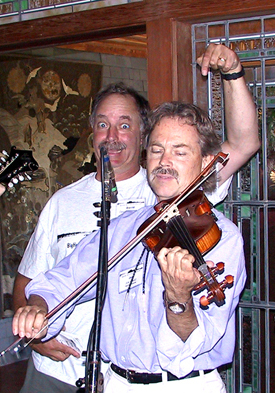
unable to find. That's Joe Weed. Joe is not only a musician, he's also
a record company owner, a producer, an arranger, a recording engineer
and a studio owner. Joe, do you want to say a few words?
Joe Weed: I don't know how relevant my experience
will be, but because David's a good friend, I'd like to share a little
bit. First of all I do have my own independent record company. My experience
all my life has been marginalized from the centralized big four or big
five.
Every musician that I've ever worked with or known who's
been involved with those big five has regretted it. I've spent 30 years
in the music business. I don't have a single acquaintance who has done
well as a piece of fodder of the majors. So that's point number one.
Point number two, we've been talking about Napster
a lot today. I write a column for a bluegrass magazine and was railing
about Napster, especially last summer in July when we the Erie Canal and
went into a little coffee shop one morning and read about the injunction.
And wrote an article for the magazine about Napster. And then I realized
that I've never even done this. So I said, before it disappears, it is
time for me to learn about Napster.
 So
I downloaded Napster on my Mac. The first thing I noticed was that I had
to sign an agreement that I would never give it away, that they owned
the software, that it was proprietary. I could never share it, re-engineer
it, or make copies of it. So that seemed to me to be patently illogical
based what they were trying to do with my and everyone else's music. So
I downloaded Napster on my Mac. The first thing I noticed was that I had
to sign an agreement that I would never give it away, that they owned
the software, that it was proprietary. I could never share it, re-engineer
it, or make copies of it. So that seemed to me to be patently illogical
based what they were trying to do with my and everyone else's music.
I just produced a new album called Swannee and everyone
here is welcome to have one for free. Fortunately the NY Post gave us
a very nice review on the third of July, the day before Foster's birthday.
Stephen Foster was born July 4, 1826, the day the U.S. turned 50, the
day the founding fathers Thomas Jefferson and John Adams died. Foster's
music survives to this day. Many of us think of it as folk music, but
he's the guy that wrote Oh Susannah, Camptown Races, Hard Times Come Again
No More and Way Down Upon the Swanee River.
Stephen Foster died with 38 cents in his pocket in New
York City's Bellevue hospital on January 13, 1864. ASCAP was founded on
January 13, 1914, specifically to honor Foster. They chose the 50th anniversary
of his death to say never again shall someone who can create this wonderful
material for our country die with 38 cents in his pocket. 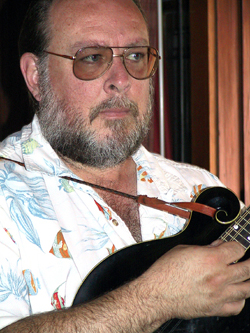
Most of you have heard my music. I would assume a large
portion of you listen to NPR. Morning Edition and All Things Considered
like to use pieces of my first album, Waltz of the Whippoorwill for their
snippets between stories. Unfortunately, BMI, which is a competing organization
to ASCAP worked out a deal with NPR where NPR can use our music for free
because it gives us "exposure."
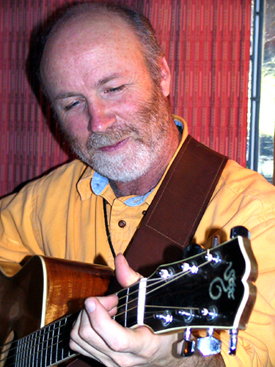
My dear friend Steve Palazzo, the guitar player here,
says that people have died from exposure. So I think frequently about
sending in with my mortgage payment a little clip from NPR. Saying here
you go, this month I'm sending this in instead of money because this is
my exposure, my coupon for being in the music business.
Anyway, there is a good living to be made if you are creative
and if you have an understanding and creative spouse and family. There's
a good living to be made in the music business, but we need to protect
intellectual property as much as all you need to protect your own property.
 It's
fun to sit here and listen to these big issues being talked about. Especially
Napster. I know a lot of what we are talking about Napster today is not
music-specific, even though music is the driving thing that made it all
happen. And we are talking about intellectual property and people turning
on in huge numbers to this sort of function. Anyway, that's my three minutes. It's
fun to sit here and listen to these big issues being talked about. Especially
Napster. I know a lot of what we are talking about Napster today is not
music-specific, even though music is the driving thing that made it all
happen. And we are talking about intellectual property and people turning
on in huge numbers to this sort of function. Anyway, that's my three minutes.
Isenberg: Okay, now I'm going to turn the floor
over to David Reed, who's going to continue on the theme of the Architectures
of Innovation and Bob Lucky will offer his 38 cents worth later.
David P. Reed: I have too much to say and no time
to say it.
Man: So speak up.
Reed: I've become completely convinced, I think
I was convinced when I was born, that architecture is everything. Architecture
matters. Most human thinking seems to not recognize architecture as valuable.
We have this [grand old?] architecture around us.
 In
particular if you look at Larry's chart, the three layers, the physical
layer, which things are made of; the content layer, which is what we as
consumers all care about, there's this middle space that's usually viewed
as in the way. Sometimes it does get in the way. But more importantly,
what is viewed as necessary but not useful, if you looked at economics. In
particular if you look at Larry's chart, the three layers, the physical
layer, which things are made of; the content layer, which is what we as
consumers all care about, there's this middle space that's usually viewed
as in the way. Sometimes it does get in the way. But more importantly,
what is viewed as necessary but not useful, if you looked at economics.
I've spent a lot of time trying to live in the world of
economists because that's where the arguments always take place even though
technology isn't about economics. If you look at economics, for many years,
they had this architecture-free view, that economics is about atomic goods
and distribution to consumers and how you got there really didn't matter.
Mostly it was a pain in the ass how you got there.
Then a variety of writers started focusing on the architecture
of various things. They tended not to be working in the traditional economic
big schools of thought. Bob [Meeses?] is one of those guys and Coase is
probably the more modern thinker along these lines. Coase worked in a
law school because he couldn't be hired by an economics department.
Coase won his Nobel Prize, not just because he said transaction
costs are important, but because he said structure was important, because
structure is what creates the transaction costs in the first place. He
was in some sense the economist who crystallized the notion that value
was created or destroyed by structure and that structure actually mattered.
So I got interested in the interaction between architecture
and economic value and discovered that there are a bunch of people who
are interested in that question now. They tend also not to work in economics
departments. They tend to work in business schools, where it's practical
and applied. Carlos Baldwin is a friend of mine, and there's a guy [???]
who I've read but I have not met.
What they write about is modularity and structure, among
other things, and how those things create value. The reason I bring that
up is that I'm still very sensitive to the fact that people can say like
[Tom] Nolle did in David's SMART Letter that the Internet was created
by a bunch of hippie anarchists who didn't care enough abut economics.
In fact we all did care about economics. The number of
conversations we had in naive economic terms around the design of the
Internet was huge, and it wasn't about anarchy, it was about designing
something that could both scale (which is what I want to talk about today)
and create value and pay people for the value. For example we had lots
of conversations about billing and we left out billing because we thought
it perverted the structure of the network. We all knew that the telephone
network was about billing and that 70% of it's architecture was designed
to make it billable.
 Now
if 70% of its architecture and 70% of its resources are devoted to designing
something to be billable, the engineer inside of me says, well, maybe
there's a way to do billability cheaper. Why waste 70% of the resources
on billing? So we said lets put billing off, because we'd like to figure
out a way to do billing later. Not because we thought you shouldn't bill. Now
if 70% of its architecture and 70% of its resources are devoted to designing
something to be billable, the engineer inside of me says, well, maybe
there's a way to do billability cheaper. Why waste 70% of the resources
on billing? So we said lets put billing off, because we'd like to figure
out a way to do billing later. Not because we thought you shouldn't bill.
Maybe we thought that charging for minutes is not right,
charging for sessions is not right. We made lots of intuitions that charging
-- that the particular charging structure -- distorted the whole thing.
What we wanted to do is create incentives for people to build networks
and create content and hopefully do it in a way [that was different].
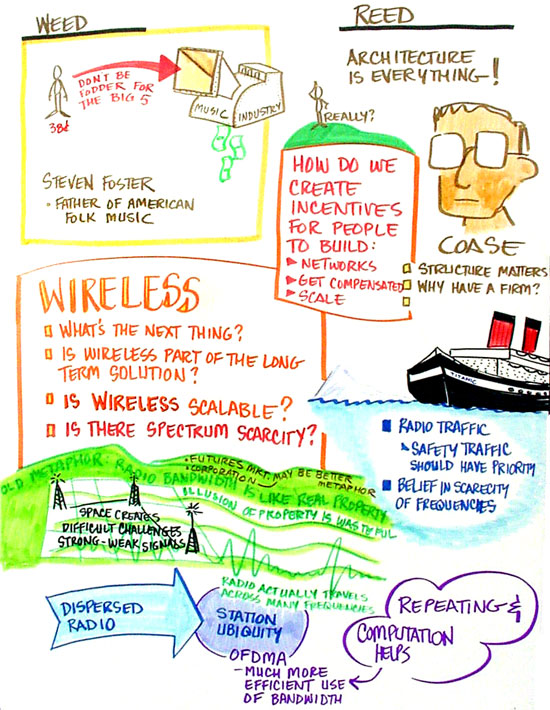
So I want to talk about wireless. I'm shifting gears.
My new five year intellectual focus is the scalability of wireless technology.
I got fascinated by it five years ago by talking to people who were asking,
"Can't we just have ad hoc networks that grow organically that are wireless
and that would change the capital structure of the industry because capital
would come from the users not from some capital source that has to bet
that 10 years in the future that they are going to recover it?"
What we didn't want was another Iridium. Iridium was a
beautiful technologic product. You cannot fault it on technology. Talk
to the guys at Motorola. Not only did they build great technology, they
also built great technology that updated over time could be the best technology.
But the interesting question is why didn't it work? Well
the reason it didn't work is because the only way to get value out of
this was to figure out what the applications were -- that's what they
thought. They predicted an application that at the time made sense, and
they architected the system for that application -- voice telephony from
remote locations. I think they thought maybe they could eliminate the
need for cellular networks with a lower cost alternative because it would
be more universal.
In any case, pricing of cellular was really high at the
time and they didn't predict significantly lower pricing. But what's really
interesting is that they built a very brittle architecture in the large.
It's not that it didn't work, it's not that it was particularly late,
but rather it was aimed at the wrong target. There really isn't a market
for [the Iridium] architecture at the moment that we can find. Lots of
people have tried. The military is about the best and that's not a big
market.
 In
wireless, there are a bunch of questions that are pragmatic ones, like
what's the next thing in wireless. But I think the more interesting thing
long term is, is wireless part of the long term solution, or is wireless
something that will bother us once in a while and be an irritating thing
around the edges, or a thin strip -- the last five inches of distribution
so you don't have to have a cable. Exactly where does wireless fit in
in this world? In
wireless, there are a bunch of questions that are pragmatic ones, like
what's the next thing in wireless. But I think the more interesting thing
long term is, is wireless part of the long term solution, or is wireless
something that will bother us once in a while and be an irritating thing
around the edges, or a thin strip -- the last five inches of distribution
so you don't have to have a cable. Exactly where does wireless fit in
in this world?
The fundamental question is, is wireless scalable. It
keeps coming back to that. This is where the intellectual battle is being
fought, and it's in fact where the policy battle is being fought as well.
If you go to Washington, you can have lots of conversations
with people and they will tell you there is a scarce supply of spectrum,
just not enough. We need to do something about that, because there are
some people who want to use more of it.
The question that keeps coming to mind is, is it really
scarce? On the opposite side, there are people who find a lot of spectrum
lying around unused. Somebody points out to me that if you walk with a
spectrum analyzer through downtown New York, which you would expect to
be heavily used, you'd find a few cellular peaks, which are very small
in terms of bandwidth, and no other use averaged over a very long period
of time.
The reason for this is regulatory. But the reason the
regulatory thing exists is because we've taken a particular path. Where
did that path start? It started largely with the Titanic. I've heard this
from Bob Lucky.
I just want to read a quote. There are a whole lot of
interesting things about the Titanic and you can find all about on the
Web. Here's one quote that I found.
So [???], one of the ships that happened to be not very
far from the Titanic on that fatal night sent to the Titanic the following
message: "Ice Report -- much heavy pack ice and great number of large
icebergs, also field ice.
The Titanic said, "Keep out, I'm working Cape Race."
In other words, the wireless operators on the Titanic
were sending passenger traffic -- it was the first liner to support full
passenger radio. They were sending passenger to Cape Race to relay off
to various other places, and that was considered priority. Weather reports
were not high priority at the time. So they received this message and
they basically ignored it, because their goal was to prioritize passengers
traffic.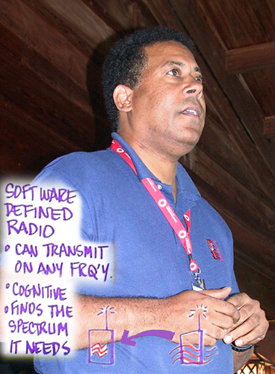
Two things were going on there. First, it was an example
of interference. This was not a message to the Titanic, this was a message
to all ships on that channel. The rule was one user had priority and the
other users had to shut up. The other thing that was going on, was that
no one had recognized that safety-oriented traffic ought to have priority
in marine applications. So the FCC was largely created around these two
things.
One was safety because it was clear that radio had more
of an impact on public safety than anything.
Isenberg: The FCC was created in direct response
to the Titanic disaster?
Reed: No, the first structured regulations, which
ended up in the FCC, and then ultimately in the way we do this worldwide,
said the government has an interest in safety. The government didn't have
an interest in anything else about radio, but this has been parlayed into
a much more interesting question, and the source of that path has been
the notion that there is only so much radio to go around.
If you got to have safety and there is only so much to
go around, we ought to keep the regulation in one place because that's
the place that matters the most.
Man: At that time was it still spark-gap radios?
Tom Freeburg: No, radio was much more sophisticated
than that by that time.
Reed: There were some other interesting things
going on. For example, radio came with a human. If you had a radio, you
had an operator. And your operator worked for Marconi or Telefunken. They
didn't work for the ship owner, and because of proprietary concerns. The
Marconi operators were not allowed to talk to the Telfunken operators.
A lot of things were going on in radio at that time that
caused the regulators to want to get involved. They wanted to force interconnection
for safety. So regulation is good, there is a lot of goodness that regulation
created. I just want to put that on the table.
But it's not a very old system of regulation. And the
metaphor, which led to the architecture of radio, is the metaphor of land
and property rights. And that fit with a very naive notion of radio that
was perfectly sensible at the time, that radio was narrowband, it was
possible to confine your transmissions to a narrow bandwidth, and two
people could not transmit on the same frequency at the same time and expect
the receivers to distinguish the two transmissions.
The technology at the time said the exciter and the demodulator/detector
worked in this way that was very frequency specific and it was cheap to
do that way. That was the only way you could do radio. Now radio could
have evolved another way, but somebody got the great idea that there were
bands of spectrum and that you could regulate according to these bands.
I think that’s the last contact that regulators had with business.
A physicist knows that radio is basically an electro-magnetic
field wave. And there is no such thing as frequency for magnetic fields.
A frequency is a particular decomposition that Fourier invented, and people
have found useful as a way decomposing what is going on in some complicated
system into a manageable coating, if you will. In particular it is done
by frequency.
I’m not going to dwell on physics, but the interesting
question is if you transmit supposedly in a frequency band, in fact the
information even in a narrow-band signal is splattered all over the spectrum,
and maybe gets splattered at lower power in other areas of the spectrum.
But because the transmission varies in time, it’s got components
everywhere, even if you filter it a lot.
This results in some rather strange things, where people
invent modulation techniques that seem to violate various physical laws
by transmitting more than they can possibly transmit, because in fact
they mange to encode information way outside their band, but at very low
levels, so it’s somewhat like spread sampling.
Then they come out and say, I’ve created this great
new radio and then when you actually look at them, the way they actually
work is that they are actually transmitting more information than will
fit in a band. So bands are not fixed. In fact the way we manage the bands
is that every time we divide them we do something like draw little areas
between the bands. They used to be called guard bands, but there’s
a lot of things going on there. When we divide space up we do the same
thing, so that whenever you divide something you lose a whole lot of capacity.
So the result of this property model is that as you subdivide
you tend to waste more and more. Almost every radio system works this
way. Except that in modern times we started understanding a few more interesting
things abut the physics and exploiting them. Actually we can build really
neat radio systems now that work and don’t waste the spectrum anywhere
near as much. Cellular is a great example of that because it basically
geographically reuses spectrum. So cellular uses a frequency band much
more efficiently than, say clear channel broadcast radio.
So one interesting question is, if it becomes really easy
to build cell sites, why don’t we build wireless broadcast TV networks
that use cellular architectures, which would much more efficiently use
the spectrum rather than transmit at really high levels in order to bleed
very low power signals out to the edges.
An even more interesting question gets raised as systems
get really dense. Now we live in a world where radio is really dispersed.
And there are a set of engineering solutions that were practical at [a
certain] point in time, like traditional broadcast radio, which has a
transmitter that covers a metropolitan area. [In this architecture,] you
have the fringes that don’t work very well, and if you are too close
to the antenna it’s too loud, but basically it works reasonably well.
You design intelligence into the receiver.
But we are going to a world where radios are everywhere
-- a world is station ubiquity, if you will, and radios are two-way everywhere.
The question is, do the regulations and rules and design principles that
used to work very well in the dispersed situation work here? I submit
that there is a technological discontinuity somewhere here where it stops
working.
There are a bunch of interesting technologies which I’ll
call to your attention. One is called OFDMA. It is actually being used
in 3G (or 4G) network designs. OFDMA basically says you don’t have
to have this wasted space between the bands. Because if you choose the
center frequencies of all these transmissions to be orthogonal, that is
properly spaced, then you can simultaneously decode all transmissions
at once. If you simultaneously decode them, in fact, the power can bleed
out between the bands and it doesn’t matter.
So in an OFDMA network, you can get much more capacity.
Capacity doesn’t go down with the number of stations or the number
of bands used, which is a nice property.
Tom Freeburg: I just wanted to add one thought.
You are saying in general terms exactly the stuff I’ve been preaching
to my management and all my potential customers for the last five years.
You've got a good large part of it. I just wanted to throw in one thing.
When you talk about distributed radio becoming the only form of networking,
you come to a problem of, lets call it a multi-hop problem in radio, but
I’m reminded of the highway system in Italy, where up until just
a few years ago, the only way to go up and down the Italian coast was
to weave in and out of all the highways, and it took a painful long time
to get from village A to village C. Then somebody built the Autostrada
system, which is a toll road system. It’s a private corporation and
you pay tolls. You know what? Anybody going any distance at all uses it.
There’s no question at all as to the way to go if you have any distance
to go.
So I’m only suggesting that there will definitely
be a place in this future that David is describing so ably here of multi-hop,
mesh networking, complete peer to peer networking, whatever you care to
call it. There is going to be a place for long haul toll ways. By the
way, that network is already in place, what we call the Internet today,
without thinking about the last mile.
Reed: I might be talking over people. I’m
a little worried. So OFDMA is this interesting technology -- it’s
called orthogonal frequency division multiplex access. There is also something
called OFDM, which is kind of a lower level [?] that doesn’t affect
the access part.
If I were George Gilder, I’d go around saying OFDMA
is unlimited bandwidth. But I’m not. OFDMA is not a magic bullet.
It’s just an illustration of the general phenomena that hasn’t
been practical and now is. The reason it hasn’t been practical is
one of my two messages. One is computation.
Computation helps. You can trade computation off to create
a much richer thing. We only had coils and capacitors in the old days.
OFDMA requires that you do a Fourier transform on every symbol and an
inverse Fourier transfer on the other end. You can only do that if you
have cycles to throw away -- that's the reason why nobody’s ever
done it before.
Now there is another thing. I want to talk about space.
So we have frequency, and the old property model said that to achieve
the illusion that we have property that frequency is the thing that we
could trade or allocate. In the old days frequency was allocated by fiat,
now the proposal is to auction it. To achieve that illusion of property,
we waste resources. We waste more resources the more we chop it up.
Now the other dimension is how do we manage space? [The
traditional idea was that two distant cities can use the same band, but
adjacent cities must use different bands.] So what you need is a careful
allocation process to make sure that space is reasonably efficiently used.
But the problem is that power drops off at the square -- or other power
laws -- from the point of transmission.
So you have tremendous differences in power that have
to be handled by receivers. That results in a definition of interference
that is extremely conservative in the design of receivers, because they
have to be very sensitive to very low power; on the other hand they have
to handle very high power. To make practical receivers you have to waste
resources in the whole way of assigning frequencies. In fact you [might]
barely detect the signal [in certain circumstances, yet] but it [can be]
perceived as interfering with something somewhere in the fringes. Spatial
division historically in radio has been considered bad, and has created
extremely wasteful use of spectrum as well. This wastefulness accretes
over time because people make the rules more and more conservative. And
you start to play games with the rules, rather than the technology.
The cellular guys have some motivation to start thinking
about the space problem.
 Man:
Isn’t it true that the experience has encouraged innovation -- not
intentionally -- because you need bandwidth when you are pressed on spectrum?
I’m an advisor for Centrepoint Broadband Technologies, and what they
can fit on a single channel is amazing. Nobody in their right mind would
design anything so fiercely complex to transmit the signal unless they
were backed into a corner and said you have *this* to do everything else. Man:
Isn’t it true that the experience has encouraged innovation -- not
intentionally -- because you need bandwidth when you are pressed on spectrum?
I’m an advisor for Centrepoint Broadband Technologies, and what they
can fit on a single channel is amazing. Nobody in their right mind would
design anything so fiercely complex to transmit the signal unless they
were backed into a corner and said you have *this* to do everything else.
Reed: I think you are actually right. If you think
of innovation in isolation, yes, lots of innovation happens because of
this. And in fact, if you think about it, lots of innovation happens because
of the desire to control things. We got great innovation about managing
digital rights management and encryption and unbreakable stuff -- there's
lots of innovation going on.
It is not really a question about whether lots of innovation
is happening. It’s to what end. Is the innovation being directed
toward creating value for society and consumers or is it focused on creating
value to the suppliers and so forth. And sometimes the question is mixed
because the same innovation can be useful to . . .
Man: If you are arguing about capitalism, it’s
a long story , but . . .
Reed: I’m not going to argue about capitalism.
I will argue about property laws. And the reason is that I’m a capitalist
but I’m not a property capitalist, I’ve decided. Capital is
the deferred reward. It has nothing to do with property. There are lots
of ways to get a deferred reward, only some of which can be structured
as things that behave like property. What we’ve had is a bunch of
radicals to say we can think of everything as property. If that were true,
that would be great. I would claim that it is very bad to think of spectrum
as property because in fact it results in incredible waste because there
is no way to make spectrum look like property.
Here’s the final example that I think is the most
interesting. If you had a fixed geographic region and you had a fixed
frequency band -- a band limited system in a defined space -- there is
an interesting question you might ask. I asked this question and I found
out that no one could answer it.
Here's the question: What’s the scaling law that
describes the capacity of this space as the number of stations goes up?
So you have stations. I don’t care whether they are
randomly distributed or whether they are arrayed in rectangular coordinates.
You specify the problem to that level of detail and just tell me if you
have N stations in this region, how much capacity in bits per second --
actually the best measure is how much capacity in bit meters per second
because if you transmit a bit twice as far you clearly got twice as much
capacity in some sense.
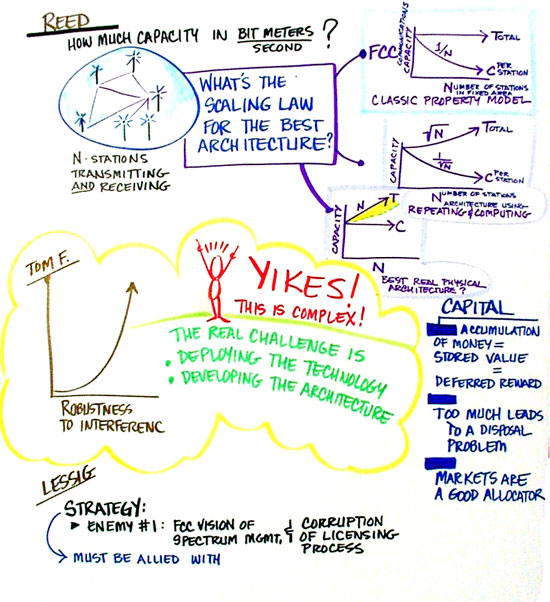
So, how much capacity in bit meters per second? If you
can get one bit, one meter that’s a bit meter per sec. If you can
get one bit two meters, that’s two bit meters per second.
Man: You are missing a whole bunch . . . a huge
number of variables.
Reed: Holding all other variables constant, can
you answer the question, what’s the basic scaling law of the system.
The answer is you can’t tell unless you specify the
architecture of the system. So you have different architectures. You could
have an architecture where every time slice sends all their messages to
some central point and it then sends it out. That’s kind of an access
point oriented structure, or maybe a multiple access point structure.
Over all such architectures, there must be a best architecture. So what’s
the scaling law of the best architecture?
Well, it turns out that no one knows the answer to that.
Even though it is purely a result of physics -- this is a physical system
-- no one knows the answer. If you knew the answer, you’d know what
the best architecture was -- at least you’d know what you were shooting
for.
There are several possible answers. And this is what I
want to get at -- the structure of possible answers.
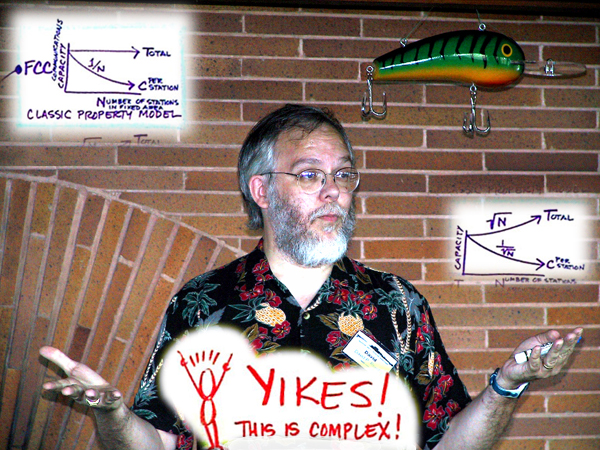
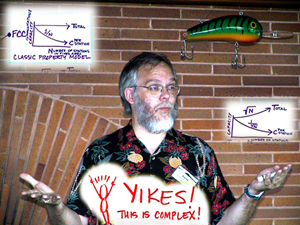
The FCC model, which is also the model that is supported
by the incumbents, is that as N increases, the total capacity, which we
will call T, is constant. Which means that the per-station capacity, C,
declines as 1 over N. Now if that were true, that would be a classic property
model. The property model says you got a fixed amount of stuff -- you
have to allocate it. You can’t make much more of it. It’s very
expensive to make much more of it, if you can make any at all. So you
need an allocator that allocates it to the best possible use. That’s
the property model. For that kind of property, property rights work real
well.
So the second question is, maybe it’s unlimited.
In the George Gilderish sense of the word, it’s fixed only in the
sense that technology can make an infinite amount. You have a total of
infinity and it doesn’t really matter how many stations there are,
it’s just a question of technology, so this is the unlimited case
and I would claim that basically because of physics, we know that’s
not true. It can’t possibly be true. Just like DWDM isn’t really
unlimited. It is just a lot less limited . . .
So if that’s not the case, is there possibly a model
where the total capacity goes up with the number of stations, or worse
yet is the true model something worse than the FCC model, which is that
total capacity goes down with the number of stations. Fortunately, we
don’t have to consider that one because there is at least one known
architecture, and it’s basically the architecture that Tim Sheperd
sort of worked out. He was a PHD student at MIT and got his Ph.D. for
this.
It basically shows that the total [capacity of the system],
which should be a curve, goes up as the square root of [the number of
stations] with his architecture. Now we don’t know if that’s
the best architecture or not. A number of other people have done some
interesting papers. By the way, that’s not so great, because it’s
sort of a funny kind of scarcity. What happens is the square root of N
over N is a curve that is 1 over the square root of n individual capacity.
So as you get more and more stations, everybody gets less and less. It
is just that they get less and less slower and slower than the FCC model,
so there is a need for allocation. But what’s interesting about this
is that the only thing Shepherd needed to do to get to square root of
N growth was a simple thing, which is to allow stations to repeat each
others traffic.
So besides computation, you get repeating. And repeating
is an interesting form of cooperative behavior that isn’t normal
in a market. In order to get that, I don’t know of any architecture
that gets square-root-of-N growth without cooperation. That says that
individual actors acting alone can’t achieve the best possible use
of diverse resources.
Man: What about the tragedy of the commons?
Reed: Well maybe there is a tragedy of commons
without additional rules. You need some kind of rules.
Man: Individual actors acting along will not manage
the resource to the collective benefit of the whole.
Reed: Right. Which is why you need an FCC or some
kind of regulation in the first model. Or you need a market that is driven
by externalities, which are the value people place on the usage. What
we are saying here is yes you need a market, in this model, but you don’t
need a property market because subdivision doesn’t work. Cooperation
works better than subdivision. But the more interesting question about
this is is this the answer for the physical world, or is this just the
answer for an architecture that repeats? And this is where no one knows.
So what’s the answer for the physical world?
Well, I can tell you an upper bound on the physical world,
and it has to do with the work of some people at AT&T Labs and others
in what’s called space time coding. There is a practical application
of this in the system sort of an architecture called BLAST.
Isenberg: Bell Labs is actually Lucent now.
Reed: The key idea is that if every station is
transmitting and every station is receiving in a space, then every station
has a slightly different path to every other station and what’s really
interesting is that this works even better if the path is a multipath
environment where things are reflecting and bouncing off stuff, because
then the paths are really different.
You have N-squared different paths which fill in a matrix
of N-squared coefficients, although they are actually impulse responses,
and if you have N equations and N unknowns you can back-solve the entire
matrix because you have enough information. So, in that model, which is
a little bit impractical because in order to do the computation you have
to assemble all the operators in one place and obviously they are distributed.
In that model you get a growth that grows linearly with N and in capacity
it grows flat per station.
The question is, between these two there is a whole range
of architectures that are possible that involve not just cooperation,
but cooperative computation. If you can share a little bit of information
with your friend, he can compute on it. And if you share a little information
about the impulse response between you and various partners out there,
ultimately you can at least get N. I still haven’t said whether you
can get more than N, but if the physics work this way, and regulators
think it works the other way there is a huge problem…and that’s
where I’ll stop.
[applause]
[Gap to change tape.]
Reed: (explaining his graphic) This is a fixed region,
no new spectrum allowed . . . N transmitters and I’m assuming N growth,
because what’s interesting to me is how does wireless capacity grow
when everybody is carrying four on their belt and they all converge in
this room. And cellular systems don’t work in that case.
Man: *Today’s* cellular systems don’t
work.
The X-axis is N growth and the vertical axis is a measure
of capacity -- I am using bit meters per second. N is hand-helds plus
cell sites because right now just like in the last talk, hand-helds are
just stupid terminals on a backbone. But if you take into effect that
the handhelds can compute and cooperate with each other, there are a lot
more resources in the system then the backbone. Unfortunately it’s
not under the control of a capital provider.
Isenberg: Can I ask you to work with Joe Sterling
to create a labeled version of the chart?
Freeburg: David definitely is on the right track.
I want to point out two very simple things all based on the concept that
you don’t need to get nearly as complicated as David was talking
about and describing accurately what’s going on in the industry today.
But you don’t need to get nearly that complicated to get there. Just
small nudges have already moved the technology development of radio in
the direction that it takes.
For instance, six years ago I published a paper that talked
about, if this is an axis of some measure of spectrum efficiency or spectrum
effectiveness in the direction that David was talking about, and this
other axis is robustness to interference, it turns out that as this robustness
to interference improves (and you don’t have to get into regions
where you can work in the presence of interference stronger than your
signal), as that robustness improves spectrum efficiency, the number of
bits or bit meters that you can push from 1 Hz goes to infinity. All it
takes is directional antennas and a very little amount of interference
robustness.
Second point is that both of these views of how you manage
spectrum, one is property, one is some kind of common thing, already exist
today in the US, the so called UNII bands at 5GHz, [where there are] 300
MHz that we get to use as we want.
I had a lot of input into the way those rules are written
and I personally am convinced it’s enough. If you like, the camel's
nose is already under the tent. There's a shared kind of thing and that’s
enough. There’s enough there to do everything that we are talking
about and that needs to be done for the next half decade, maybe decade.
Reed: Let me respond. I think we mostly agree.
I think the problem is not with the technology, but with the ability to
deploy the technology, which might be due to regulation, or dumbness on
the part of operators, or lack of capital or whatever. The problem is
deploying these innovations. The other thing is it’s not any particular
innovation, which is why I emphasize OFDMA is not the next DWDM. Don’t
go invest in OFDMA companies or UWB companies. Right now you are going
to hear a drum beat for wideband radio, or impulse radio, which has some
of these properties. It does not come with an architecture. Basic ultra-wideband
does not come with an architecture. The game is in the architecture fitting
with the technology, not the other way around. And UWB is interesting,
but not necessary.
Freeburg: I have bet my career at Motorola on being
able to bowl something meaningful through the particular knothole that
you have just described. I've been aiming at this for several years now.
It’s birthing as a commercial product as we speak, very first phase
simple, but I really believe, and have for a long time that’s what
we are going into production with. The third trial production runs about
to begin.
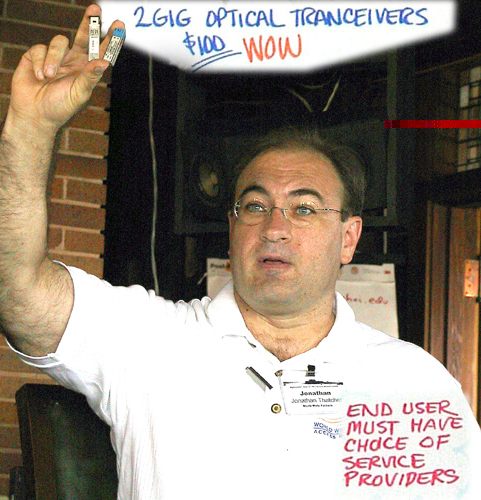
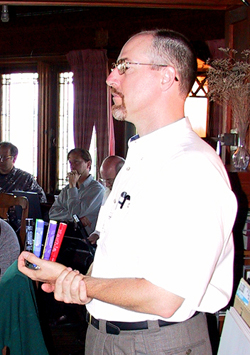
Isenberg: Here it is. [Holding up plastic transciever.]
One of these is providing our backhaul link across Little Harbor to the
Oceanographic Institution.
Freeburg: There’s no property rights in that
at link at all and its just enough sophisticated technology to meet all
of the stuff that David has described.
Reed: An interesting thing happens when you start
talking about all these technologies, that other kinds of property rights
start showing up, like the right to put the antenna on the roof or the
pseudo interference that might happen if the system is designed wrong,
or whatever. And you know a company like Motorola can play that game because
it’s big.

Freeburg: Actually it is easier for a smaller company
to play that game.
Isenberg: 3 min coupon!
Larry Lessig: So I spend my coupon to make one
small plea. You know because we’ve been doing this stuff a long time,
I completely agree with you about your intuitions about where this can
go. But I want to talk about strategy. Because the real enemy here is
not people talking about property, the real enemy is the existing FCC
bureaucracy that’s talking about licensing spectrum for particular
uses.
And there’s another movement out there that I agree
ultimately won’t be the best way to allocate spectrum. This is the
Tom [Hazlet?] view of perfect property rights. It’s the Ronald Coase
view of let’s create real property rights and spectrum, which is
not you are allowed to use this spectrum at this time for this particular
use. Rather it is, "You have the spectrum, sell it, do whatever you want
with it. It’s your resource just like this piece of property is your
resource."
That view is so radical relative the existing FCC vision
that it would completely blow up spectrum management if it were adopted.
And I think there is a great opportunity for us to recognize what Tom’s
work is doing. Tom’s implementing what you’re talking about,
I think that what you’ve done with the FCC and your work is the future,
it’s brilliant and great, but we get there if we ally in some sense
with people who say we need a radically new way to organize spectrum.
One part of it has to be a commons and this way that Tom [Freeburg] is
taking advantage of in unlicensed spectrum, it may well be that a huge
chunk of it’s going to be property-like. But we have to get away
from the existing method, which is that people buy the rights through
political power at the FCC…That’s the evil. And it’s not
ideas about property, it’s corruption of the political system.
So if you talked about licenses and said you know lets
have a world where we experiment with lots of commons and lots of property,
but lets get away from government, centralized, Soviet control of spectrum,
we could find alliance with an extremely important right wing world out
there who would say, yeah, that’s where we ought to be going.
Man: Can you give examples of what you are talking
about? Are you talking about radio broadcasters using the spectrum?
Lessig: The catholic model is, you buy a chunk
of spectrum just like you buy a piece of property. You sell it for whatever
use you want, you can use it for cellular radio or you could use it for
unlicensed…whatever…you have the right. And it’s unlike
existing allocation of spectrum, because in the existing system you have
this particular chunk for this particular use for this particular period
of time. You are not free necessarily.
Isenberg: Bob Lucky has prepared some remarks and
then we’ll continue in the all hell breaks loose mode. Unless somebody
wants to use a coupon here. Quick question?
Man: At some point can somebody take what this
discussion is and tell us what the underlying technology . . .
Isenberg: Yes, after lunch we have Dewayne and
Tom and one or two others who are going to delve into what this wireless
thing is in a more nuts and bolts sort of way.
Man: If property model doesn’t work, what
is the alternative model?
Isenberg: What *are* the alternative economic *models*
 Bob
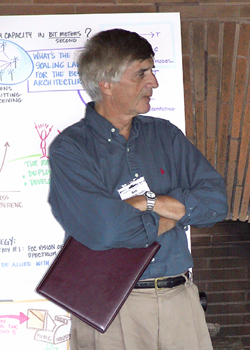
Lucky: I don’t have any prepared remarks, in fact, I don’t
know what I’m going to say. I should say that I happen to chair the
technology advisory council at the FCC and Dewayne chairs the committee
on spectrum management. We do talk about these issues regularly at the
FCC and there is a certain willingness to listen so we are not exactly
silent there. But as Larry said, there certainly are entrenched political
forces that far surpass [the power of] any advisory council that they
have. Bob
Lucky: I don’t have any prepared remarks, in fact, I don’t
know what I’m going to say. I should say that I happen to chair the
technology advisory council at the FCC and Dewayne chairs the committee
on spectrum management. We do talk about these issues regularly at the
FCC and there is a certain willingness to listen so we are not exactly
silent there. But as Larry said, there certainly are entrenched political
forces that far surpass [the power of] any advisory council that they
have.
But I don’t want to talk about that. I want to talk
about Dark Forces. I have been a member of the Dark Forces for my entire
life. I am currently with Telcordia and I used to be with Bell Labs many
years. Telcordia is independent and not associated with any particular
Dark Forces, but since all of our money pours down from Dark Forces I
suppose that makes me a captive of these forces.
Let’s try to look at what’s going on there for
the few minutes that I have. In another month it’s the witching hour
for my AT&T options to expire and they are almost worthless. The question
that I think about sometimes when I wake up in the morning and that is,
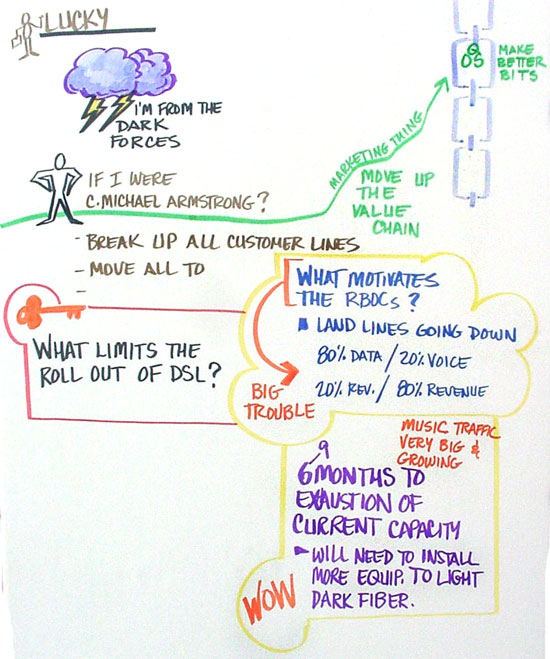
"If I were C. M. Armstrong, what would I do?"
What would you do if you were C. Michael Armstrong?
To me you’ve been given the short end of the stick
and it’s your own fault, it’s what you took, the long distance
and technology undermined that. The cost structure of the way it was built,
the historic way it was priced has gone out the window. Frankly I don’t
know what I would do.
David, you were there for many years. Do you have a simple
answer to that question?
Isenberg: No, I have some good hindsight observations,
but that ain’t fair. I think that’s one of the hardest jobs
in the world.
Man: I’d sell AT&T Broadband to Comcast,
I’d take my retirement package and leave it to the next guy.
Man: I'd break it along customer lines -- wholesale,
retail.
Man: I'd listen to my customers, which they never
do.
Matt Oristano: I would destroy the whole pricing
principle and install flat rate long distance and move the whole thing
to IP non-switchable.
Lucky: Now the RBOCs are in a different situation
and usually when you think about Dark Forces you think abut those rather
than AT&T, which is underwater, not just my options but the disability
charts.
What do the RBOCs want to do? They don’t want to
be caught in this business of selling commodity stuff. So they all talk
about moving up the value chain. Let’s sell services. Let’s
get value added services and build on that. The problem is nobody knows
what these are. But somehow they are there. Now the initial grasp for
these higher valued services are QOS [Quality of Service], SLA’s
[Service Level Agreements]. Lets have higher quality bits. My bits are
better than yours. They will draw a premium. I’m not a commodity,
I have good bits as opposed to these lousy bits.
I’ll just bypass the idea for a moment of provisioning
VPNs. But SLAs and QOS has been this Holy Grail now for a number of years,
and in fact the technologists buy into this too. And for sort of a dirty
reason -- it is one of the few good technical problems around. You know,
I mean lets make these bits good. You go to conferences on telecom and
all the papers are on QOS, like there aren’t any other problems here
that are worth looking at. So just from the standpoint of finding interesting
problem, QOS is a great problem for engineers, let’s do it. Management
likes it because these are superior bits that will draw a premium. So
for quite a while now this has been sort of a Holy Grail.
Now how many people here believe this will work? QOS as
a marketing thing.
[Very quiet audience]
I don’t see any great show of hands. I’m very
skeptical myself. too, but it is amazing how the industry has bought into
this.
Peter Cochrane: Well you bolt CRM on it and you
have the Holy Grail.
[Laughter]
Man: . . . and CTI
Man: . . . and BLS
Lucky: It is amazing how we engineers have bought
into this and never really questioned.
Isenberg: Ours is not to question why . . .
Victor Blake: If you go to conferences, I’m
a complete anti-QOS person, any conference you go to, you start to talk
like that, what happens is that the Worldcoms and Sprints and Genuities
and Level 3s light up and say, "Victor, you’re stupid…You
don’t know anything.."
Man: They’ll all be bankrupt in the next year,
so . . .
Blake: Probably true, but in the meantime they
wield a great amount of influence in standards organizations and their
voice dominates the intellectual effort to work on problems. I’m
actually amazed that no one raised their hand here because I would have
thought . . .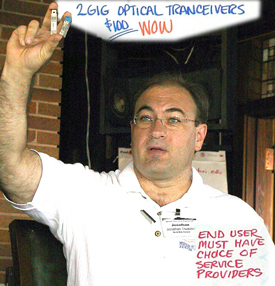
BL: How many people would say they are anti-QOS?
The forces of industry here are aligned.
Man: Their point is hey look that’s what the
carriers are buying. I can make what’s right or I can make what sells.
Isenberg: QOS is about allocating a scarce resource,
and it ain’t scarce.
Cochrane: The problem is there are flavors of QOS.
You say to an engineer QOS, they are going to tell you about down time
and performance issues. If you go to the marketeers, God knows what it
is.
Man: At some point everybody is going to have to
build their networks to a certain 99.999 it’s just going to be there
. . . everybody’s going to have to be there.
Lucky: Yeah but maybe that will just come naturally
-- the rising tide theory.
Man: I don’t know what the anti-QOS issue
is.
Gigi Wang: I’m going to take a stand. I believe
in QOS. From the customer side, it depends on how you look at it. If you
look at QOS from the customer side you have a choice of different qualities
of service and what you want to pay for. Right now for long distance,
you get to punch different codes. What’s really interesting is that
SingTel has 011 as their premium quality service, and 013 is the budget
stuff -- 019 is VOIP.
Man: It all goes through the same pipe.
[Laughter]
Lucky: So what motivates the RBOCs right now. One
very important thing is that for the first time, they are losing lines.
They are losing lines big time. BellSouth a month or two ago, lost the
most lines in its history. Land lines are going down. You have the substitution
of wireless going on, they are losing second lines. This is a panic situation,
this has been their bread and butter.
And then they got this other situation where data traffic
is growing, and now 80% of the traffic is data. And yet, voice down at
20% is 80% of the revenue. So you have a total disconnect from where the
traffic is and where the revenue is.
How do they survive this cataclysmic shift from where
they get money out of the data? And they haven’t figured this out
yet. It’s really a desperate situation. We’ve been going for
a century with a very artificial pricing structure for telecom that’s
not based on any kind of cost or reality whatsoever. Technology has shattered
this. It’s drawn out all the underpinnings that held up this artificial
thing.
So what does motivate them and what are the hopeful things?
I think there are a couple things that might be helpful. We heard recently
that Larry Roberts collected all this data on network traffic. It’s
on their web site, Caspian Networks. For the first time instrumented the
whole core and measured all the traffic going into it and found incredibly
that traffic now is growing faster now than ever.
Bradner: Internet traffic.
Lucky: This is very encouraging. And he says in
6 months or so, you will have exhaustion of the embedded capacity that
they are just sitting on and using up because they are afraid to buy new
stuff right now. At the current rate of traffic growth you will need to
start buying stuff to light the dark fiber in 6 to 9 months at the current
rate of increase.
I take that as one of the few glimmers of hope. Traffic
continues to grow, and that I think is good news.
There is one caveat here. Larry Roberts, as we know, is
a good guy and one of the founders of the Internet is also founder of
Caspian Networks and sells gigabit routers. So it is very much to his
interest that the traffic is growing. But nonetheless he’s a good
guy and lets assume that he . . .
Man: It can’t be verified. The source of the
data is actually much better if you believe that he actually bought the
right to instrument all the Tier 1 guys, as part of buying the rights
he had to make it clear that he couldn’t share it with their competitors
and therefore he is only aggregating it.
Man: It is not a real scientific study because
he won't expose the data.
Lucky: I recommend that you look at the data. It
is terribly interesting.
BellSouth said in January that Napster was 5% of their
traffic and in June was 1%.
Man: Music traffic has grown slowly despite the
drop in Napster.
Lucky: How many of you used Napster in the old
days? Okay. How many now use some other music sharing. About two-thirds.
Let me summarize -- even though it is hard to summarize
when I didn't really start. A lot of people have the idea that if you
could open up this local loop bottleneck that you would stimulate the
traffic and the applications to come on. And is there someway we can undo
this.
My question at the beginning of the session is what limits
the rate we can roll out DSL? I mean, why can’t we all get it out
there? I’ve asked a number of the people in charge of DSL deployment
at different companies, what are the limits. They don’t seem to know,
but a lot of the elements are financial. A lot are just logistical. And
a lot of them have to do with the complexity of customer care and all
that.
Let me ask question. How many here do not have DSL offered
where they live? See that to me is the problem. I ask that question in
a number of places where I give talks to computer industry people and
typically three quarters of the people will say that I don’t get
it where I live. Yet if you talk to the RBOCs they say 75% of our offices
are equipped and it’s available there. My theory is that computer
executives don’t live in places like that.
Isenberg: Thank you very much Bob. [applause] Now
does anyone have a 3-minute coupon that’s burning a hole in their
pocket?
Man: Even if you get DSL out, a lot of what they
are rolling out is 256 or 512 . . .
Lucky: You only have 3 kbps upstream anyway.
Man: I mean are they going to spend to do another
whole cycle again?
Lucky: On the average they all get about 3 kbps
per customer upstream. The real fallacy of the argument between DSL and
cable modems is that there is sharing somewhere upstream [so the hidden
question is] how much have you really got?
Isenberg: We have a three-minute coupon -- Peter
Cochrane
 Cochrane:
Let me give you a low down on ADSL. First of all, it could only come out
of the diseased minds of the telco. Cochrane:
Let me give you a low down on ADSL. First of all, it could only come out
of the diseased minds of the telco.
[Laughter, applause]
Cochrane: It’s a completely stupid idea. The
world is not asymmetric, it is symmetric. Why? First of all, you have
a bunch of marketeers in there who don’t understand the very simple
phenomenon called cross-talk.
They also don’t understand what a complete and utter
ball of wool the local loop is. So you go to the laboratory and you do
ADSL and you say, hey, we can do 2 megabits over 8 kilometers, we can
do 10 megabits . . . the whole deal.
Then you get out into the real world and , oooooh shit
. . . Why does it become uneconomic? Because suddenly you find that the
cables are not like the ones in the laboratory. They are in a hell of
a mess. There is more cross talk than you anticipated and as you get more
DSL out there, cross talk goes up, the speed goes down and you have to
employ more and more people to go out there and do customer testing.
In the UK we had this reaction, and I bet you it was the
same everywhere else. Fiber Optics comes along, and the decision is made
-- not on any financial basis -- to roll fiber into long lines. Devastating
success. 90% of the people employed in long lines are taken out. The people
in the local loop say, "Ooops, better stop fiber or we are out of a job."
The way we can do this is invent ADSL. We’ll promise 50 megabits,
12 megabits, anything you like. Hold off this fiber, guys!"
Now the reality starts to bite now, because when they
roll out this technology it is absolutely killing them.
I would ask you to think on this. How come all the population
can buy radio, TV, HiFi, cordless phones and satellite receivers and they
can install them, but they can’t be involved in the installation
of wideband access in the local loop. If we had done the very simplest
of things…given away these to everybody closed down the local loop,
sent 50,000 people home, saved $12 billion a year in operating costs,
recovered all the lead and copper out of the local loop, which is worth
a fortune and then rent off the duct space to companies who can then put
fiber in, but for the moment 802.11 in the street, bingo, you would have
the replication of a situation that occurred in this country in the late
1930s, early 40s where it was not economic for the TV stations to build
repeater stations so communities did community antennae TV (CATV), amateurs
did it. When it became complex, it became the CATV industry.
[applause]
Peter Ekelund: I hear the US perspective and I
think you are really quite far behind. This is too simple a tack for what
is happening now. Telecom Italia in hopeless world of copper in Italy
is currently going to make a decision this autumn. It is very likely that
they are not going to go for ADSL. [It is likely that they] are going
deploy fiber in all the ducts as a matter of strategic decision. So there
is a glimmer of hope, even among the incumbents, because they know that
their copper is completely useless when things go to ADSL. It’s a
very big project. The decision can be expected this year. And that will
have significant repercussions in industry.
Number two, on the wireless side, as an illustration.
B2, the company I was part of founding, has at the moment about 30,000
customers in Stockholm, each with 10 to 100 mbps full symmetric connectivity.
They are starting to buy, just accidentally these type of devices and
are putting them into their apartments and their houses. And Stokab and
other operators are also putting them in the streets. There are about
50,000 of them -- the total investment is about 15 million dollars, and
the consumer is paying for that. There is an 11 mbps wireless network
that’s virtually being created in the city of Stockholm. This is
basically happening now in the hometown of Nokia and Ericsson.
David Curry: I mentioned yesterday a couple of
communities in the Pacific Northwest that are converting. The business
model for these communities is to build up the networks, finance revenue
bonds, and invite, in an open access model, voice, data and video providers
to come in. They are going to be overbuilding existing ILEC infrastructure.
Now in looking at these community strategies to bring in voice and data
providers, it begs the question should we approach other ILECS. Would
they be interested in bringing services into their competitors’ territory?
And bring them into a community.
I had meetings in the last two weeks with Qwest and Century
Telephone. Forget my Canadian metaphor. In meeting with the Qwest folks,
they were discussing the thinking and philosophy in Qwest these days,
the dark side. The suggestion was that Nacchio and friends the Qwest folks
were going to follow this model that this fellow used to describe it,
and he described why Wayne Gretzky, the hockey player, was successful.
Gretzky as you know is not the biggest hockey player in the world, or
the fastest skater, nor did he shoot the puck the hardest.
Gretzky says he's successful because, "I don’t worry
about where the puck is. I spend all my time thinking about where it’s
going and being there first."
This Qwest middle management fellow said that’s Nacchio's
thinking. Now, whether they behave that way remains to be seen. I posed
the question over lunch with them. I said, if a community in your serving
area is going to overbuild your network and take your dial-tone customers
away from you, what would you do? Without a moments hesitation, we’d
bring our dial tone into that head end to keep those customers.
A week later, I met with Century telephone, which is a
largely rural, 3-million access line, non-contiguous service provider,
a local exchange provider, all around the country. And I posed the question
to him, "Would you be prepared to bring in voice and data services in
a community owned, community built access network that overbuilds Qwest
territory?
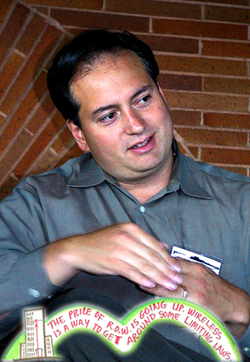 He
said, "In a heartbeat." I asked why. He said, "It’s about as profitable
a business as we could ever be in, to bring in that service and be the
service provider." That suggested to me -- and those conversations were
about a week apart -- where the puck is going. That the service provider
new business model is to bring services into -- and the ironic thing is
into those territories. He
said, "In a heartbeat." I asked why. He said, "It’s about as profitable
a business as we could ever be in, to bring in that service and be the
service provider." That suggested to me -- and those conversations were
about a week apart -- where the puck is going. That the service provider
new business model is to bring services into -- and the ironic thing is
into those territories.
Will they be the service provider into their former dark
side colleagues' serving area? Seems to me in that very small sample,
that there is a willingness to build these business models.
The Century guy says I don’t have to deploy my capital.
My ROI hurdle is much much lower. Let the municipality do it and finance
a revenue bond. I’ll make my money delivering and differentiating
services in that community. That is a really salable, sustainable business
model.
Isenberg: Until it becomes competitive.
Victor Blake: Observations about DSL: I actually
very much agree that it can be difficult deploy. Conditions are pretty
horrible out there. On the other hand even when I was at AOL, we were
doing pilots for DSL. As the manager of architecture I was a candidate
to be a pilot if I chose to be. I asked about DSL in my service area knowing
that there is a PairGain multiplexer running HDSL about 40 ft. from my
driveway, and it successfully carries a T-1 with multiplexed telephone
lines on top of it every day and therefore I completely qualify for HDSL,
which is more stringent than ADSL.
I was told that DSL can’t work where you are. And
I said sure it can, the tech on the street showed me while he was configuring
the PairGain box. And still I was told by a variety of Bell Atlantic people
that the equipment wasn’t there. They denied for months. I invited
them to come to my house to see it. Maybe there is truth that there are
technical complexities. I think it would be less rude if they said, you
know what Victor, it will work there, but it’s not cost effective
for us to deploy it.
Matt Oristano: Along the lines of not true and
DSL. For a long time telephone companies very happily provided dry copper
pair to alarm companies. As soon as people figured out they could use
that to do home grown DSL, the telephone companies all of a sudden started
saying we can’t find any more dry copper pairs, and they started
terminating the tarriffs. Viscous gamesmanship in the regulatory area.
Adina Levin: I would like to hear David Reed explain
what he means about having a model for capitalism that’s about deferred
reward and not about sheer property rights.
Reed: This is really flaky. I run into danger trying
to pretend to be an economist so . . .
Isenberg: That's OK. You stayed at the Nautilus
Motel last night.
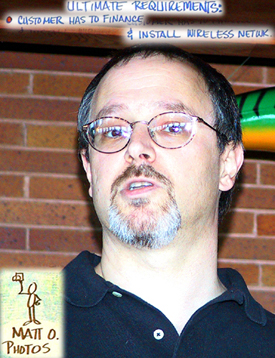 Reed:
If you ask really what capital is, I think everybody, even regular economists
would say capital is about the ability to defer -- capital is an accumulation
of money, which is just a deferred reward. Somebody who has capital has
excess something and they are saying I’m willing to take that off
the market and give it to you because in the long run I’ll get more
back. Money is a great vehicle for time travel. Stored value, that’s
the right term. Reed:
If you ask really what capital is, I think everybody, even regular economists
would say capital is about the ability to defer -- capital is an accumulation
of money, which is just a deferred reward. Somebody who has capital has
excess something and they are saying I’m willing to take that off
the market and give it to you because in the long run I’ll get more
back. Money is a great vehicle for time travel. Stored value, that’s
the right term.
So capital is really useful when you have to make decisions
that happen over a period of time. Capital is completely useless in a
situation where manna is raining down from heaven. You don’t need
capital to allocate the manna. There is more than you need. If you have
more manna than people you don’t have an allocation problem you have
a disposal problem. We don’t normally live in that kind of economics
although I would suggest that the manna is a very good analogy.
The other thing is that I think in the world of markets.
Markets are great allocators. They tend to allocate things -- with the
exception of broken markets -- they tend to allocate things to the highest
possible use because everybody trades off value. I believe that works.
I’m not a socialist because of that. I think most of the time you
can make that work.
But the interesting question is what do you trade? Does
it have to be something that behaves like property, which is something
that has a strong conservation law? Or can you trade other things? And
we trade other things all the time in the same money system we trade services,
we trade options. Options are not property in any real sense.
Isenberg: Services have a conservation law.
Reed: No. Labor may have a conservation law. The
amount of service you can provide with a certain amount of labor is very
architecture dependent. So if you have me try to design this building
you are wasting your money, whereas if you have me design your network
it might be useful.
I think there is an interesting market for communications
capability. But if you really want to create a market that works and rewards
the right things you ought to focus on not trying to map it into property,
but into what it behaves like. There are a bunch of things that tend to
be closer to that. A futures market is not about property, it’s about
claims, contingent claims, which are different than property. It’s
a much richer economic market. The interesting thing about futures markets
is that they can cope with more futures than actual goods. That doesn’t
mean I know how to make a futures market. I think that may be a better
place to look.
The second thing is that when you are talking about structure,
the corporation itself may hold assets, but the value of a corporation
is different than [property]. The structure of a corporation and the ways
of doing business have value that are not a simple property -- you can't
divide it and get half the value.
When you are talking about a communications system, that’s
an assemblage of parts with an architecture that behaves more like a corporation
than it behaves like a field of wheat. A field of wheat you can imagine
buying and selling a la Hazlett. But a corporation you buy it’s from
a very different world. It’s called a market for corporate control.
It’s not a market for corporate property -- it’s a market for
corporate control and that’s a much richer market. What I’m
saying is that there are things you can buy and sell in this space, I’m
not sure what they are.
There is a broad analogy from mathematics that I hope
will sort of point out that low level architecture can have big effects.
Imagine the world as a two dimensional grid. a simple world, and you are
measuring the distance between two points. Some mathematicians make these
kind of mistakes and then they  get
corrected, but if you measure the distance between two points, if you
could only cut vertically or horizontally the distance between two points
is always equal to the sum of the height difference and the horizontal
difference. No matter how many points you put in that space, no matter
how densely you space the grid you can never get diagonal lines and therefore
you always get this distance function that's rather strange. get
corrected, but if you measure the distance between two points, if you
could only cut vertically or horizontally the distance between two points
is always equal to the sum of the height difference and the horizontal
difference. No matter how many points you put in that space, no matter
how densely you space the grid you can never get diagonal lines and therefore
you always get this distance function that's rather strange.
If you admit diagonal lines, you end up with a very different
scaling plot. And a very different system behavior. And we see this in
peers all the time because people do design bad architectures like that
-- the rectilinear communications model -- but that doesn’t mean
we have to force a rectilinear model on any currently non-rectilinear
world. So that is my metaphor of the day.
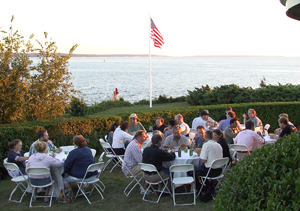 Isenberg:
Does that answer your question? I hope not. Let’s break and have
some lunch, take a swim, the water is warm, and reconvene at 2 p.m. Isenberg:
Does that answer your question? I hope not. Let’s break and have
some lunch, take a swim, the water is warm, and reconvene at 2 p.m.
(return
to top)
page last modified: July 10, 2002
|