|
Session
3: Architectures of Innovation
Thursday, September
6, 2001
David Isenberg: Today I'm
going to violate my own rule of no presentations because we have some
absolutely extraordinary presenters. Well, maybe in this crowd maybe I
should turn the expectation knob down.
The topic this morning is 'architectures of innovation.'
Before the break we have Clay Shirky of Accelerator Group. After the break,
we'll have David Reed. We will give Clay half an hour and then give Larry
Lessig a shot at commenting or rebutting. After the break it will be David
Reed, and Bob Lucky will get a well-practiced shot at commenting and or
rebutting.
Clay Shirky: I'm going to try to do 4 things in
my allotted time.
First I want to compress the last 20 years of computing
history into one drawing. I will skip some things when I do this, so if
I miss your favorite turning point, we'll get back to it later. I want
to do this to stipulate what I think the background was in which peer-to-peer
happened.
Second I want to define peer-to-peer and talk about what
that definition means.
Third I want to sketch out some of the architectures that
fall under rubric of peer-to-peer and what the ramifications of what those
different architectures are.
Then, fourth and most important, I want to take on two
current issues in peer to peer -- one of them being private name spaces
pointing to the public internet and the other one being a potential hardware
control point for preventing users at the edge from participating fully
in the Internet.
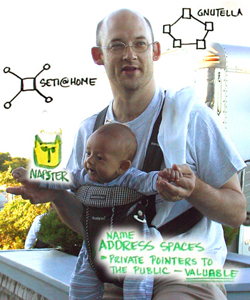 We
got the modern computing world, and everything we recognize as being based
on it, in about 18 months starting on January 1 1983. On that day the
IP network launched, although badly. That was the moment the whole network
switched over to the familiar dot-delimited 32-bit address space that
gave everyone their numbers. Anyone time-transported from 1983 to now
would look around and see that we are still using that address space.
They might be confused as to why, but it's still recognizably the same
beast. About a year and a half later we got the domain name system which
gave us the familiar human-readable addresses so people didn't have to
go around remembering the 32 bit name space -- [in other words, e.g.,]
IBM.com automatically mapped to its IP address. We
got the modern computing world, and everything we recognize as being based
on it, in about 18 months starting on January 1 1983. On that day the
IP network launched, although badly. That was the moment the whole network
switched over to the familiar dot-delimited 32-bit address space that
gave everyone their numbers. Anyone time-transported from 1983 to now
would look around and see that we are still using that address space.
They might be confused as to why, but it's still recognizably the same
beast. About a year and a half later we got the domain name system which
gave us the familiar human-readable addresses so people didn't have to
go around remembering the 32 bit name space -- [in other words, e.g.,]
IBM.com automatically mapped to its IP address.
At the same time as this was happening -- as we got the
modern Internet -- we also got the modern personal computer. In 1984 Apple
famously launched the Macintosh, which brought a GUI [graphical user interface]
to the text-only operating system. Suddenly we had a machine where, if
someone were to come from 1984 and sit down at any one of these machines,
they would see windows icons, and [menu] pull downs and they would say,
"Obviously a lot has changed but this is recognizably the same thing that
I saw in the beginning of 1984."
So that 18-month period was a period of incredible foment.
Then, astonishingly, nothing happened -- for a really, really long time.
These two revolutions did not intersect in any significant way. [It was]
a highly connected revolution for the rabbis in the center, a highly disconnected
revolution for the Goyim at the edges. No overlap at all.
The philosophical characteristics of the PC and the Internet
were so different --that's a whole side conversation, but it's essentially
protocols which are both group defined and group owned versus APIs [Application
Programmer Interfaces] which, although they are used by groups are defined
by individual efforts, meant that it wasn't easy to cause these two things
to overlap.
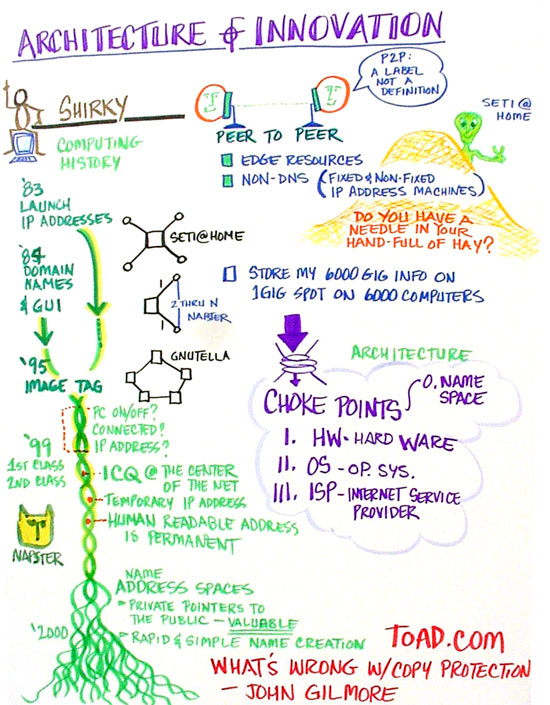 Then
about 10 years later came the event that that changed all our lives and
fundamentally altered the global economy, which was, of course, the image
tag. Tim Berners-Lee did the heavy lifting for the Web, but until the
image tag came along the Web was really an awesome replacement for gopher. Then
about 10 years later came the event that that changed all our lives and
fundamentally altered the global economy, which was, of course, the image
tag. Tim Berners-Lee did the heavy lifting for the Web, but until the
image tag came along the Web was really an awesome replacement for gopher.
Isenberg: What's an image tag?
Shirky: The Web prior to the image tag was was
a much better but still text-oriented way to find information. The image
tag is a tag that embeded clickable images into the mosaic browser. It
was the thing that brought the GUI to the previously text-only Internet
in the way that, 10 years before, Apple brought a GUI to the previously
text-only OS.
For the first time, and all of a sudden, after 10 years
of this side-by-side development we had a reason to connect these two
worlds [the worlds of the internet and the PC], and we made a total hash
of it. We did that because these PCs at the edges had none of the characteristics
of the machines at the center -- they weren't reliable, they weren't always
on and they weren't always connected. The OS's were flaky and crash prone,
the hardware was poor, and worst of all they had to connect using modems,
so that even when they could connect to the network, the connections were
extremely intermittent for a wide variety of reasons.
Now the regime of connectivity in the Internet proper
assumed that a machine was always on, always connected, and always had
the same IP address. The IP address was the core attribute of a machine.
You can still see the effects of that today, where adding a new host name
to an existing IP address is trivial, but changing an IP address under
a host name can take days to propagate through world's routing tables.
Permanence of IP address was the core attribute of connectivity in the
center.
You could not assign permanently connected, permanent
IP addresses to the edge of the network for two reasons: One, the connectivity
was so poor. Modems were just a bad way to connect. But two, we suddenly
ran into the ramifications of a 32-bit address space, particularly one
that was assigned in large bulk -- Class B and and Class C addresses and
so forth. We were connecting these machines, once we had a reason to,
much faster than we had address space, so people began to dynamically
assign IP addresses, and so at any given moment you could never count
on any given computer being on, being connected, and having the same IP
address.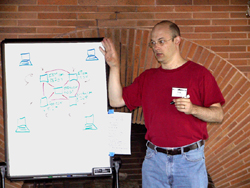
In this period, 1994 to 1999, the first Great Wiring,
we didn't so much connect the PCs to the Internet as we hung them off
the edges. Now we had two zones, a first-class zone and a second-class
zone. The zone of second-class connectivity [for PCs] meant that these
machines could always consume but never produce or provide resources.
So we had gone from a peer-to-peer core network, to a client-server network.
Now people noticed this early on.
Man: One observation. This is all true but before
any of that happened PCs were used as dumb terminals in corporate networks.
This perpetuated client-server a lot more than it should have. It was
probably the most expansive use of address space at that time.
Shirky: I consider terminals not to be connected
to the network, rather they are connected to something that is connected
to the network.
Man: Universities were using computers as terminals
to get to supercomputer research centers. That was thought to be the primary
use of the Internet, as basic IP transport to connect some dumb terminal
in Rochester to one in Ithaca.
Shirky: As it was through the browser revolution
when your PC was considered to be a life support system for you browser;
this was the public update of that mode.
People noticed that we were not connecting PCs to the
network as first class citizens, and the answer came back, "Yeah, yeah,
it's going to be fine. Fiber-to-the-Curb, IPV6, any day now. Set your
watch by that, and everything will go back to normal."
So we set our watches, and calendars, and then we got
tired of waiting. Finally one company broke ranks and said if this system
is not letting us use the resources or connect the PCs, we are going to
have a different system. And if the bottleneck is that we can't give the
PC a permanent IP address, and therefore we can't give it a domain name,
we need to rethink the whole thing from the beginning. The company was
Mirabilis and the product was ICQ.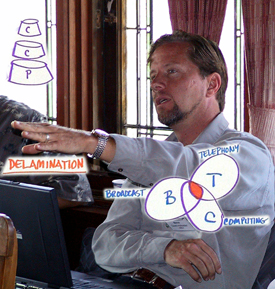
What Mirabilis did was they turned the domain name system
inside out. They said we are going to make the human readable part of
the address permanent and assign temporary IP addresses to it. So if I
want to have chat session with David, what they did was they set up a
central database at the center of the network, and when I would connect,
it would take my name and assign and IP address to it -- "I am currently
at this address" -- and when David connected, it did the same thing. When
David wanted to chat with me, the ICQ server would say, "You guys want
to chat, you're both in the cloud and you both have IP addresses, you
figure it out." It would offload all connections 2 through N, to the cloud.
Then David and I would establish a connection for the duration of our
chat, both using our current IP addresses for an ordinary through-the-cloud
connection that did not go through the central server. So it used the
central server to bootstrap an ordinary through-the-cloud connection.
ICQ, just before AOL bought it, was running half a million
simultaneous users on 13 standard Pentium PCs running Linux.
One of the big deals about this stuff [that goes to what
Roxane was talking about yesterday] is that this will affect the hardware
manufacturers in the same way that we talk about bandwidth providers yesterday,
because super-efficient use of resources at the edge of the network is
bad news for people that sell storage area networks and big fat servers
in the center.
This is the beginning of the routing-around-the-domain-name-system.
ICQ chat was a wildly successful application. I suggest we not use "killer
app" -- it seems unhelpful. ICQ has wildly successful adoption characteristics,
but it used this as just an inverted domain name system.
The real action came with Napster. Napster figured out
that not only might David and I like to talk to one another, so we have
this two row database of our names and IP addresses, but David is a big
Metallica fan and he has all of their MP3s stored on his drive. What Napster
realized is that if you contact the Central Server and upload information,
it doesn't have to be just name and IP address, it can be anything. This
is a database --you can hang any number of columns off of it. So what
they figured out was that, in addition to David's current the IP address,
I will get David's current music collection.
Man: When you say those columns what are they?
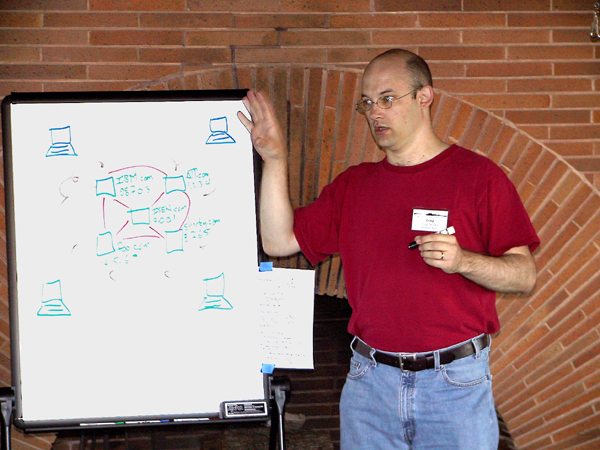
Shirky: [Refers to drawing.] Here is "name", here
is "IP address", and here is "music". So the rest of the rows are, e.g.,
you have copy of this Britney Spears song, this Frank Sinatra song and
this Metallica song. I can hang any amount of information off of a user
name and IP address combination. Once I can do that I can have a look-up
in the center. The Napster server says these are all the songs that David
has. And when I go to get a song this is the round trip I make. I go through
the cloud directly to David's machine. I don't go through Napster.
(Napster at one point thought it would get out of legal
trouble because it was not storing any copyright infringing material,
nor was it passing any copyrighted material between users, even tangentially,
it was all going through the cloud. That was their idea.)
So that innovation --saying that if I can bypass DNS and
make the human readable address the permanent part, and update all of
the other transient information -- that is the thing that lets me break
this second class bottleneck and bring the edge-connected resources directly
into contact with one another without forcing them to go through the center
of the network.
So my working definition of peer-to-peer is if it falls
into both of the following two categories:
First, if it aggregates unused or underused resources
at the edge of the network, bandwidth, computation, storage, human presence
-- and really I want to emphasize that this can be anything. I have not
yet seen a peer to peer application that needs 30,000 sound cards to run,
but someone out there is working on it and I'm going to be awfully interested
when it launches.
Second, if it bypasses the DNS system to aggregate those
resources because it has to operate in a regime of unpredictable or intermittent
connectivity
Scott Bradner: I don't see why that's a determining
characteristic.
Shirky: My argument is that it's a historical characteristic.
Bradner: But I don't see why a determining characteristic.
Many of them do that, but that doesn't mean someone with a fixed address
can't be participating in Napster.
Shirky: That's right. It has to provide a way for
things that don't have fixed addresses to participate in the system, so
you can have both fixed and non-fixed IP addresses, but it has to make
provisions for non-fixed IP address machines to work on equal footing
with fixed IP address machines.
Napster bootstraps with DNS because server.napster.com
is the pointer, but the nodes in system have to be able to operate outside
the DNS system. If you use Napster even if you have a fixed IP address,
you do not have a DNS address, you have 'Green_Day_fan'.
Bradner: I don't think that a determining characteristic,
it has to be a historical accident because dynamic DNS didn't get done
early enough.
Shirky: Right, I'm going to argue is that it is
a frozen accident, that this accident, having happened, is not going to
unhappen, because there is a generation of people for whom Napster is
just information.
Bradner: That may be true, but I don't think that
should be core to your discussion. I think it's totally tangential. The
ability to have someone who is at a non-fixed address participate is a
perfectly legitimate requirement. But what the technology to do that is
seems to be irrelevant.
Shirky: I'm going to get to the DNS system again
at the end because I do think this is going to have some significant ramification.
My argument is going to be that it works in practice, even if it doesn't
work in theory, and having happened, a generation of engineers is going
to go after this whether or not it's a necessary characteristic of the
network.
Man: Couldn't you fix Scott's observation by saying
that no necessary central name service or no DNS required?
Shirky: Napster actually has a centralized name
space -- it is more centralized than DNS.
Let me hold this until we get to the DNS discussion, because
that is actually one of the two issues I want to bring up.
It is important to remember that "peer-to-peer" is a label
and not a definition. The phrase came out long after the applications
it was meant to describe. When you now hear people going around saying
Napster is not peer-to-peer, we only try to find a word like peer-to-peer
because of Napster. So there's no point in defining it out of the club
after the fact. Many peer-to-peer applications, in fact most, use some
aspect of client-server to bootstrap the connectivity. Pure distributed
peer-y-ness is not actually a necessary condition for something to be
considered peer-to-peer.
There are a bunch of architectures that fit under this
model. I want to draw three of them to make the point that there are lots
and lots of ways to aggregate edge resources.
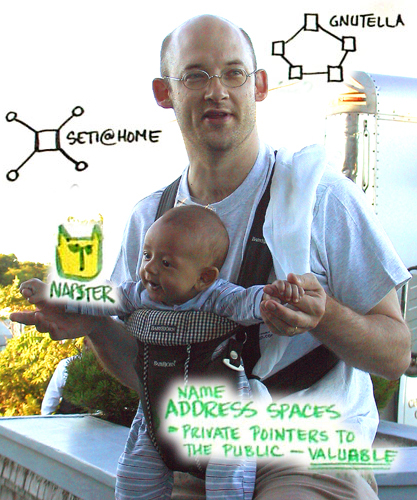
The first one is the model used by SETI@home. There is
a central server dispatching [pieces of computation]-- they look for a
needle in a haystack by dispatching the hay one handful at a time to PCs
at the edge of the network, which are coming back and saying "I have the
needle" or "I don't have the needle" in this handful of hay. SETI looks
a lot like client-server. It's a star topology, but in client-server the
computational heavy lifting is done at the center and the results are
distributed to the edges. SETI@home reverses that by doing computational
lifting at the edges of the network and redistributing the results back
to the center. That is one way to use the resources at the edges of the
network outside the bounds of the client-server architecture.
The second [architecture], which is the commonest [in
P2P systems], is the sort of triangle that I drew when I was talking about
ICQ and Napster, where a central server bootstraps the connectivity. The
first connection that anyone in the system mixes with the central server,
but all conversations and file transfers and whatever else goes on in
the system happen in the cloud away from the central server.
Model three dispenses with central server and says, all
these other things are half measures, but what we really need to do is
move the idea of the cloud all the way out to the edges of the network.
We need to make a way for nodes to be able to address one another without
even having the bootstrap problem.
So what Freenet attempts to do is restore Internet style
connectivity to all nodes irrespective of whether they have hard coded
IP addresses or not. Gnutella also tries to do this. It uses local bootstrapping,
which is to say when you connect with any popular Gnutella server like
LimeWire or BearShare or ToadNode, it goes to a well known Gnutella host
and then distributes it.
Freenet is really an attempt to create an almost unbreakable
and untrackable network where no node has a bootstrap. Freenet is an interesting
idea, but it seems to be the Xanadu of our generation, which is to say
the software that is so ideologically perfect it will never launch. Because
its such a large attempt to create this sort of fabric built-in, that
many things they could have done pragmatically they didn't do, and the
result is that not nearly as large as Gnutella.
(Has anyone has read Dick Gabriel's paper, 'Worse is Better:
the Lisp vs. C Debate?' Gnutella is objectively worse than Freenet, but
there are many more people who want to make Gnutella better than want
to make Freenet at this juncture.)
Man: I'm told that Napster could not have been
invented by anybody at Microsoft because the older guys would have said
it can't be done. So when you refer to the Xanadu of our generation and
say this ideologically pure notion is non-achievable, would that be susceptible
to things you couldn't know that were obstructing your view...
Woman: You many need to define Xanadu...
Shirky: Xanadu is Ted Nelson's hypertext system,
which had many characteristics of a perfect hypertext system. Every piece
of information existed in only one place, all links were implicitly two-way,
all links were self-updating when information moved. And Berners-Lee threw
out most of that work when he invented the Web. What he said was, when
information moves we are just going to provide a mechanism for everything
breaking hopelessly, and we are going to call it the 404. And that lack
of coordination -- the fact that they didn't require global coordination
-- meant that the system could scale much better because things could
break asymmetrically and be updated asymmetrically.
So I'm not saying that Gnutella is the only example of
this, while Freenet won't work. What I'm instead trying to do is say that
there are two systems that occupy this zone -- Gnutella and Freenet. Freenet
has the superior theoretical characteristics to Gnutella, but my bet is
that because more people are using Gnutella and trying to make it better,
it will improve over time, albeit in small increments. It may always be
worse in practice than Freenet is in theory, but it has better survival
characteristics.
Man: Are we talking VHS vs. Beta?
Shirky: Right, were Freenet to be implemented,
it's survival characteristics would be superior. But it's not used with
anything like the breadth of Gnutella. So, like the Lisp vs. C debate,
where Lisp and C were both implemented, my bet is that Gnutella is going
to improve because of its user base
Man: The only problem here is that you have Time
Warner and a whole bunch of other new companies where Gnutella is the
next target in their sites. Freenet is going to survive that.
Shirky: Freenet in this case is the cockroach.
Man: What happens when someone throws their shoe
at it?
Shirky: This was one of the two last issues that
I want to bring up. The last thing I want to say about this architecture
is that although in the popular press you see "Napster was great, it was
great, but then they came along and they killed it", there's a whole bunch
of 19-year-old Computer Science students for whom this is information.
[These folks see Napster and think] "Aha! If I have an
application that needs 6000 gigs of space, I don't need a 6k gig hard
drive. I just need 6,000 people to give me one gig each." These are just
architectures that a lot of people take for granted and they are going
to start reappearing in all sorts of places that are very far from mp3
file sharing.
There are still two issues I'd like to bring up:
The first is name spaces. Here's the thought experiment.
You have a PC under your desk, and let's say I gave you a file and said,
"Here, serve this file from your PC." What would you have to do? You'd
have to go to register.com, you'd have to pay them your money, you'd have
to wait for it to come, you'd have to mess around with NIC handles, then
you have to get somebody to give you a fixed IP address. You have to map
the two and wait for the world's routing tables to update, then you'd
have to download Apache and screw around with...
Bradner: There's nothing to do with routing tables
in that -- the routing tables have the address whether you are using it
or not.
Shirky: I'm sorry, I meant the DNS entry, in the
DNS server. It would take days, it would cost you money, and you would
have to involve a lot of other people. If the file I gave you was an MP3
file, you could download Napster and be serving it in five minutes. So
what Napster does is it brings usability to name space configuration.
With Napster, you can create a routable, human-readable address in five
minutes without asking for help or permission. And this is a huge change.
The number of people in world who can create a routable,
human-readable address has gone from an order 10 thousand to order 10
million in the last two years. So one of the big issues in this world
where address spaces owned by Napster and ICQ are, what do we do if anything
about privately owned address spaces that are pointing back out to the
public network? This is something that people didn't really think possible;
DNS seemed to be the only game in town for a long time.
We've just seen two companies build up hugely valuable
assets by owning private pointers to the public network. The other interesting
characteristic about those name spaces is that they violate almost everything
we know in engineering terms about name spaces. They are user generated,
they are flat, they are not well characterized. They encode information
in the name, and yet, they have been wildly popular.
There were more Napster addresses created in Napster's
short span than there were in the entire existence of the domain name
system. So we have seen two examples where people have created tremendously
valuable (and fragile in many engineering ways) name spaces that nevertheless
worked well. So, what do we have to say about that?
My second concluding issue, which I hope will lead into
what Larry Lessig is going to talk about, is control points. Something
Larry said yesterday that I thought was very smart is that we've had this
idea that the network itself is going to necessarily resist these attacks.
But as we have grown with the network, we can see that there are some
places where there's a bottleneck. Where people who want to control the
ability for people at the edges to use their PCs to publish can get at
it. The [ability] to be a global publisher has fallen below the level
of the requirements of being a corporation, it's fallen to level of the
individual. With Napster I can publish material to the world without even
having a lawyer.
So who do they [e.g. the RIAA] go after? They don't go
after me, who is infringing the copyright, they go after someone upstream
who does have a lawyer. So where are those technological chokeholds? I'd
like to propose that there are three and then I'd like to open it to discussion.
One is the hardware manufacturers. People who make disk
drives are talking about installing digital rights management software
into the drive, building DRM into the hardware directly. DRM is an attempt
to take all the inconvenience of the physical world and map it into the
digital world and then tell users you have to pay the same amount of money
for content online as offline because it's costing us so much to make
things so inefficient. If that works, the place that will happen is at
the hardware manufacturer.
Jerry Michalski: You should point to John Gilmore's
essay, "What's Wrong With Copy Protection" at toad.com, I think. He sorts
through the various scary ways that the media and copyright industries
have already crippled the next generation of PCs.
Shirky: The second place there is a choke point
is the Operating System for PCs. We have about 1.08 vendors of OSs for
PCs, and if any large subset of that group were to alter their OS, that's
obviously a major chokepoint.
The third place it can happen is ISPs, who have two problems,
one is that they don't want to be sued -- Pac Bell just announced that
it was dropping 80% of the alt.binary groups because they are afraid for
be sued for copyright infringement. The other problem is they sold you
your bandwidth on the assumption that you won't use it. So if you start
using your upstream bandwidth to publish, their under-provisioned network
suddenly looks problematic.
So Cox Communications is the first one to go, and they
banned people from using Napster on the grounds that it's a server and
many of the ISPs will be following suit.
Now let's open up for questions.
Man: What about companies like Real Networks?
Shirky: Here's the interesting thing to me. I don't
think that software is a choke point. The software market is open enough
so that if any one software company builds this in, it can be routed around.
So of the four possible places [to control content, i.e.
including software], the place where we have a functioning market is not
the place where we have a choke point.
Michalski: Here's one thing I want to throw in
-- Napster is not a great application if you love music. It's not about
music appreciation. Napster's implicit message is hording files. I better
get all the MP3s I can on my machine because they are about to shut this
thing down. Now, if everyone were able to share, cache and move files
around, you've separated whatever application you are going to run to
enjoy music, which gives you context about music, which lets you tell
stories about it, link music to other music -- separate that from where
the files are actually stored.
I'll paint two alternate options -- one is the celestial
jukebox model that the media companies want to sell you -- and there are
several of them already in progress and the media seems to think that
that's where the only battle is. In this case, the songs kind of get stored
on some big celestial server, the celestial jukebox in the sky. You then
pay a subscription and listen to all you want, but you are usually fetching
the songs from the server.
In the opposite world, look at Freenet (the most distributed
version). Instead of thinking about, "I'm going to have copies of all
this music, I'm going to use up 30 gigs of hard drive storing all the
songs here," think about the frequency of use and the patterns of traffic
and allow those files to settle across the Net wherever they are being
used, with some people volunteering some local cache and so forth.
If I listen to a song once a month it won't be cached
on my machine. I may just fetch it whenever I play it. But if I play a
song every day, I may cache that [in my] machine that may be local to
me, and then other people from my neighborhood may pull it from me. And
all of a sudden if you allow the traffic to move to natural patterns of
use and let natural caching to happen, you don't bring the network down.
It doesn't freak everything out because suddenly you have extremely local
fractal use of files. And that's great. That's pico cell sharing. I don't
know what you want to call it, but it doesn't fuck up the network.
Isenberg: Let's hold the questions and give Larry
a few minutes to comment, and *then* we will let all hell break loose.
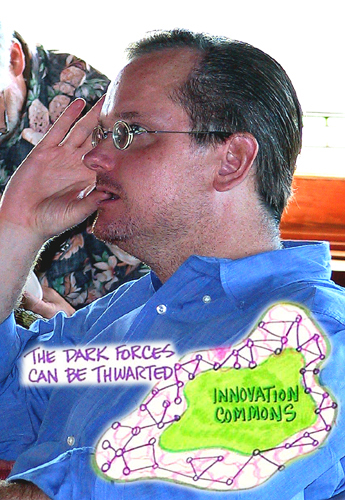
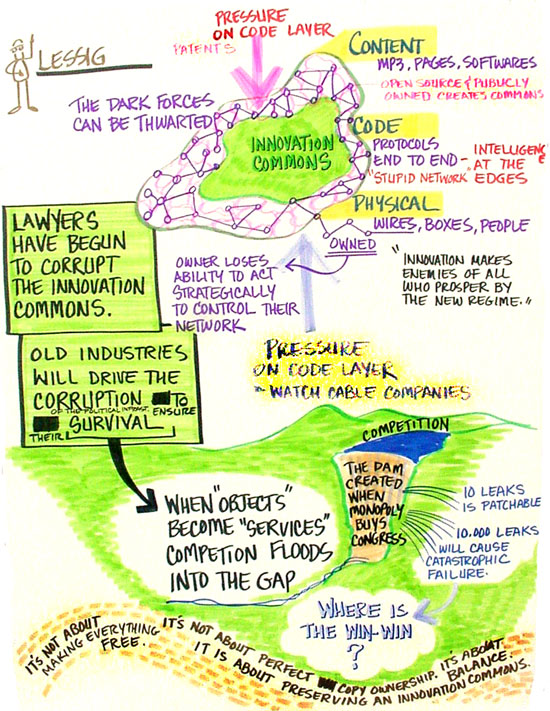
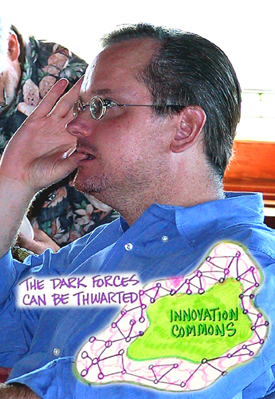
Larry Lessig: I think Clay is doing two great things.
First he is attempting to identify an architecture that second is subject
to push-back from the dark forces. I want to reinforce his point, but
shift it a little bit. The part I want to bring into focus is where dark
forces can do damage. Dark forces cannot have any harmful effect in competitive
markets. Put differently, the great thing about competitive markets is
that they defeat strategic behavior on the part of competitors. Thus,
when we try to think about where the architecture is vulnerable to the
dark forces, we need to locate vulnerability at those places where the
markets is least competitive.
To do this, I want to suggest a slight modification to
Clay's picture.
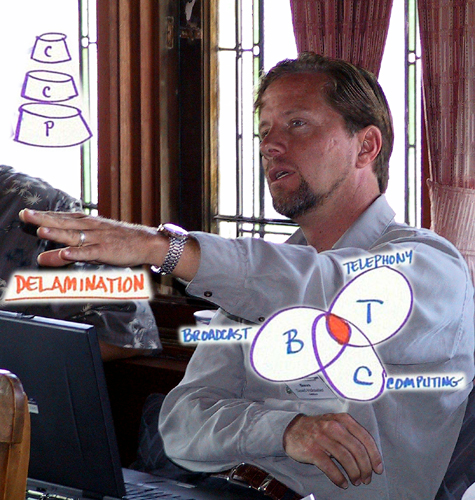
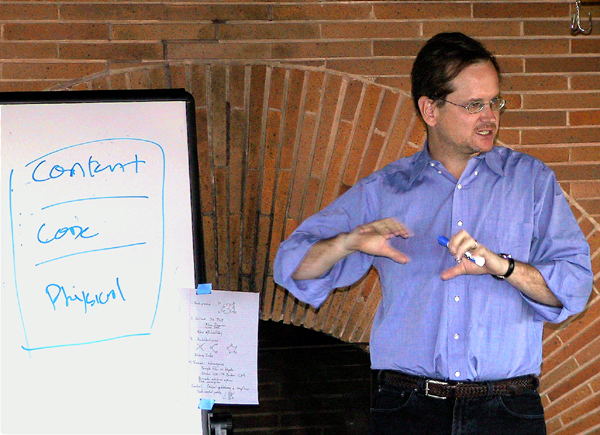
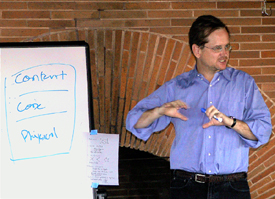
Think about three layers to the network -- one is content,
the middle is code and the bottom is physical. The physical layer: the
wires and machines that built the Internet. The code layer: the protocols
of the network, the IP, et cetera. The content layer: both mp3 files and
web pages, as well as bunch of software that is essential to make the
network run including Apache servers and the Microsoft OS.
The essential characteristic of the original Internet
-- indeed, the single brilliant characteristic of the original Internet
-- is that the code layer has a feature that Saltzer, Clark and Reed call
end-to-end. This design pushed intelligence to the edge of the network
-- stupid networks in Isenberg's conception of it, with smart applications.
This design meant that network [architects, owners, builders]
were not in a position to second-guess how innovation in this network
developed. Stupid networks meant the owners of the network didn't have
a role in how the network developed. The networks were just shipping packets
and didn't have any intelligence to do anything with applications or with
the content. This was a competitive environment in the sense that applications
and content developed as people at the edges wanted it to develop. That
was the genius of the original network.
In a formal sense, the code layer constructed an "innovation
commons." It's a commons in that there is no one in control over who gets
access to the resource and who does not: everyone has equal access. And
it is an innovation commons because the resource that is held in common
is the right to innovate --the end-to-end design meant that anyone can
innovate for that network.
Now each of the other two layers in the Internet also
have commons-like features. But these other layers also had essential
non-commons like features -- proprietary characteristics as well as commons
characteristics. Start with the physical layer. The original network was
run on AT&T's wires. That physical network was owned. It was not a commons.
But a critical feature of this network -- maybe the most
important, accidental feature of regulatory history affecting this network
-- is that at the time the Internet began to take off, AT&T was a disfavored
monopoly. It was not allowed to play games. The network owner was not
allowed to behave strategically against new competitors. People were entitled
to connect different networks to this telephone network. Thus the original
network had a part that was proprietary at the physical layer, but common-carrier
like regulation meant that physical layer also had features that were
commons-like.
The content layer too had proprietary and commons resources.
Much was proprietary --proprietary software, copryrighted material, etc.
-- but a critical part of what made this original network function was
the range of free and open source software that also lived at the content
layer. This content was not exclusively in the public domain -- some was,
such as TCP/IP, HTTP and HTML -- but open source and free software is
not in the public domain. It is software that is licensed in a way that
guarantees that everybody can take the source code and build on it in
certain important ways. That makes that software also a kind of innovation
commons. No one can close it down. It's constantly there for people to
be able to draw upon. Thus here too, at the content layer, there was both
controlled and free resources.
At each of these layers then there was an aspect of free
resources, an aspect of a commons. At the middle layer, there is essentially
a commons -- the structure of end-to-end predates what we have to think
of as a commons.
What we have seen in last 5 years is pressure from the
physical layer and pressure from the content layer to corrupt the code
layer. That's the bottom line. Pressure from the physical layer happens
as the network moves from telephones to cable, which is the dominant broadband
provider right now. Cable is not regulated in the same way the telephone
lines were. It is allowed to discriminate however it wants to. In fact,
a Broward county court has ruled that the first amendment means that cable
has a constitutional right to discriminate in its deployment of services,
which means the obligation that they operate neutrally at the physical
layer is constitutionally prohibited. The first amendment does not allow
the government to tell the Cable Company that they have to be neutral
at the physical layer.
Thus cable companies are developing technologies to enable
them to exercise control over the types of applications or content that
gets served across the network. Policy based routers make it easier to
figure out which content goes quickly and which goes slowly, thus building
a potential chokepoint of the sort Clay was talking about.
This is why we need to worry about whether there is competition
at the physical layer. If there isn't, dark forces can play strategically.
That's why the wireless stuff that Dewayne Hendricks will talk about is
extremely important.
The content layer is even more frustrating. Both in the
patent world and copyright world, lawyers are securing to existing interests
extraordinary power to veto how the network develops.
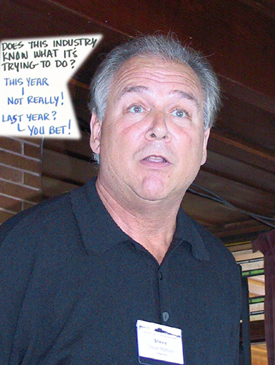
Peter Cochrane: This is all very nicely reflected
in Europe, except for the simple difference that everybody ignores the
lawyers. Over here do people actually comply?
Lessig: Yes, there's no such thing as ignoring
your lawyers in the U.S. [laughter] Five years ago there was a huge industry
called music over the Net. Twelve companies were out there that were keen
on finding ways to distribute music across the Net. Now there are two.
What happened is that every single mode of distribution
that the RIAA didn't like, the lawyers shut down, so MP3.com, Napster,
a whole scad of them, that have been shut down because the content industry
has succeeded in convincing the courts that unless they have perfect control
over their content...
Cochrane: The reality is that young kids don't
give a fig... there is now peer-to-peer networking and for the first time
we see CD sales dipping. If you ask yourself the question why breaking
up those dozen music distribution companies, which were actually aiding
sales, have now led to a new paradigm where...
Lessig: I worked on the Napster case. I think the
data is a lot more complicated than that. In fact Napster seemed to have
the effect of increasing sales and when it was shut down, that's when
sales fell. It's not because everybody went to these other tiered ways
of sharing music. Napster really did reduce the number of people who were
trading MP3s when it was shut down. Now I agree there are kids out there
who are still doing it, but the question is not whether 20% can get around
the regulations. You can't think like an engineer when you are talking
about law. Engineers think if it's not 99 percent effective it's not effective.
Lawyers think, man 60%, 70%...
Tom Freeburg: I submit that you don't know what's
happening. I'm very sure of it. What often happens when you make a very
public attack on a very public and commonly understood figure, as happened
in the Napster case, a whole lot of people say the hell with it and go
underground and go right on doing the same thing. The fact of the matter
is that now when music sharing goes on you can't find it any more. All
you did was shut down the one clearinghouse where the stuff was published.
Lessig: Wait. You can't both say that you can't
find it any more and volume is not affected.
Tom Freeburg: I didn't say I couldn't find it,
I said you couldn't.
Lessig: My point is that, if the lawyers continue
to do what they are doing it's certain to have an effect. Just look at
the market cap in these industries. What the lawyers have done is essentially
establish a system where unless existing content holders approve, innovation
is not allowed. That's Clay's chokepoint. But from my standpoint, this
is a chokepoint to worry about because content industry is extraordinarily
concentrated. In 2000 five companies controlled 84% of the music distribution
in the world. This means that this is one of the most highly concentrated
industries there is. And if they get a veto over new innovation that will
mean they will make innovation that challenges their business model scarce.
Man: Illegal.
Lessig: Illegal. Here's the bottom line. We should
worry about chokepoints where there are opportunities for old industries
to kill new innovators. Those are the chokepoints we need to be worried
about. And those are exactly the chokepoints that are developing now.
So this story is a story about how these old industries at the physical
and the content layers have succeeded in convincing the world that unless
they are allowed to re-exercise their power through massive expansion
of copyright or through the right to have perfect control over what happens
at the physical layer, then there won't be anything like the Internet.
The reality is that changes at the content and the physical layer will
change the character of this end to end innovation commons that we...
Man: It all makes sense, but my question is that
why couldn't it be that these measures of control on hardware and software
and in networks existed for legally copyrighted material but are not enforced
for non copyrighted material? There's nothing illegal about putting up
something exactly like Napster for non-copyrighted music. The problem
is a complicated one; it's not the technology that's causing the problem.
Technology could be used to fix the problem. Bit it seems to me that both
the folks at Napster and the users of it and the folks who own the copyrighted
material are headed for war because neither of them wants to budge. There's
actually a compromise position, which is you could make the technology
aware of the copyrights and enforce the law for copyrighted material.
In fact, it can be done.
Lessig: I completely agree. I have in principle
no objection to the DRM. The reason to oppose the DRM now is that it will
be deployed such that the existing interests, the copyright holders, get
to determine what the mode of distribution will be for content in the
future.
Here's a perfect parallel to the Napster story. The first
Napster is the CATV industry. CATV gets born creating an antenna that
is stealing other people's content and selling it to their customers.
That's what they do. Twice the Supreme Court is asked to shut this "theft"
down. Twice the Supreme Court has said no. So when Congress got around
to regulating this, it created a very sensible balance. Congress said,
copyrighters must be paid but the cable industry has a compulsory right
to get access to this content. A compulsory right means that content owners
could not leverage their control over content into control over this new
emerging industry. If we had that in the music context right now...
All I said is they have the right to rebroadcast, but
they must pay for the content they are rebroadcasting. The point is that
is a compulsory right, and what that does is you can't leverage your power
over content into control of next generation of technology.
The same thing could have happened with music. In fact
Napster's chairman, Hank Berry, has always asked for a compulsory right.
If they had done that, we could have had DRM, which would protect legitimate
copyright from being stolen, but we don't worry about protecting legitimate
copyright from being stolen when there is a competitive market here, which
is what the compulsory right would in effect replicate. Because for distribution
there would be competition and lots of different ways to distribute you
wouldn't have to worry about strategic behavior by the five or four...
Man: They are trying that now. There is a proposal
in Congress to suggest that the music industry must license its music
for distribution by all players, but it cannot favor it's own distribution
outlets. The RIAA is lobbying heavily to prevent that, because the last
thing you want in a business with high fixed costs and low incremental
costs is competition. And the music industry has managed to squeeze that
out with things like minimum advertised price with only four players and
the battle will probably fought and won or lost in the next six weeks
in Congress.
Stephen Kamman: Somebody said that we need to somehow
protect the ability for new industries to attack old industries and protect
the right to innovate. The thing that frightens me is if you listen to
the Microsoft trial, either you understood that there were possibly better
ways to build operating systems and therefore Microsoft was a bad thing.
Or you thought that this is the operating system, this is the way the
world is, in which case you thought, "Why is the Government competing
with Microsoft?"
Legally speaking, do we have laws on the books to enforce
a case that says the copyright owners are restricting or using their control
of distribution to preserve an economic model that technology already
is...
Lessig: I've been in that can with all those worms.
And I think that the court of appeals decision on the Microsoft case is
brilliant. Here's its principle: The court of appeals has embraced the
idea that when you have a monopoly and you exercise your power to protect
yourself against a competitor who has a different way of doing something
that might compete with your monopoly, you have committed something called
defensive monopolization. Microsoft has been found to be a monopoly. It
has been found to have violated the law. Not just one or two technical
violations. The Court of Appeals unanimously said Microsoft systematically
violated the law through exercising monopoly power to stifle innovations
that might threaten their underlying monopoly.
The browser was one, but it wasn't the only one they were
pointing to. Systematic behavior was protecting their monopoly position.
That's clearly illegal now.
Man: What about the RBOCS?
Lessig: That's going to be harder now. The problem
with this case is, as the Microsoft case reveals, is that okay, in principle
you could bring against the RIAA. It would cost 12 million dollars. It's
not like the government's ever going to do it. No government would ever
go against Hollywood.
So it's not the government's case, it has to be a private
case, $12 million to do it. Whose business model includes $12 million
to litigate a case that has even a 60% chance of winning? So the law is
clear. It's just the gap between the law being clear and the law having
an effect is huge.
Man: Something else about the RIAA that Jerry was
saying earlier is that there's a big fight right now between the recording
industry and the music industry. The recording industry is anybody who
makes their music selling CDs and the music industry is anybody who thinks
you make your money selling music. And the iron law of bureaucracies is
whatever else you were put in place to do, what you are really doing every
day when you go to work is trying to keep yourself alive. So the RIAA
is in many ways litigating this as hard as they are because they want
to stay viable. And the thing they are fighting is not whether or not
people get paid for music. People get paid every day from BMI and ASCAP
for music played on the radio. It's that they desperately don't want music
to go from being a product to being a service.
If music is sold as a service the RIAA is doomed. Their
backs are up against the wall in ways that people haven't realized because
the minute objecthood leaves data, the minute we get really distributable
digital data, the people who make their money selling objects are out
of business. Then we get into this three ways split of you got physical
infrastructure and you got how the data passes over that infrastructure.
That is the thing that the RIAA is trying to stifle. It's much bigger
than the music industry, it's objecthood for works of art.
Lessig: Because when it's a service it will be
a competitive market and they don't win.
Tom Freeburg: I just wanted to make two observations.
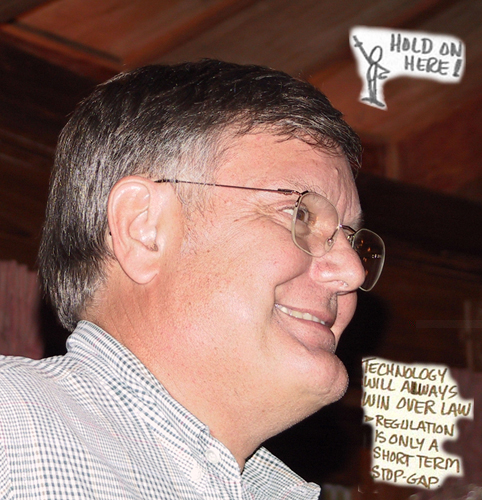
History teaches us that when the law comes up against technology, technology
always wins in the end. And the time frame by the way is roughly on the
same scale as the time frame of technology development. Whatever the Hell
the outcome for the RIAA is going to be they are doomed if in fact they
can't find a way to adapt to the new technology, or they can't roll it
back and it's going to be in the time we care about. Within the next half
decade perhaps. However, there are going to be a lot of battles. I'm reminded
of something my grandfather taught me when I was a young kid, he said,
"Never corner a skunk, they really get ferocious."
Lessig: So last night I resisted that and thought
strongly about the resistance. It's not about technology's power to overcome
some force. It's about paths. And when an industry succeeds in deflecting
the path of development, that has a profound affect. Even if the technology
in the end wins. Think about radio. It's a classic example of how bureaucracy
was captured by commercial interests in a certain moment that deflected
the development of radio for 60 years.
And it takes an extraordinary amount of power. Look at
the failure of low power FM. There's no reason it should have failed.
It only failed because this powerful industry succeeds in buying off Congress
to stop any further...
So I agree with you if we are just talking about competitive
markets and technology. You are probably right. But we live in a world
where it's competitive markets and protected markets that are protected
by a political system that is bought off by campaign contributions in
an extraordinarily powerful way. In that world I don't buy the idea that
technology in the end wins because bureaucrats always get between the
winner and technology.
Man: But the question here is the technology able
to escape the effects of whatever supervision or attempts to crush it
are put in there, even when it remains public. The old answer is drive
it underground, and I really do believe that driving it underground works.
It reduces the volume to something. Criminalizing it as much as the DMCA
criminalizes all these things also works. But can it be made so that it's
just unstoppable?
Lessig: What do you mean by works? I'm confused.
The DMCA works in stopping people from... ?
Man: The DMCA works when you have a person you
are going to catch for doing something like Dimitri and you put them away.
But if a million people are busy using stuff and doing stuff you can't
go...
Lessig: So here's the story with content. Let's
say the RIAA wins and shuts down all these rogue companies like Napster
and MP3.com or buys them up and then channels them to one or two on-line
distribution services. Then let that be like this for a year or two years
until most people are using these one or two on-line distribution services.
Then you've got the buy-in to these services that makes it really hard
to five years from now for someone to come out and create some kind of
competitor. Not impossible. I'm not talking about perfect control. I'm
just saying that you've got inertia on your side at that point. And they
have succeeded in using inertia to protect themselves against these other
forms of competitors.
Isenberg: Hang on! I'm going to play my three minutes.
Mark Petrovic said something that I've been thinking for a long time that
goes to Tom's concern and the whole conversation on the floor right now.
As the technology roars ahead, there are going to be irresistible forces
to adopt that technology. And huge resistance. The ultimate scenario there
is all out shooting, dying, bleeding kind of war -- real war, where you
get irresistible force meeting an unmovable object and the only solution
is conflict. It's happened a lot. We can't ignore that if this stuff is
as big as we think it is, and if the resistance is as big as we think
it is, war becomes a viable scenario that we have to admit of, and start
thinking about, and maybe even start thinking about how to prevent it.
Man: The way that war is fought in this country
is that lawyers...
Isenberg: That's not war. That's just legal...
Man: To his point that the first consent decree
on Microsoft was a massive patent[?] change that made Microsoft even more
cocky. It went from $10 billion market cap to a $500 billion market cap
in that time frame. These are not small path changes. And did Microsoft
change its behavior? No. Instead of saying you could sell MS-DOS DR-DOS
in the same disk drive, but guess what, you still have to pay us even
if the customer says they don't want Microsoft DOS.
Lessig: In the sense that Tom says you can't know
what's going on underneath, let me make the same argument about the effect
of law on lawyers and the industries they regulate. You can't see the
effect of these rulings on how it controls how people behave within companies
and in universities. When [Princeton professor] Eddie Felten, in the case
you were talking about, wanted to publish his paper and was threatened
by the RIAA that if he published his paper he would be violating the DMCA,
there were people in Stanford and in Xerox Parc who were telling the other
collaboratives on that paper that they couldn't publish the paper. Not
because of the threats of the RIAA, but because they wanted to be legally
conservative in this type of research. And that kind of conservatism permeates
the system. So you just need one Eddie Felton and sacrifice one Russian
programmer for 25 years of his life and you are going to have 100s of
thousands of lawyers around you changing the behavior of ordinary people.
I'm publishing a book called The Future of Ideas. In this
book I quoted Courtney Love's amazing riff on the music industry. And
I quoted less than 10% of the article in the book. The lawyers from Random
House contacted me and said you are going to have to cut the quote, it's
too long. And I said in what sense is it too long. They said well we have
a policy that is either 10% or 50 words, whichever is less, and this is
more than 50 words. I said, this is fair use. They said we don't care
about fair use we care about being safe and we say you have to cut the
quote.
I said, you know, this is a book about the over-reaching
of copyright law! [laughter]
The lawyers said, we don't give a damn about what the
book is about. This is Random House and we have our policy and you can
take your book someplace else or you can cut the quote. The point is that
this is an absurd view of copyright law, but it's Random House's view
of copyright law and what is anybody going to do. I mean, that's the underground
theft that I think you need to worry about when you start ....
Isenberg: There are a bunch of questions here.
Man: Can you spend more time elaborating on what
you mean? I'm confused about the point you're trying to make.
DI: You mean about the real shoot 'em up war?
Man: Yes. What is going to drive people...
Isenberg: Let me defer that. There are a lot of
questions on the floor and I'd just like to hear some of them.
Eric Best: My simple question is, do you think
there is really something new and fundamentally different going on that
is the point of this discussion. Because I want to refer back to what
Roxane was saying. As I took it last night she was talking about a circumstance
in which capital is withheld because you have these low barriers to entry
and you can't basically reclaim a return under these conditions, so why
go there.
I'm struggling with, there either is or isn't something
about information communications technology and power distributed to individual
users that is actually anathema to proprietary capitalism as it's been
practiced. Because monopoly positions that are required to get the return
on capital investment to make it worth doing are so threatened by the
dispersion of power access and ownership despite copyright that this system
is broken. It is broken.
Now the question is how to you unbreak it? Because the
listening to this, I got to this point: So IT impact challenges capitalism
at its core. The proprietary rent-garnering advantage for capital investment
return can only be achieved through some mix of monopoly and non-monopoly.
We have a problem. My question is do you think there is something new
and different going on, or are we just having a conversation we could
have had 10, 20, 30 years ago in a different room about some different
stuff.
Lessig: Under the original architecture of the
network, there was something new and different about the threats to existing
power. If that architecture were fixed in the way the idealists talked
about it 10 years ago, it would be something new and different.
But the existing monopoly interests realized how this
architecture threatened them and they have succeeded in a campaign that
the content layer and the physical layer is to react to that to change
the architecture to protect themselves against what threat originally
produced.
Now, is that something new? Well, this is my favorite
quote: as Machiavelli said, "Innovation makes enemies of all those who
prospered under the old regime and only lukewarm support is forthcoming
for those who would prosper under the new. Their support of the different
is partly from fear and partly because they are generally incredulous
never really trusting new things until they have tested them by experience."
This is our conflict. People who benefit from the new
system don't really get it, they don't go to Congress, they don't buy
Congress, Congress doesn't hear them. People who are threatened by the
emergence of the new system, they've gone to Congress and gotten the DMCA
and the Net Act and all these new regulations. They've also convinced
Congress that what they need to do is "deregulate" in the context of cable
and everybody to allow them to exercise once again physical-layer kind
of control that will re-establish their power.
Best: So that's a 'no'.
Lessig: Yeah.
Man: I'd like to take a slightly different tack
on that. The question I've been asked often is, well, if the Internet
was always peer-to-peer, what's the big deal now that we just sort of
restored it after this sort of five-year imbalance?
And I'd like to suggest that in many ways, computer revolutions
are at least as important as social revolutions, if not more than as engineering
revolutions. If the engineering revolution we've had is just restoring
us to something we had three years ago, the fact that it's being extended
to 100s of millions of new users is genuinely new. And that the complexity
people always say that more is different. That when you have more people
participating, it's a new kind of system, it's not just a difference in
degree. It's a difference in kind.
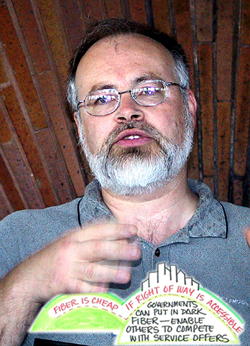
The difference is that a system that has sprung ten leaks
is implicitly catchable and a system that has sprung 100 million leaks
is implicitly not catchable. And if the edges of the network are really
as distributed and if resources can be moved around and aggregated as
easily as possible around the edges, I do think that is a different kind
of problem.
Lessig: I would agree and disagree. I agree if
you have a thousand leaks then that's going to have the effect. But the
Napster case is critically important in the following sense: the court
has established the principle that Napster can be held responsible for
the misbehavior of its users. And in the latest round the court when Napster
came back and said we have a system to guarantee 99% compliance, the court
said, we aren't interested in 99% compliance. You come back and show me
that you have a system that guarantees 100% compliance with copyright
laws. Can you imagine if Xerox had to face that kind of test? The point
is that's the attitude that goes against Napster.
Now if every peer-to-peer system faces that legal requirement,
then venture capital will not go to these systems. VC is an extremely
important part of this story.
Raj Sandhu: I agree with you about changing paths
because God forbid if AT&T had stifled the innovation of TCP/IP and end-to-end
we would still be talking on the phone most of them time. But where is
the middle ground here? Clearly both sides have to find a win-win -- this
is the art of business negotiation. How do both sides win? How do you
do it in some ways without. . . How, if you have your book and you get
zero revenues from it, obviously you are not a happy camper, right?
Lessig: I think the critical thing is that people
not think that what you are saying is that the world has to be completely
free. That's not what I'm saying. When I talked about the three layers,
there was one slice that was free -- the innovation commons. But on top
of that free layer, there was lots of people making money in the traditional
way -- through copyright and control.
Second, when all the pressure is coming from dinosaurs
who are trying to protect themselves against extinction, then the rest
of the world will say, "look if it's really dinosaurs we are talking about,
we don't like them except in movies, so let's let the dinosaurs die and
embrace a principle that induces lots of new dominant industries to be
born." It's those two things that need to happen in people's minds.
The first one is the hardest. People really do intuitively
believe that the idea of a commons or free resources, this is all just
academic malarkey. They think that what we really need is perfect property
rights and perfect protection of property rights and that's why copyright
is great. That's ignorant of the history of copyright and the history
of innovation. New innovations always emerge where there is space for
people free to be innovative outside the control of existing organizations.
Isenberg found himself thrown out, not physically, but spiritually from
that organization [AT&T] when he started talking about...
Man: It's interesting to think that Guttenberg
could have been shut down by the people that were handwriting all those
manuscripts... the same thing with the RIAA. But that succeeded and the
Xerox machine was about to go to market and
Isenberg: News didn't travel fast enough to shut
[Guttenberg] down.
David Weinberger: Larry, you are the most enthusiastic
pessimist I've ever heard... Sean Parker at Napster the other Sean...
Lessig: The one who was silenced...
Weinberger: He says that there are about 57 million
registered users at Napster at the time that the court stuff started,
and estimated that there were about 10 million registered U.S. voters
in that 57 million users. So here is a very substantial voting block that
had no effect -- zero. I find that very disturbing.
Lessig: Where the hell is the revolution? There
was no revolution because people buy into this mentality that unless there's
a system of perfect property, then its all just "theft". They don't have
a historical context to say that every use of copyrighted material is
not a theft just because the copyright owner doesn't approve of it. But
most of the 57 million users thought okay I was getting away with something.
And that's the attitude.
Man: Although Orin Hatch said he got more e-mail
about Napster then he got about the Gulf War. Hatch was saying Napster
is a public issue. I think another one of the reasons that people didn't
then exercise is that they didn't really believe it was going to be taken
away.
Man: Who were those 10 million voters? College
kids. No one cares abut college kids, they don't vote.
Man: Only a third of the Napster user base.
Adina Levin: It would cost 12 million to do [more
litigation]? 12 million is cheap. I mean compared to a college student
or to me, 12 million is a lot of money, but how many people. Is there
someone who rich enough or crazy enough to bankroll it.
Lessig: We've been trying to find an artist who
is crazy enough...
David Reed: I'm continually troubled by this question
that there is a collection of technologies that enable the perfection
of property rights. I don't mean perfect in my ideal. I mean perfect in
the sense that the air should be property rights-based because we would
allocate it better.
But what I'm particularly struck by, is back in the hoary
days of software copy protection, a lot of us sort of fell in love with
neat technology for doing copy protection and then the pragmatists among
us, Mitch Kapoor being one of them, said this is nuts, we'll get paid
for most of the copies, who cares. We'll do some things that make it more
likely that we will get paid.
I had conversations with Andy Grove at the time. He said,
this is great. You guys are being pragmatic, business is going to be great.
Now Craig Barrett in the NY Times said, not too recently, one of the two
key barriers that it tells these to the future is one breaking the RBOC
monopoly, which I agree with. And the other is perfecting copy protection
so everybody gets paid. Philosophically, that's why Intel is into this
whole hard disk protection thing because they actually believe they will
make more money on processors by enabling content providers to get paid.
And what seems to have been the result?
There are two explanations for this. One is Intel has
now finally gotten into the content business, albeit mostly as an investment
strategy. So that's why they've changed. The other one is that Intel is
indirectly influenced by all the RIAAs of the world. And in some sense
the RIAAs have been smart enough to realize that in your three layer thing
that the strategy at the top won't work unless it's enforced by strategy
at the bottom and they've just been really good friends to Intel.
Lessig: I have met with Intel about this question.
I don't think Intel is as bad as this makes it sound. Intel is under extraordinary
pressure because of another market, the consumer electronics market. And
they are playing this game where the RIAA is able to go to the consumer
electronics market and get them to agree to anything, because they don't
care. So they agree to anything and then Intel is in a position where
they are worried, this is a real competitor to the ability to people to
use PCs to do stuff. They've got to strike a deal that doesn't absolutely
make CE the winner. And also doesn't disable the ability for innovation.
I gave an end-to-end talk and Intel chief lawyer right
there said I completely agree, this is exactly right and we are cornered
because we want to have boxes that use lots of our chips. We don't want
to play this kind of game, but we are cornered into playing it because
of the CE market. If they can get a deal that really had a sensible structure
I think they would buy it.
Victor Blake: My comment is only minute or so.
I think it's much more complicated than that. Keep in mind that technology
has reached a point where the description of how an Intel microprocessor
works is software. It's PHTL. You can take the software file and build
a microprocessor with it. Their intellectual property has essentially
been reduced to software. They know that. There is a vested interest there
just as there is everywhere else and I thought it would have been more
obvious.
Man: You are just saying they want to protect their
own idea?
Woman: You don't have a fair use issue on a microprocessor
the same as music.
Blake: Absolutely, from a legal perspective I think
they pursue the same issues. I did have one other thing to say. I'm not
a lawyer, my wife is one so I hear about this all the time. I think also
there is a distinction when you talk about 10 million users and why didn't
they make an issue of it. There is legislative law and there are interpretations
of that law by judges, which builds a history of cases and therefore case
law. That's the practice under which these decisions are made. At the
same time in parallel it can happen that new legislation is being conducted.
All the decisions that have shut down Napster have nothing
to do with what registered voters want. Because
before any of them were born, the law the judges are making decisions
under and the case history of it, which has nothing to do with computers
at all, has already been established. And those
are the precedents by which they need to act .
And those people are actually, just as in other areas of law, highly constrained
in the sense of decisions they can make based on those histories. So it's
not entirely un-possible that a decision could be made in a court that
seems awful to us, can actually be undone later by legislative change,
by those 10 million people when the grow of age and can understand all
the...so it may take years for them to grow up. .
And those people are actually, just as in other areas of law, highly constrained
in the sense of decisions they can make based on those histories. So it's
not entirely un-possible that a decision could be made in a court that
seems awful to us, can actually be undone later by legislative change,
by those 10 million people when the grow of age and can understand all
the...so it may take years for them to grow up.
[Note: Tape ran out before the session break -- David
I]
(return
to top)
page last modified: July 10, 2002
|